Impacts of Urban Green Spaces
This is a summary of a paper written by Vashet Zariro, a researcher. This study examines how green spaces impact rapidly urbanizing areas from 2015 to 2024. This study utilizes the country of Zimbabwe, measuring the amount of green space correlation to lower temperatures.
What are Green Spaces
Urban green spaces are spaces within the city that have any type of natural or artificial vegetation. Urban green spaces can have both artificial and natural vegetation, which serves a purpose, such as being a park, bare land, or office (Zariro et al. 2025).
Impacts of Urban Green Spaces
Assessing the impact of green spaces depends on placement and the amount scattered in the city. Green spaces have a great impact on cities providing cooler weather. Urban greening and the cooling effect have the potential to mitigate harsh weather and improve weather in urban communities (Li et al. 2024).
Study
Harare, the capital of Zimbawe and, is rapidly urbanizing. As more people come to the city, more natural green spaces are being replaced by heat-trapping concrete and asphalt. The scientist was to see if the rapid loss of urban spaces has led to increasing surface temperatures in urban settings.
Results
The study proves that green spaces correlate with decreasing of temperature. When measuring the amount of green spaces from 2015 to 2024, it can be noticed that surface temperature drops. This proves that urban development needs to consider green spaces when building new areas or buildings.
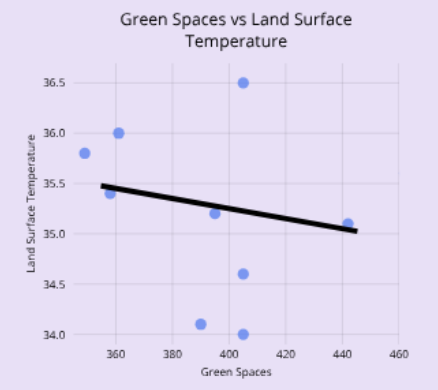 Figure 8 from Zairro
This graph highlights the increase in green spaces leading to a decrease in Land Surface Temperature. The correlation is that over the years, more green spaces have been created, lowering the temperature. Even though the x-axis increments by 20, it can be shown that 20 green spaces can be the key to lowering the temperature a little bit. Now, if scaled into hundreds of more green spaces in urban communities, that may equate to lower and more optimal temperatures.
Conclusion
As more people move to urban areas, integrating green spaces into city planning is essential for optimal living conditions. Green spaces effectively cool urban environments, mitigating temperature fluctuations and making cities more comfortable. Cities like Harare in Zimbabwe are experiencing cooling benefits as more green infrastructure is introduced. Therefore, construction plans should prioritize green spaces to ensure livable and sustainable urban growth.
References
Zariro, V., Zvidzai, M., Ndaimani, H., & Mapfumo, R. B. (2025). Assessing the impact of green spaces on the urban heat island effect. Geocarto International, 40(1), 2603724.
Li, G., Cao, Y., Fang, C., Sun, S., Qi, W., Wang, Z., … & Yang, Z. (2025). Global urban greening and its implication for urban heat mitigation. Proceedings of the National Academy of Sciences, 122(4), e2417179122.