Fast Fashion vs Environment
Background
This is a summary infographic about a study done by Urska Trunk. This study looks at fast fashion brands, measuring the amount of certain materials in clothing and the effect of these materials on the environment. This research study was published by the Changing Markets Foundation
What is Fast Fashion?
Fast Fashion is the concept of rapid production of low-cost, trendy clothing. Relying on speed brands quickly makes these clothes without caring for quality, making the creation bad for the environment.
Quality
Often brands such as H&M and Pacsun produce clothing with high volumes of cheaper material rather than better-lasting material. The quality makes the product’s lifetime a couple of uses before something new is in style.
Study
Researchers wanted to see whether garments from brands like SHEIN, Zara, and Nike are sustainable or made from recycled polyester reduced the release of synthetic microplastics in the environment. Researchers hypothesized that recycled polyester would be durable and shed fewer microparticles compared to new polyester.
Results
| Brand | Virgin Polyester fibre count (fibres/g) | Recycled Polyester fibre count (fibres/g) |
| Nike | 20,258 | 30,772 |
| Shein | 6,931 | 3,519 |
| H&M | 2,737 | 8,289 |
| Adidas | – | 25,517 |
| Zara | – | 4,276 |
Table from Trunk
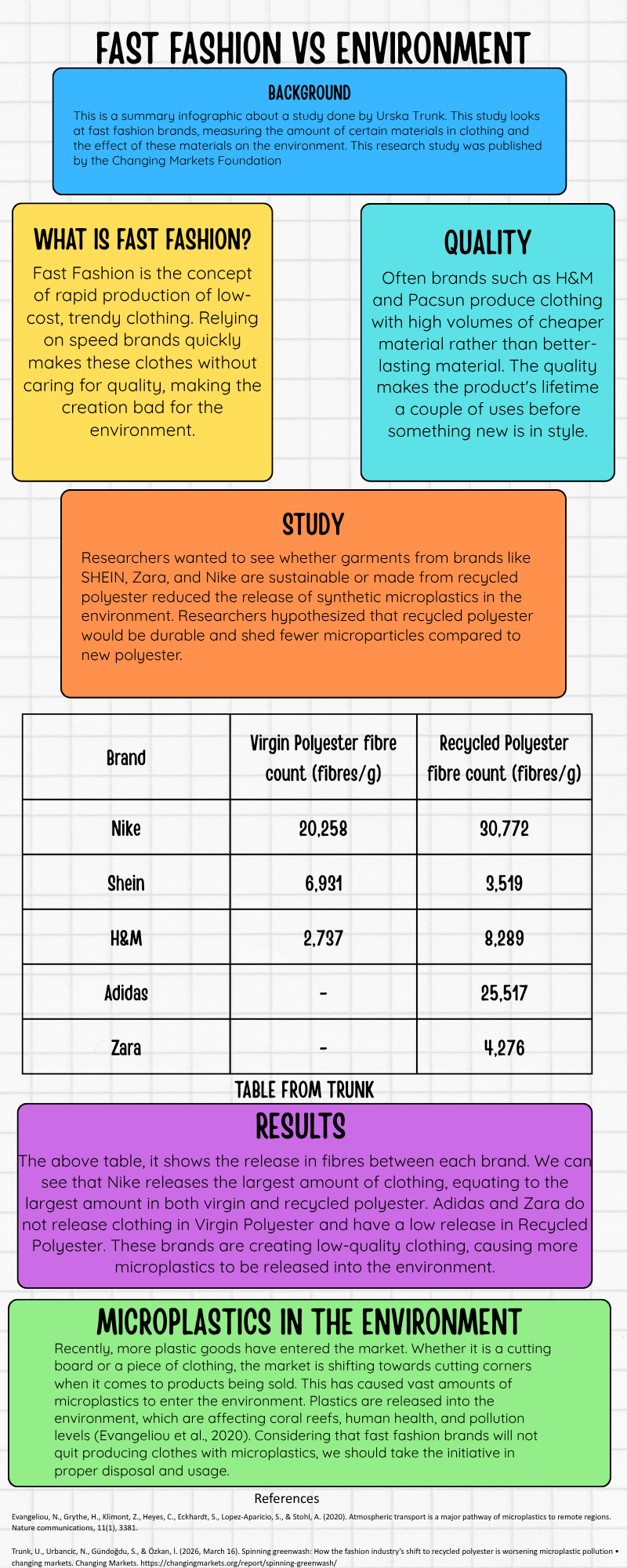
The above table, it shows the release in fibres between each brand. We can see that Nike releases the largest amount of clothing, equating to the largest amount in both virgin and recycled polyester. Adidas and Zara do not release clothing in Virgin Polyester and have a low release in Recycled Polyester. These brands are creating low-quality clothing, causing more microplastics to be released into the environment.
Microplastics in the environment
Recently, more plastic goods have entered the market. Whether it is a cutting board or a piece of clothing, the market is shifting towards cutting corners when it comes to products being sold. This has caused vast amounts of microplastics to enter the environment. Plastics are released into the environment, which are affecting coral reefs, human health, and pollution levels (Evangeliou et al., 2020). Considering that fast fashion brands will not quit producing clothes with microplastics, we should take the initiative in proper disposal and usage.
References
Evangeliou, N., Grythe, H., Klimont, Z., Heyes, C., Eckhardt, S., Lopez-Aparicio, S., & Stohl, A. (2020). Atmospheric transport is a major pathway of microplastics to remote regions. Nature communications, 11(1), 3381.
Trunk, U., Urbancic, N., Gündoğdu, S., & Özkan, İ. (2026, March 16). Spinning greenwash: How the fashion industry’s shift to recycled polyester is worsening microplastic pollution • changing markets. Changing Markets. https://changingmarkets.org/report/spinning-greenwash/