 Inside the Helmet
The Hidden Psychology of Football
Rishi Sukumar
What Fans Never See
Every Sunday, Monday and Thursday of every single week from September to February, millions of eager fans, fanatics, and fun-lovers alike all gather in front of their televisions. What they see isn’t an emergency broadcast, or a new Pope being sworn in. Some would even say that this is more important than either of those things; Football. Viewers see their favorite players score touchdowns, make big hits, record highlight reel moments, and dramatic nail biting finishes. But what the fans don’t see is what goes on behind the helmet. Hours, and even sometimes, days before the kickoff happens, athletes spend their time managing nerves, reviewing game plans, building confidence, and preparing themselves to perform under the pressure of hundreds of thousands of viewers watching them from all over the country – and that is ignoring any physical injuries that players may have sustained. This lingering effect that the mental aspect has on the game is the reason why the most important collisions in football don’t even happen on the field – they happen within the player, mentally, where focus goes head to head with distractions, and confidence is intertwined with enormous doubt.
Football is often described as a physical game – some may even say the most physical game – and that is true to many extents. Abnormal strength and size, lightning fast speed and reflexes, inhumane physical attributes and abilities, and endurance are all a must if you even want to step foot on a professional football field. But football also demands intense emotional control, and mental resilience. In many cases, the better team is simply the one that has better strategy and an advantage mentally compared to their opponents.
Football as a Cognitive Science
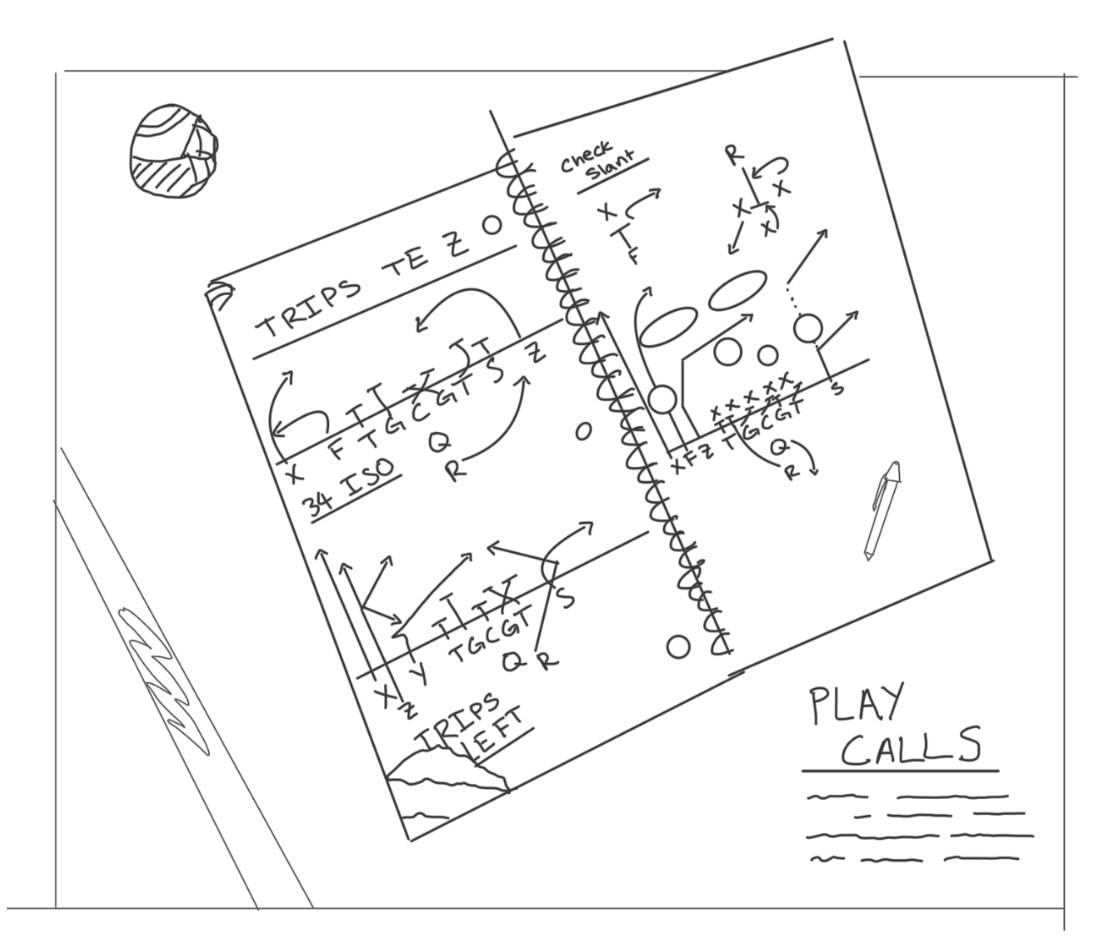
The game of football moves fast. Lightning fast. But it’s designed on decision making, down to the most precise detail. Athletes are forced every play to process various pieces of information and react correctly – often in sync with their teammates. A quarterback may have only a few seconds to recognize the defensive coverage, adjust protection, scan receivers, and make an accurate throw before pressure arrives. Simultaneously, linemen have to handle blitzes (or sometimes a lack thereof), receivers must adjust routes, and running backs must read blocks protecting them from 300lbs steamrollers in real time.
On the defensive side of the ball players must face the same challenges. Linebackers must analyze and decide if the play is to run or pass within seconds. Safeties must scan the quarterback’s eyes while covering the deep space. And cornerbacks need short memory to recover from mistakes and lightning fast reaction speeds after every snap to guard the receiver.
Because of all these moving pieces, the game of football depends heavily on reaction time, concentration, memory, and pattern recognition (Craft et al.). Almost like a game of chess where every play involves every piece moving at the same time. These mental demands show that football performance depends heavily on cognitive processing and focus, not just athletic ability (Craft et al.). Physical ability can create opportunities, but mental mistakes are often the deciding factor for many games. One missed assignment, one blown coverage, or one incorrect decision by anyone can completely change momentum and be catastrophic or fortuitous (depending on which side of the ball you’re on).
The Science Behind Split-Second Decisions
Football players are required to make elite decisions under extreme pressure within split seconds. This places an enormous demand on the brain. Neuroscientists have found that reaction time is heavily dependent on the ability of an individual’s brain to process visual stimuli, predict movement, and then to send signals throughout the body – Do I run? How hard do I throw? How should I contort my body? Etc. etc. For a quarterback, this means reading defenders and making a precise throw in typically under 3 seconds. Stress can also lead to an increase in cortisol levels – a hormone that can sharpen alertness in short bursts but harms decision making in the long term when levels get too high. This further explains why athletes that are calm and have extensive experience often perform better within these chaotic moments than younger or more mentally rattled players (Craft et al.).
Training the Mind Like a Muscle
Players, as they are forced to train their bodies through the weight room, many athletes spend excessive amounts of time through psychology and therapy. Mental Imagery, one of the most common methods used, is utilized a lot by players who envision a game in their head through multiple variations just to prepare themselves. Although this works across many fields, these mental reps help athletes feel more prepared when the real moment arrives.
Sports psychologists have proven that imagery can help boost confidence, concentration, and performance (Weinberg). When players picture themselves in situations, pressure situations feel more familiar and less overwhelming. Pre-game routines serve a similar purpose. Athletes will put on a familiar song, or think of a specific memory, or repeat personal affirmations, all for the same reason. While these habits seem miniscule from the outside, after repeating this process across hundreds of games, athletes fall into a rhythm where they know what works and doesn’t work for them, to really fine tune this process, to be most effective in game.
Pressure Changes Everything
In high intensity games, pressure can completely change a player, and therefore an entire team’s performance. A simple throw made in practice feels herculean when having to do so on third down in front of 80,000 fans. There are instances where pressure helps athletes perform better, through sharpening focus, or increasing their energy or stimulating situations. But too much pressure can have the opposite effect causing players to panic, rush decisions, limit their physicality, or lose confidence (Craft et al.). One of the first examples of this obsessive approach to preparatory habits in the NFL is Tom Brady, whose emotional control under pressure set his film study apart. Brady’s discipline is also attributed to his longevity in the league, showing that mental discipline can set one apart and extend their success well beyond their physical prime. This perfectly explains why even the best of the best can struggle in their biggest moments. A kicker who’s made dozens of kicks during practice may miss a critical kick in game, with the game being entirely in their hands. In football, managing pressure is just as important a skill as throwing, tackling, blocking, or catching.
Confidence and Momentum
Momentum in football is a critical concept, which isn’t even tangible. There is no set play, or route to run, or pep talk to have that can physically give or take momentum. Many things contribute towards this concept. The current score, the effectiveness of the opposing teams offense/defense, the fans (with their taunting), past rivalries, etc. When a team is down by multiple scores, winning can seem impossible, causing players to feel dejected, or play less than their full limit. The same is done for the opposite, when a team is winning by a lot. But more importantly, a momentum swing can happen at any time. A team that was playing flawlessly can start making mistakes when the opposing team does something big. It could be as simple as gaining one yard sometimes, but even then affects how ALL the players including the fans who voice their support through loud cheering and roaring, all see the same.
While mistakes happen all the time, it’s important for an athlete to shake the mistake off and come back bouncing. When a quarterback throws an interception, the next throw becomes mentally important. In his head, the game is still back to before he threw the interception, as he’d be recollecting how he could have played differently. But the difference between winning and losing players is not how many mistakes they make, but how they react and move forward after the mistake. Thousands of games have been played at every level where a costly mistake is made by one player, then within the same game that player redeems themselves, as well as boosting the momentum for their entire team. Football constantly tests a player’s ability to move on, stay composed, and focus on the next snap instead of the last one.
Recovery Is Mental Too
Top-tier performance in football covers multiple factors that are not just talent and training, and that includes the quality of one’s sleep, level of hydration, and recovery habits, since they are tied to the mental sharpness of the athlete. Increased sleep, for example, has been shown to improve an athlete’s reaction time, mood, and physical performance (Mah et al.). In football, mental fatigue is detrimental because one delayed reaction or slow read can impact the entire outcome of the game. For this reason, NFL teams monitor sleep schedules and recovery data as closely as they do weight room progress (Mah et al.).
The Off-Field Battle
A lot of football’s toughest mental challenges happen away from the stadium. Injuries, especially, can be emotionally difficult because they disrupt a player’s routine, identity, and purpose (Mah et al.). This most recent season, Cincinnati Bengals quarterback Joe Burrow suffered an injury called turf toe where he was not able to do the job he does best for 3 months. In those 3 months, his entire mental schema could have been completely shattered. Especially when you are getting paid $400 million dollars to be one of the best, and now your elite skillset can’t even be put to use. Many athletes spend years building their lives around football. When injury suddenly takes the game away, frustration, anxiety, and depression can often easily follow.
Additionally, there are external and personal problems. Athletes dealing with past mistakes, family drama, death/divorce, financial issues and extortion, and a plethora of other problems, can all affect a players performance. Former NFL Tight End Aaron Hernandez (despite his legal encounters), was a legendary player who was set to break multiple records. Unfortunately, in his past he was heavily involved within gangs and that followed him into his career as an NFL player. People would often attempt to threaten or extort him by threatening his family, unless he met their demands. Things like this can all mentally mess up a player, which in turn causes them to limit their performance on the field.
There is also pressure from outside sources. Players feel extensive pressure from coaches, fellow teammates, family members, and most critically the media. The media over-analyzes every single move and action a player does, as the concept of privacy is something traded away for the fame and glory of being an elite player. Athletes consistently need to “prove” themselves to fans and media critics, who realistically cannot play at the level these athletes play at, yet completely dictate their actions both on AND off the field. A player who is involved in a scandal, or with allegations (whether true or not), may lose fan support causing them to be affected mentally, which reflects onto their game. Every missed pass, or dropped ball, or lost tackle is a subtle reminder to the athletes of what the critics say about them all the time. Because of this, mental health has become a larger topic in sports. Studies across athletics have increasingly shown that emotional well-being directly impacts performance and recovery (Mah et al.). More teams now recognize that emotional well-being matters just as much as physical health. Athletes – who are forced to maintain a rough, nonchalant, and cold demeanor – are realizing that asking for help is slowly becoming accepted, and asking for sympathy is seen as strength rather than weakness.
The Real Scoreboard
Football is often remembered through the final scores, championships and conference trophies, and unforgettable plays. After all, who doesn’t love a player that can seemingly do it all or break the laws of physics. While these moments are always nice to see, they are usually built on qualities that no camera or reporter can ever fully capture. Confidence, failures, and mental health is a facet of sports all over the world that is never seen on the field or the court. To be a successful athlete, one must keep believing under pressure, because mindset often shapes outcomes more than raw talent ever could. The physical side of football may draw an audience, but the psychological side reveals the humanity behind elite athletes. Behind every ball that is played, is a person – just like anyone else – managing insane stress, expectation, fear, and pain, while trying to perform at the most elite level. In that sense, football transforms into more than just a game. It becomes a reflection of how resilient these athletes are and how they respond when everything around them demands their 110% as they are physically and mentally breaking. In football, the strongest players are not always the biggest. They are often the ones who refuse to break mentally.
Inside the Helmet
Sources Used to Analyze the Hidden Psychology of Football
Anxiety and Performance
Craft, Lynette L., et al. “The Relationship between the Competitive State Anxiety Inventory-2 and Sport Performance: A Meta-Analysis.” Journal of Sport & Exercise Psychology, vol. 25, no. 1, 2003, pp. 44–65.
Sleep and Athletic Performance
Mah, Cheri D., et al. “The Effects of Sleep Extension on the Athletic Performance of Collegiate Basketball Players.” Sleep, vol. 34, no. 7, 2011, pp. 943–950.
Visualization And Mental Imagery
Weinberg, Robert S. “Does Imagery Work? Effects on Performance and Mental Skills.” Journal of Imagery Research in Sport and Physical Activity, vol. 3, no. 1, 2008.