Cognitive Offloading
This is a summary of the recent study done by Michael Gerlich. This study measures the psychological habit of cognitive offloading. The methods the researchers use include different age groups and AI tools.
Cognitive Offloading
It’s the physical or digital act of reducing mental effort when doing a task by using external tools to solve it. Today, we can see this in tasks like emails, coding, and essays being handled by ChatGPT, Gemini, or Claude.
AI models and Skills
AI tools have stagnated in usage, but with the rapid usage, critical thinking begins to decline. Usage of AI in the workspace can halt professional development (Shen & Tamkin, 2026). The popularity of these tools has led to reliance, causing people to become dependent on these tools .
Study 1 and 2
The hypothesis of study 1 states that more usage of AI tools reduces critical thinking. The author highlights that the hypothesis of study 2 states that cognitive offloading serves as a mediator between critical thinking and AI models.
Results
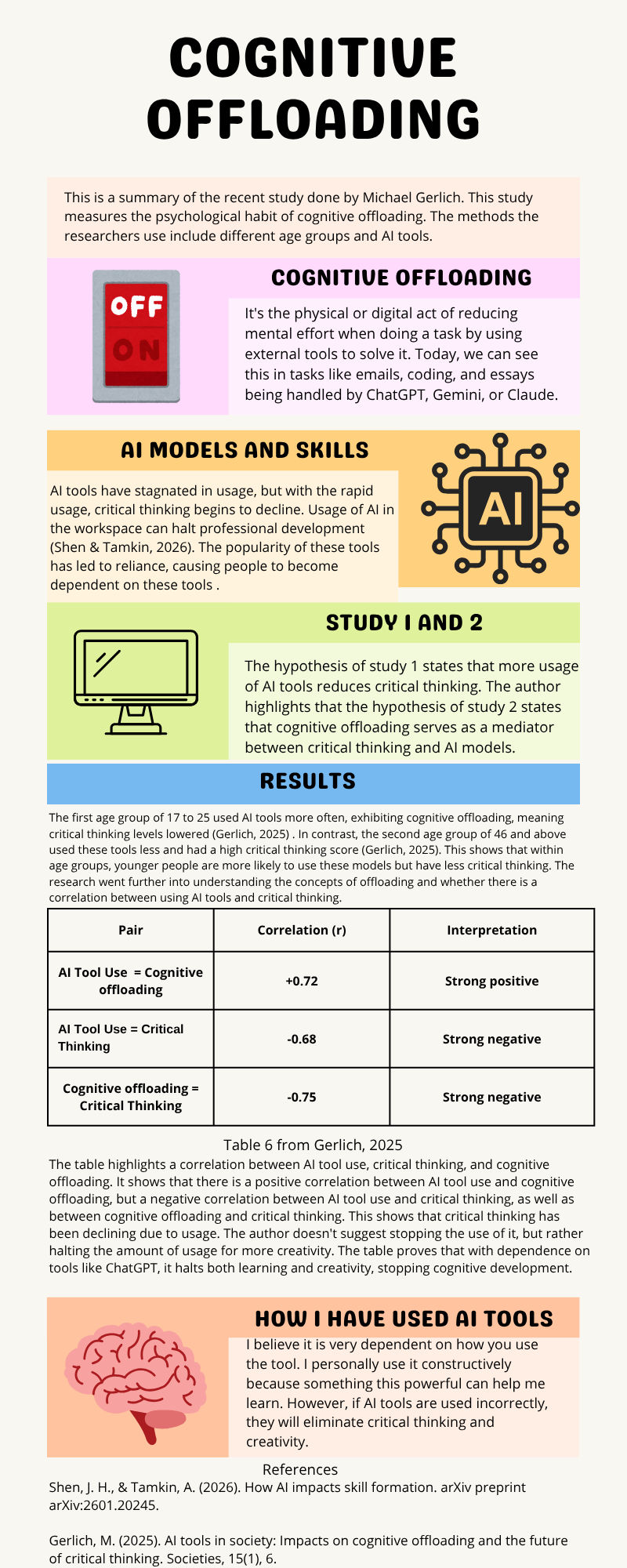
The first age group of 17 to 25 used AI tools more often, exhibiting cognitive offloading, meaning critical thinking levels lowered (Gerlich, 2025) . In contrast, the second age group of 46 and above used these tools less and had a high critical thinking score (Gerlich, 2025). This shows that within age groups, younger people are more likely to use these models but have less critical thinking. The research went further into understanding the concepts of offloading and whether there is a correlation between using AI tools and critical thinking.
| Pair | Correlation | Interpretation |
| AI Tool Use = Cognitive offloading | +0.72 | Strong positive |
| AI Tool Use = Critical Thinking | -0.68 | Strong negative |
| Cognitive offloading = Critical Thinking | -0.75 | Strong negative |
Table 6 from Gerlich, 2025
The table highlights a correlation between AI tool use, critical thinking, and cognitive offloading. It shows that there is a positive correlation between AI tool use and cognitive offloading, but a negative correlation between AI tool use and critical thinking, as well as between cognitive offloading and critical thinking. This shows that critical thinking has been declining due to usage. The author doesn’t suggest stopping the use of it, but rather halting the amount of usage for more creativity. The table proves that with dependence on tools like ChatGPT, it halts both learning and creativity, stopping cognitive development.
How I have used AI tools
I believe it is very dependent on how you use the tool. I personally use it constructively because something this powerful can help me learn. However, if AI tools are used incorrectly, they will eliminate critical thinking and creativity.
References
Shen, J. H., & Tamkin, A. (2026). How AI impacts skill formation. arXiv preprint arXiv:2601.20245.
Gerlich, M. (2025). AI tools in society: Impacts on cognitive offloading and the future of critical thinking. Societies, 15(1), 6.