Have you ever gone fishing and got something that is not a fish? I’m not talking about shrimps, squids, or seaweed. If I could get a dollar every time I fish a hook, I would have gotten 3 dollars. Three dollars is not a lot, but weirdly it happened three times, and I only go fishing like once a year!
Not that it was entangled with another angler’s hook. The hooks were abandoned in the water, attached to a long fishing line (cord). It’s nothing but an annoying occurrence. One can simply spend at most 5 minutes removing it. However, this is nothing but the tip of an iceberg that implies a bigger problem. What if it wasn’t a hook, but something bigger? Something that is way more difficult to remove, like a net? And it wasn’t your hook that was entangled, but rather tons of marine creatures were trapped?
What is Ghost Fishing?
Ghost fishing was defined as “the ability of fishing gear to continue fishing after all control of that gear is lost by the fisherman.” (Matsuoka et al., 2005) Specifically, fishing gear (either recreational or commercial) can become a derelict fishing gear (DFG) where the equipment continues to capture the intended targets or non-intended marine animals, potentially endangering protected species (Lively & Good, 2019). One uncontrolled piece of equipment can continue to fish from days to years, and it can reach as shallow as less than 1 meter, or as deep as 900+ meters. According to World Wild Life, fishing gear accounts for roughly 10% of 12 million tons of plastics that end up in the oceans every year. In the most recent update, 46% of the Great Pacific Garbage Patch is made up of discarded nets, lines, and ropes (World Wild Life). This doesn’t just happen within a single patch: it’s a worldwide issue!
Impacts of Ghost Fishing
Fishing gear used to be made of natural materials like wood and cotton.The introduction of highly durable fishing gear made of long-lasting synthetic materials makes the matter worse (NOAA Marine Debris Program, 2019). As technology advances, new fishing equipment uses stronger and long-lasting materials like plastics, vinyl coated steel, etc. These equipment now take years to bio-degrade, and hence started to accumulate within the oceans. Ghost fishing started to pose a threat to the marine ecosystem. As the 20th century progressed, it started to become a more widespread issue. By the 1970s, The International Maritime Organization Convention for the Prevention of the Pollution from Ships (MARPOL) prohibited the abandonment or dumping of fishing gear in the oceans (Lively & Good, 2019).
By late 1980s, more researches worked on the total number of mortality per gear after gear loss for gillnets and trammel-nets (Matsuoka et al., 2005). Traps continue to ghost fish as long the bait remains. Nets can ghost fish way longer due to their scale and property of getting things entangled when attached to natural marine traps like corals (Lively & Good, 2019). There were an increasing number of reports on incidental catch of non-fishery animals such as marine mammals, reptiles and seabirds along with fishing gear entangled on seabed (Matsuoka et al., 2005). Marine protected areas now accumulate a large number of DFG. These regions are designated and managed by laws and regulation for the long-term conservation of marine resources, ecosystems services, or cultural heritage.
According to the Marine Debris Program, overseen by the National Oceanic and Atmospheric Administration (NOAA), ghost fishing can impose a variety of harmful impacts to marine ecosystems. The impacts are not limited to “killing target and non-target organisms, including endangered and protected species; causing damage to underwater habitats, such as coral reefs and benthic fauna; economic losses from target species mortalities and replacement costs; and contributing to marine pollution” (NOAA Marine Debris Program, 2019). According to Lively and Good (2019), between 1991 to 2008, the red king crab caught in derelict nets may account for 1%–3% of the local red king crab population per year in Women’s Bay Kodiak Island, Alaska. Some studies estimate that over 90 percent of species caught in DFG are of commercial value, which can contribute to a significant loss of revenue for jobs surrounding marine species such as fishermen.
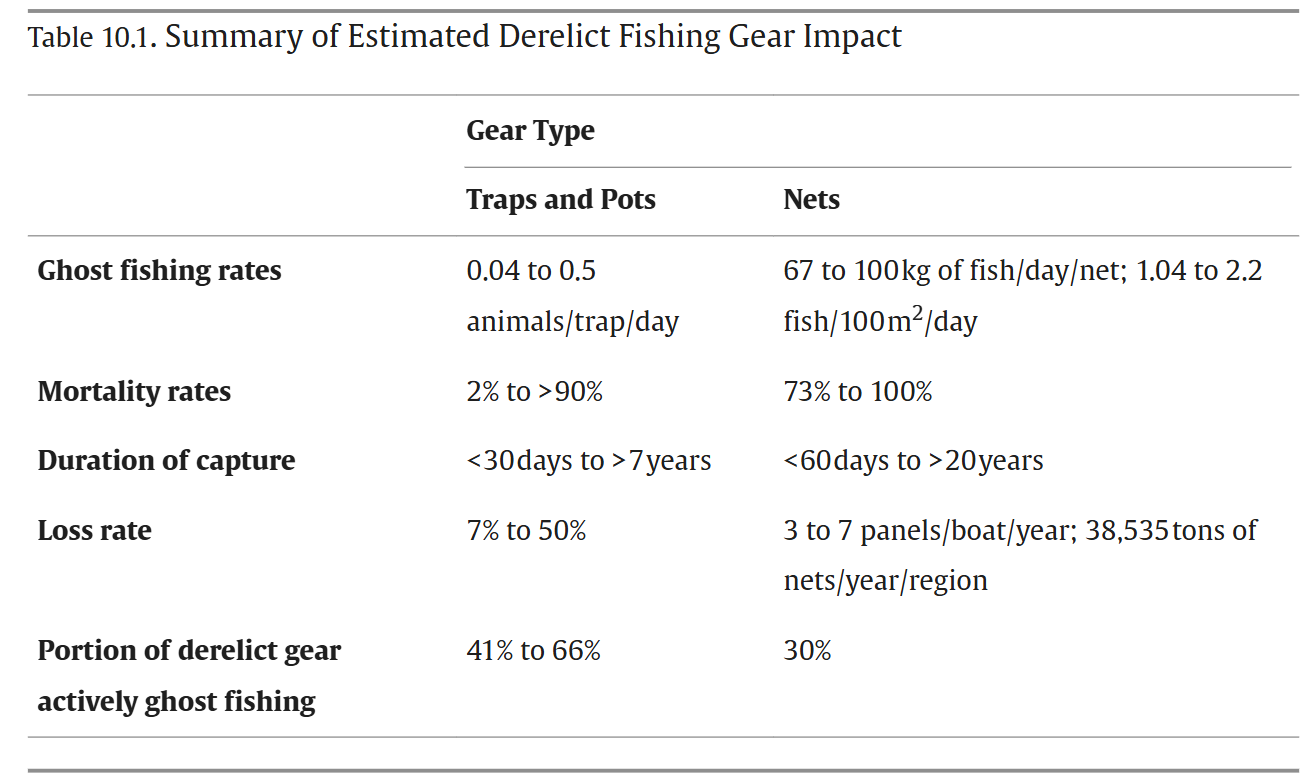
Below is a comparison table between major types of fishing gears and their impacts regarding ghost fishing (Lively & Good, 2019) .
Prevention & Mitigation
Unfortunately, these DFG might not just be the consequences of abandonment of vandalism. Environmental factors such as storms, floods, or hurricanes can contribute as well (Lively & Good, 2019). Prevention is difficult to implement, but better gear management can help reduce the impacts.
Around the world, World Wild Life joined hands with fishers, government agencies, and others to remove abandoned nets from the water. They increased establishments for gear collection and recycling programs. Better technology for tracking and recovery of gear are under development (World Wild Life). GPS and bottom mapping technology can identify obstructions that might result in accidental loss of gears. A cost-free solution is provided to fishermen to dispose of unusable fishing equipment (NOAA, 2011). Others suggest encouraging arts to monetize unused gears at proper disposal. The NOAA Marine Debris Program has collected more than 1,814,369.48 kilograms (4 million pounds) of gear from 56 locations across the United States. Everyone is working to recover the marine ecosystem.
What Can YOU Do?
Individuals cannot contribute much to the grand scale of technology and initializing these programs. However, every effort counts! Raising awareness is very important. Word should travel that everyone should try their best to minimize the garbage and gears that can make their way to the ocean freely. Otherwise, these beautiful creatures might go extinct. And before you know, the King Crabs will become protected species.
References:
Lively, J. A., & Good, T. P. (2019). Ghost fishing. World Seas: An Environmental Evaluation, 183–196. https://doi.org/10.1016/b978-0-12-805052-1.00010-3
Matsuoka, T., Nakashima, T., & Nagasawa, N. (2005). A review of Ghost Fishing: Scientific Approaches to evaluation and solutions. Fisheries Science, 71(4), 691–702. https://doi.org/10.1111/j.1444-2906.2005.01019.x
NOAA. (2005). Turtle entangled in marine debris (ghost net). Wikimedia Commons. Retrieved from https://en.wikipedia.org/wiki/File:Turtle_entangled_in_marine_debris_(ghost_net).jpg.
NOAA. (2011, September 27). What is ghost fishing?. NOAA’s National Ocean Service. https://oceanservice.noaa.gov/facts/ghostfishing.html
NOAA. (2019, February 24). What we know about “ghost fishing” | marine debris program. NOAA Marine Debris Program. https://marinedebris.noaa.gov/what-we-know-about-ghost-fishing-0
World Wild Life. (n.d.). Ghost fishing gear: Ocean’s Silent killer | world wildlife fund. https://www.worldwildlife.org/resources/explainers/ghost-fishing-gear/