If your Instagram discover page is full of posts from digital artists like mine is, there’s a decent chance you may have come across posts by an artist named Feefal (@feefal). Feefal is a very popular illustrator on Instagram, with 1.2 million followers and most of their posts gaining tens of thousands of likes and hundreds of thousands of views on Reels. Feefal describes herself as a lover of biology and cute women, which is reflected in the subject matter of the bulk of her illustrations. For example, one of her pinned posts, and the first post of hers I came across in 2023, can be described as “plant, animal, and fungi cells but they’re personified as women.”
There are many artists who do the same types of illustrations as Feefal where they turn creatures, objects, or even vague ideas into a personified character design. As someone with an interest in both biology and drawing, I wanted to try my own hand at creating an illustration where I turn a creature into a character.
In keeping with my theme about sea creatures from my previous post, I chose to base my character design on Pelagia noctiluca, a species of jellyfish that is referred to by many common names, the most popular being “mauve stinger”. A fun nickname I’ve also seen for it is the “purple people eater” (yes, like the song).
Taking both morphology and cool facts I read about them into account, this is what I came up (with with the help of my boyfriend, who asked to help and I couldn’t refuse):
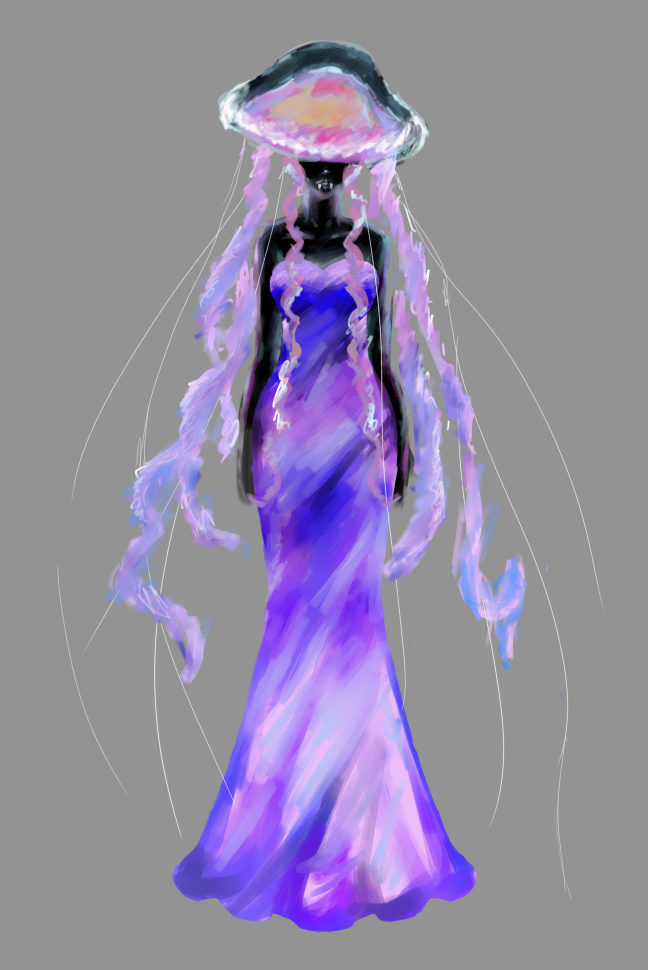
This is the part where I explain my design decisions while telling you cool facts about P. noctiluca.
- Hat: Obviously, this is meant to represent the bell, or umbrella, of the jellyfish. It is the main body of the jellyfish where the tentacles branch off from. A jellyfish’s mouth lies in the center of the underside of its umbrella, surrounded by oral arms (we’ll get to those in a second) (Macpherson & Gordon, 2023). You’ll notice that jellyfish have no eyes, so I made the bell-hat cover her eyes. I accept criticisms of this choice as lazy, as I basically just draw a jellyfish on this woman’s head. But will you dare tell her it’s not a look?
- Dress: Along with the hair-tentacles coming out from the “hat”, this is supposed to be somewhat evocative of the tentacles of the jellyfish with its flowy nature. The mermaid dress silhouette is also supposed to evoke a nautical theme. The mauve stinger has two types of tentacles: thin, string-like ones called statocysts and thicker, frilly ribbon-like ones called oral arms. It has 8 statocysts and 4 oral arms. Statocysts are used for sensing movement and orienting the jellyfish. Oral arms extend from the mouth, contain nematocysts, and aid in prey capture (Macpherson & Gordon, 2023). The sting of a mauve stinger is somewhat severe, although there have not been any fatalities due to their stings (Mariottini et al., 2008).
- Skin: The skin and the dark parts around the cap are supposed to represent the semi-translucent, soft body of the jellyfish, with the darkness being the ocean showing through.
- Sharp teeth: I took some creative liberties with this part. No, jellyfish don’t have razor-sharp fangs. Instead, this is supposed to represent the purple people-eater’s predatory nature. They’re said to be opportunistic predators that mainly feed on small phytoplankton, although they can eat prey of various sizes. They can even eat over 1.5 times their body weight in a day. (Larson, 1987). Don’t worry, at least they don’t actually eat people!
References:
Macpherson, D., Gordon, D. (2023). Jiggling Jellyfish: a guide to the jellyfish of New Zealand. (Version 2). National Institute of Water and Atmospheric Research (NIWA).
Mariottini, G.L., Giacco, E., Pane, L. (2008). The Mauve Stinger Pelagia noctiluca (Forsskål, 1775). Distribution, Ecology, Toxicity and Epidemiology of Stings. A Review. Mar. Drugs, 6(3): 496-513. doi: 10.3390/md20080025
Larson, R.J. (1987). A Note on the Feeding, Growth, and Reproduction of the Epipelagic Scyphomedusa Pelagia noctiluca (Forskal). Biological Oceanography, 4(4).