ROSINA:
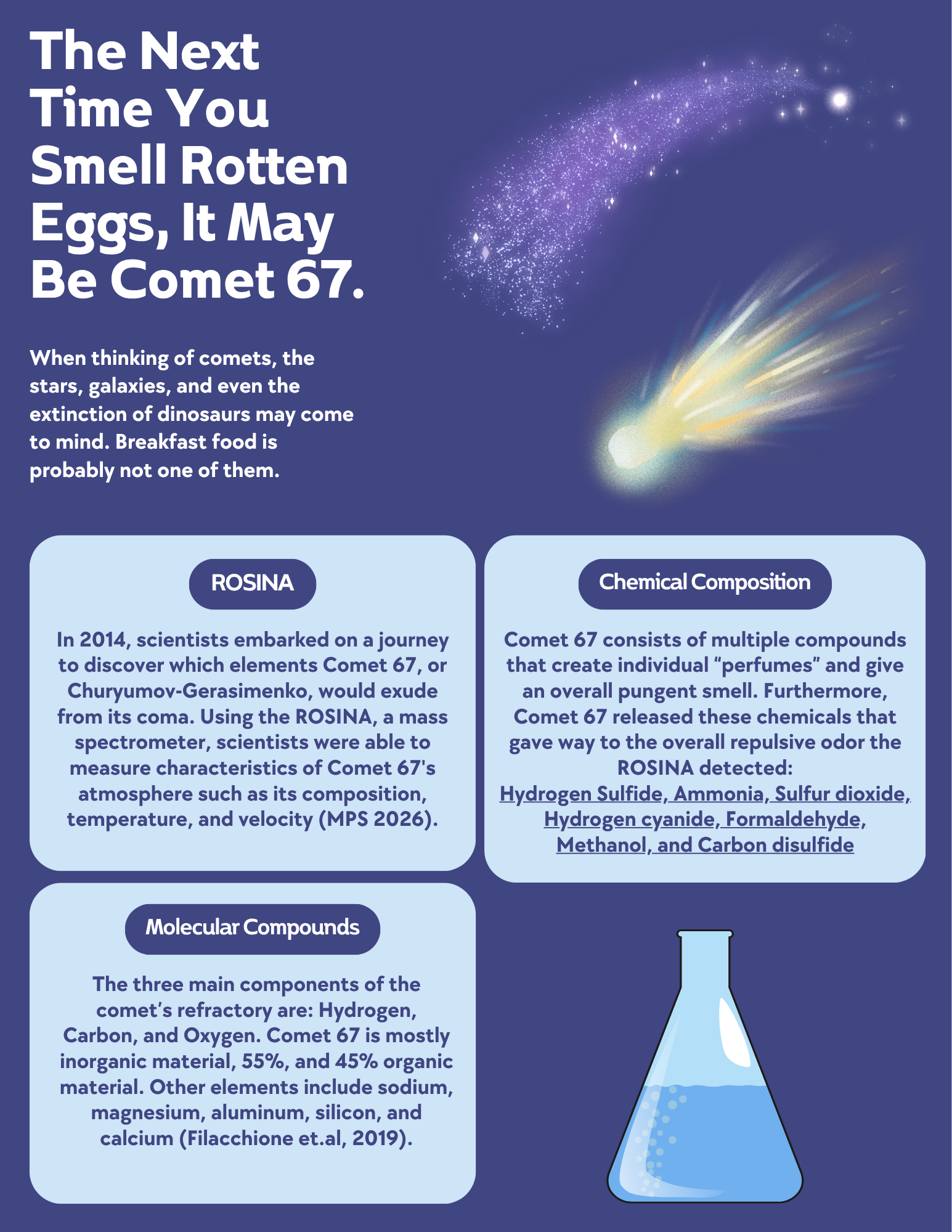
In 2014, scientists embarked on a journey to discover which elements Comet 67, or Churyumov-Gerasimenko, would exude from its coma. Using the ROSINA, a mass spectrometer, scientists were able to measure characteristics of Comet 67’s atmosphere such as its composition, temperature, and velocity (MPS 2026)
Chemical Composition:
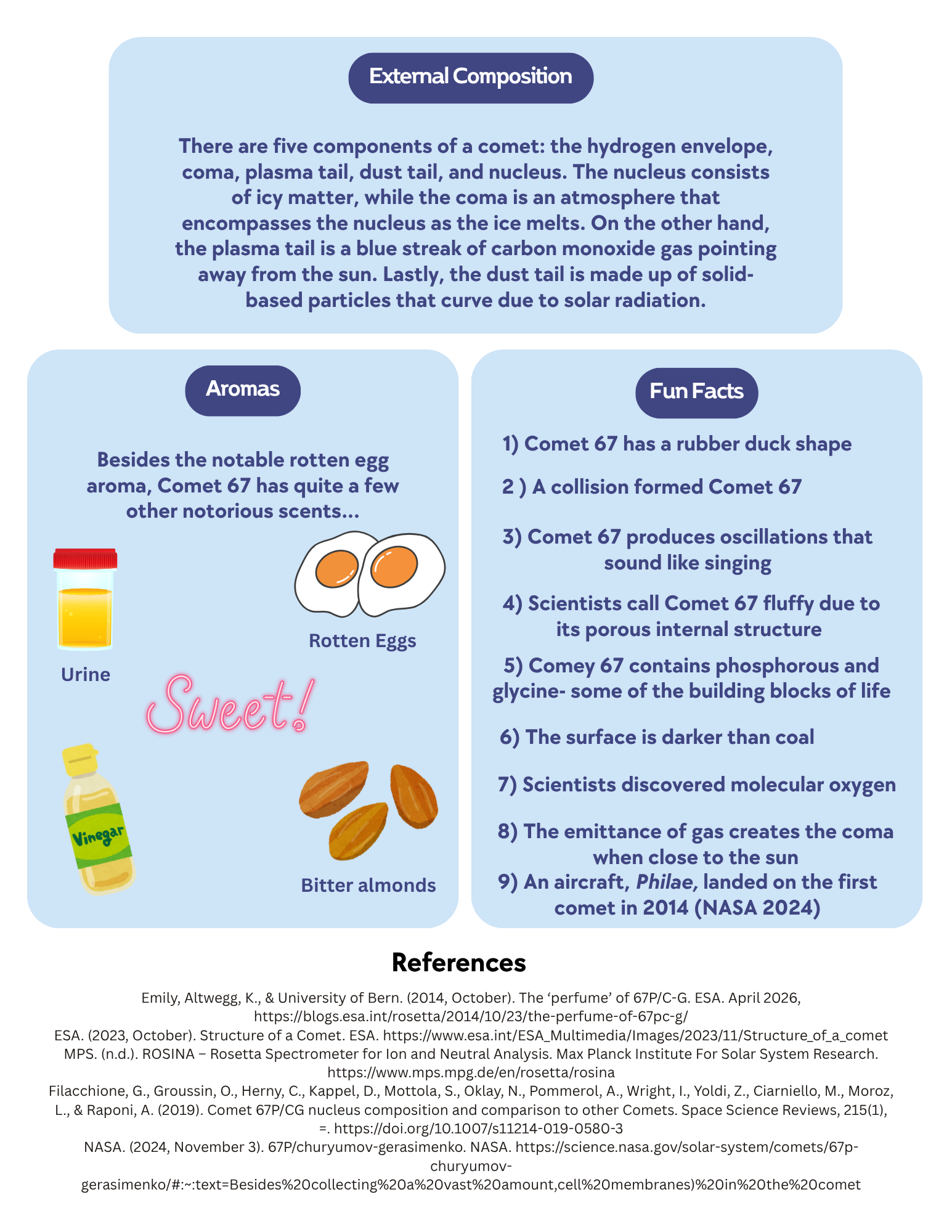
Comet 67 consists of multiple compounds that create individual “perfumes” and give an overall pungent smell. Furthermore, Comet 67 released these chemicals that gave way to the overall repulsive odor the ROSINA detected:
Hydrogen Sulfide, Ammonia, Sulfur dioxide, Hydrogen cyanide, Formaldehyde, Methanol, and Carbon disulfide.
Molecular Compounds:
The three main components of the comet’s refractory are: Hydrogen, Carbon, and Oxygen. Comet 67 is mostly inorganic material, 55%, and 45% organic material. Other elements include sodium, magnesium, aluminum, silicon, and calcium (Filacchione et.al, 2019).
External Composition:
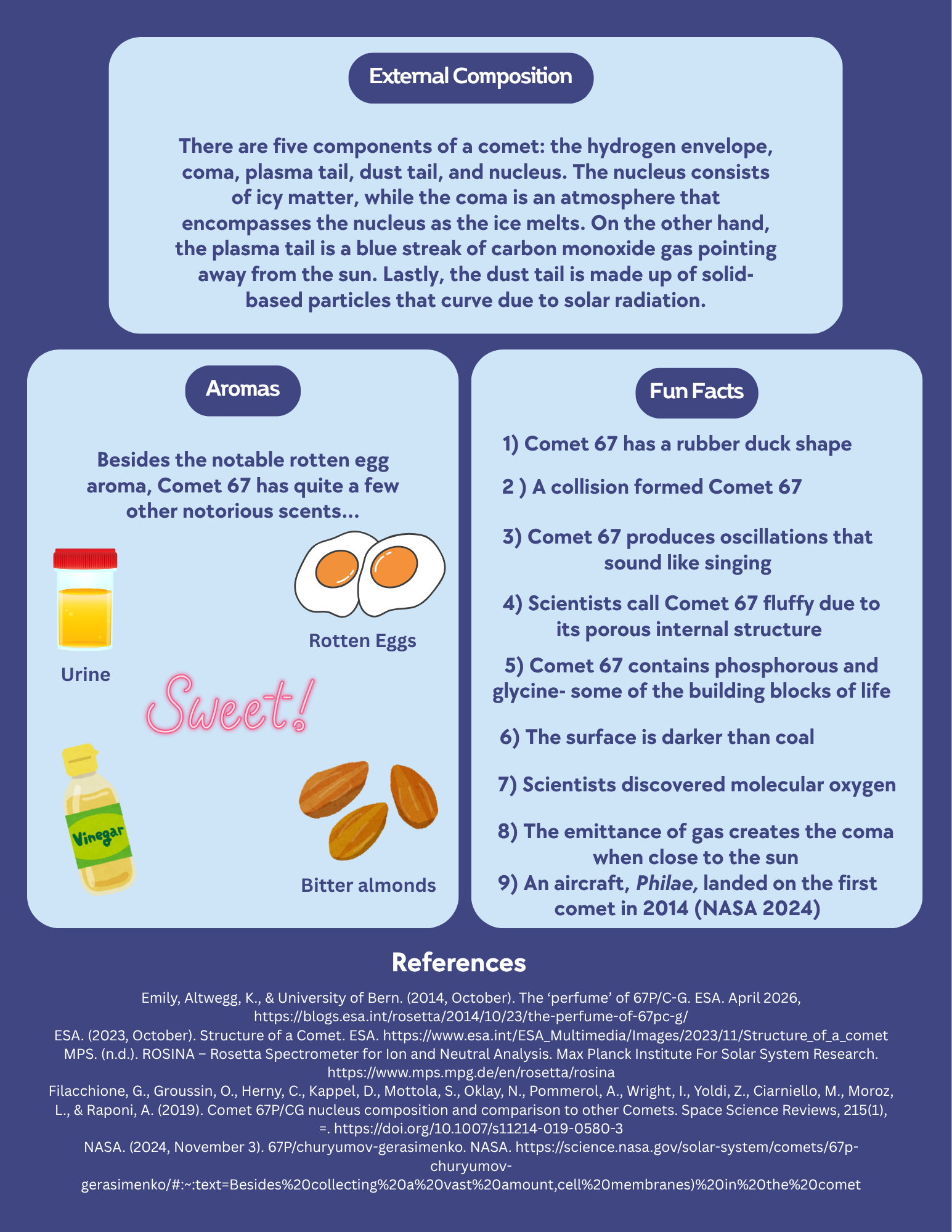
There are five components of a comet: the hydrogen envelope, coma, plasma tail, dust tail, and nucleus. The nucleus consists of icy matter, while the coma is an atmosphere that encompasses the nucleus as the ice melts. On the other hand, the plasma tail is a blue streak of carbon monoxide gas pointing away from the sun. Lastly, the dust tail is made up of solid-based particles that curve due to solar radiation.
Aromas:
Besides the notable rotten egg aroma, Comet 67 has quite a few other notorious scents…
Rotten eggs, sweet, urine, vinegar, and bitter almonds
Fun facts:
1) Comet 67 has a rubber duck shape
2) A collision formed Comet 67
3) Comet 67 produces oscillations that sound like singing
4) Scientists call Comet 67 fluffy due to its porous internal structure
5) Comet 67 contains phosphorous and glycine- some of the building blocks of life
6) The surface is darker than coal
7) Scientists discovered molecular oxygen
8) The emittance of gas creates the coma when close to the sun
9) An aircraft, Philae, landed on the first comet in 2014 (NASA 2024)
References:
Emily, Altwegg, K., & University of Bern. (2014, October). The ‘perfume’ of 67P/C-G. ESA. April 2026, https://blogs.esa.int/rosetta/2014/10/23/the-perfume-of-67pc-g/
ESA. (2023, October). Structure of a Comet. ESA. https://www.esa.int/ESA_Multimedia/Images/2023/11/Structure_of_a_comet
MPS. (n.d.). ROSINA – Rosetta Spectrometer for Ion and Neutral Analysis. Max Planck Institute For Solar System Research. https://www.mps.mpg.de/en/rosetta/rosina
Filacchione, G., Groussin, O., Herny, C., Kappel, D., Mottola, S., Oklay, N., Pommerol, A., Wright, I., Yoldi, Z., Ciarniello, M., Moroz, L., & Raponi, A. (2019). Comet 67P/CG nucleus composition and comparison to other Comets. Space Science Reviews, 215(1), =. https://doi.org/10.1007/s11214-019-0580-3
NASA. (2024, November 3). 67P/churyumov-gerasimenko. NASA. https://science.nasa.gov/solar-system/comets/67p-churyumov-gerasimenko/#:~:text=Besides%20collecting%20a%20vast%20amount,cell%20membranes)%20in%20the%20comet