If you’ve already read this far, you hopefully have a pretty good picture of what synesthesia is, seen some scientific data that supports its existence, and heard a few of the possible biological explanations.
Now, let’s take a step back together. Let’s go back to trying to understand the way the world might seem if this sentence also produced music, or the sensation of touching the computer keyboard smelled a certain way. This is the point in my research where I just began to marvel at the vastness of possibilities, all of the infinite ways sensations could be paired, and how those combinations might affect the lives of people experiencing them.
I also noticed something a bit strange though. The more than I read, and the further away and more complex synesthesia seemed, the more I started to notice the cross-sensory references all around me. For the first time, it struck me as odd that English-speakers may refer to the taste of a cheese as “sharp”, or the sting of a cold wind as “bitter”. Once I started looking for them, I found similar pairings of different senses everywhere, appearing in idioms such as “speaking in honeyed tones”, as well advertisement campaigns, like Skittle’s “Taste the Rainbow” tagline, and famous works of literature alike, with the infamous “yellow cocktail music” of Fitzgerald’s The Great Gatsby.
Naturally, this sparked quite a few questions. Where did these types of metaphor come from? Are they related to synesthesia, or merely eerily similar? Are they some sort of “cultural” form of synesthesia? Or are they merely evidence of how synesthetes have influenced society, remnants of people with synesthesia living, working, and integrating their experiences into the common language? Are we all synesthetes, in a small way, when we make these connections and use this imagery?
A precursory review of the studies I’d read provided a resounding no, at least to that the final question. Nearly every one was quick to point out that these types of imagery do not fit the three main criteria we laid out in the first article, while defining synesthesia. Synesthesia has to be involuntary, elicited, and stable; metaphorical language is made of voluntary associations, chosen to convey or emphasize an aspect of the stimulus, and is extremely creative and dynamic, depending entirely on what one is feeling in the moment, or what one wishes to say (Deroy and Spence 2013). Although it often includes cross-modal imagery, like colored descriptions of sound or tactile adjectives applied to tastes or emotions, this language is not literally perceptual. As Greg Downey states, ‘…metaphoric analogy may highlights perceptual qualities, but it is driven by elective choices to highlight qualities that may involve symbolic meanings or create meaningful analogies” (Downey). When you think of “seeing red” and associate it with anger, chances are that you are not actually seeing the color red, as you might see the blue sky or the green grass, whenever you become angry, and while you might choose to communicate the intensity of flavor in your cheese as sharp, chances are that it does not feel physically sharp to the touch.
That is not to say, however, that these expressions may not have been influenced or inspired by true synesthesia, though. In fact, there is pretty solid evidence that people without synesthesia were greatly influenced by the phenomena and the concept of linking senses. One example of this can be seen in the copious amount of cross-sensory imagery in the Romanticism movement in literature. There was actually an entire writing theory based on it, often called poetic or literature synesthesia, with classifications of “higher” and “lower” senses, and a prescribed system for linking a subject to a “higher sense” to add stress or emotional emphasis (Duffy). Percy Bysshe Shelley, a very large figure in Romantic poetry, uses it clearly in this stanza from his poem “The Sensitive Plant”, as he compares the smell of a flower to “sweet”, “soft” music (Synesthesia Examples and Definition):
“And the hyacinth purple, and white, and blue,
Which flung from its bells a sweet peal anew
Of music so delicate, soft, and intense,
It was felt like an odour within the sense.”
This is a surprisingly relevant issue, especially in historical literature and linguistics research, as academics are trying to define what criteria can accurately help distinguish between authors describing synesthetic perceptions and those using intense cross-modal imagery (Ward).
To complicate things further, a disproportionately large number of influential artists, musicians, and writers are thought to have some form of synesthesia (Walsh, Ward et al. 2008). The famous composer Olivier Messiaen, is well-documented to have color-music synesthesia, and is often quoted saying “Colours are very important to me because I have a gift…whenever I hear music or even if I read music, I see colours” (Walsh). Alan Menken, the composer behind many classic Disney soundtracks, including music from “The Little Mermaid” and, of course, the song “Colors of the Wind” (and yes, I totally tried to play off of that in the title of these articles) has also reported that seeing music in color. There are tons of well-supported examples of influential figures with synesthesia, including the physicist Richard Feynman, artists like van Gogh and Kandinsky, composer Franz Liszt, musicians like Duke Ellington and Itzhak Perlman, and writers such as Arthur Rimbaud and Charles Baudelaire, among many others.
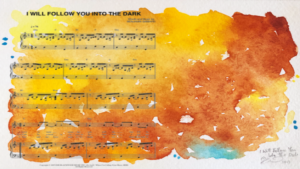
For the etsy artist Sigourney Young, this task would be perfectly intuitive. Young has color-music synesthesia, and creates beautiful watercolor pieces based on what she sees during a song. My best friend commissioned this painting, inspired by the song “I”ll Follow You into the Dark by Death Cab for Cutie, for me in 2017, and I’ve overlaid the sheet music of the piece on an image of the painting to illustrate how the two are inextricably intertwined.
With all of these tangled up cases of literal and metaphorical synesthesia in nearly every aspect of culture, it becomes a bit difficult to determine exactly how much should be attributed to the neurological phenomena, and what impact synesthesia may have had on humanity over time. It is a bit simpler to see how it has directly affected the individuals who experience it, though.
So, what do we actually know about synesthetes?
Well, just like any other group of people, people with synesthesia are all wonderfully unique individuals, from diverse backgrounds around the world. There do seem to be a few trends linking them together, however.
First of all, as mentioned previously, synesthesia does tend to run in families and is suspected to have an undetermined underlying genetic component. Studies have also suggested that synesthetes tend to be more creative than the average population, spending a larger amount of time engaged in tasks related to the arts and working more often in a job considered “creative”- artist, musician, actor, writer, entrepreneur, researcher, etc. (Ward et al. 2008, Walsh).
It also seems that synesthesia can be useful in aiding memorization, as many people report that the secondary sensation helps them recall the stimuli better. There are even some extreme cases, such as Solomon Shereshevskii, who was known for performing impossible tasks of memory for audiences, and who also had multiple forms of synesthesia (Ward). Another example is Daniel Tammet, who recited over 20,000 digits of pi. He said that each number had a color, shape, and texture that helped him memorize the sequence, and in later experimental studies, showed less dependence on traditional memorization techniques (Bor et al. 2007).
Synesthesia has not been linked to any other neurological condition and is not considered a disorder. Most think of it as an asset, and there are few instances of synesthetic experience negatively interfering with a person’s life and/or capabilities. According to one researcher, nearly all synesthetes report it as “pleasant experience that they would prefer to have, given the choice” (Walsh).
Synesthesia provides completely different ways of perceiving the world and is, at least to me, one of the most beautiful and fascinating examples of individuality and the power of the brain on our perceived reality. I had a ton of fun looking into this phenomena, and hope you’ve enjoyed learning a little bit about it as well!
References
Buja, M. (2016, February 06). Writing Music in Light. Retrieved from http://www.interlude.hk/front/writing-music-light/
Carpenter, S. (2001, March). Everyday fantasia: The world of synesthesia. American Psychological Association, 32(3).
Day, S. (2007). Types of Synesthesia. Retrieved from http://www.daysyn.com/Types-of-Syn.html
Denham, J. (2017, March 31). This Artist with Synesthesia Sees Colors in Music and Paints Your Favorite Songs. Retrieved from https://broadly.vice.com/en_us/article/gyxq73/melissa-mccracken-synesthesia-painter-interview
Deroy, O., & Spence, C. (2013). Why we are not all synesthetes (not even weakly so). Psychonomic Bulletin & Review,20(4), 643-664. doi:10.3758/s13423-013-0387-2
Duffy, P. L. (2013). Synesthesia in Literature. Oxford Handbooks Online. doi:10.1093/oxfordhb/9780199603329.013.0033
Downey, Greg. (2008, June 05). Synesthesia & metaphor – I’m not feeling it. Retrieved from https://neuroanthropology.net/2008/06/05/synesthesia-metaphor-im-not-feeling-it/
Grossenbacher, P. G., & Lovelace, C. T. (2001). Mechanisms of synesthesia: Cognitive and physiological constraints. Trends in Cognitive Sciences,5(1), 36-41. doi:10.1016/s1364-6613(00)01571-0
Gross, V. (n.d.). Synesthesia Project: FAQ. Retrieved from https://www.bu.edu/synesthesia/faq/
Hubbard, E. M., & Ramachandran, V. (2005). Neurocognitive Mechanisms of Synesthesia. Neuron,48(3), 509-520. doi:10.1016/j.neuron.2005.10.012
Rouw, R., & Scholte, S. (2010). Increased structural connectivity in Grapheme-Color Synesthesia. Journal of Vision,7(9), 108-108. doi:10.1167/7.9.108
Phillips, E. L. (n.d.). What is synesthesia? Retrieved from https://faculty.washington.edu/chudler/syne.html
Ramachandran, V.S., Hubbard, E.M. and Butcher, P.A. (2004). Synesthesia, CrossActivation, and the Foundations of Neuroepistemology. In G. Calvert, C. Spence and B. E. Stein (eds), The Handbook of Multisensory Processes (pp. 867-83). Cambridge, Mass.: The MIT Press.
Synesthesia Examples and Definition. (2015, October 31). Retrieved from http://www.literarydevices.com/synesthesia/
Walsh, V., & Mulvenna, C. (2005). Synesthesia. Current Biology,15(11), R399-R400. doi:https://doi.org/10.1016/j.cub.2005.05.039
Ward, J. (2013). Synesthesia. Annual Review of Psychology,64(1), 49-75. doi:10.1146/annurev-psych-113011-143840
Ward, J. , Thompson‐Lake, D. , Ely, R. and Kaminski, F. (2008), Synaesthesia, creativity and art: What is the link?. British Journal of Psychology, 99: 127-141. doi:10.1348/000712607X204164