The Evolution from Fossil to Monster

Humankind as a species is over 200,000 years old. We are travelers, storytellers, and connoisseurs of legends and tales. For thousands of years, mankind has entertained our children and fellow tribesmen with fables and stories of the unknown, the cryptic and the mythological. It is a unifying factor in our world. Every story needs a strong villain to maintain equilibrium and for many, the villain was the monster. From Greek and Roman to Japanese and Native American, fantasy and folklore have been influenced from the history of this planet. All cultures have created monsters to fuel their fears. Either to rationalize the unknown or to provide comfort for themselves, men and women of the past have created these stories for purposes that have been lost to time. Yet, monsters are alive and real today, be it in between a page or in a culture. These beasts came from our imaginations. However, many of these terror-bringers were imagined based on fossils, skeletons, or unknown sightings that frightened the inhabitants of their lands. 

From tales of creation, to the flood, and even tales of doom, every culture has unifying legends. Some cultures produced monsters so terrifying that they were hidden and lost to time, while some have been immortalized in books, movies, and videogames. The primal fear of the unexplainable had to be justified through something tangible by mankind. Two monsters that have fueled the nightmares of children and men; two giants of terror that were produced from the unknown, can now be explained.  

THE CYCLOPS:

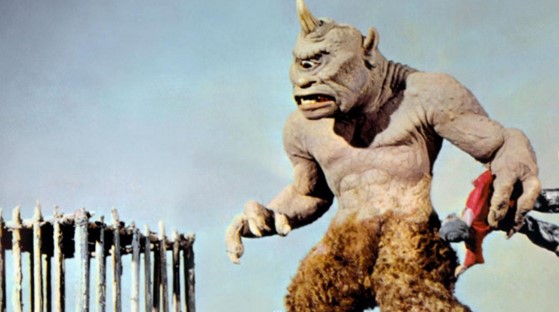
Cyclops are a cannibalistic giant race bearing a distinct feature: a singular eye in the center of their forehead. Notable cannibals and warriors in Greek mythology, the cyclops were born from the Greek God Poseidon but were cast away because of their grotesque ugliness. In Greek stories and in pop-culture, cyclopes have been used as a formidable opponent to heroes and heroines. The most well known depiction of the cyclops race comes from Homer’s The Odyssey. Other notable depictions have been seen in The Cyclops (1957), Wrath of the Titans (2012), and Tron: The Odyssey (2017). 

According to Homer, Polyphemus was the cyclops leader on the isle in which Odysseus was stranded on his return home. Polyphemus was a sheep herder and a brutal warrior. During Odysseus’ time on the island, Polyphemus severed a man in half with a single bite and crushed a man in his grasp. A nightmarish scene that captures our fears of these cannibal giants; the infamous cyclops look, from Greek vases to modern day, has endured the test of time.Cyclops from “Seventh Voyage of Sinbad”. Director Nathan Juran
Their faces look eerily similar to elephant skulls:Elephant Skull. Photo courtesy of Felipe Romao
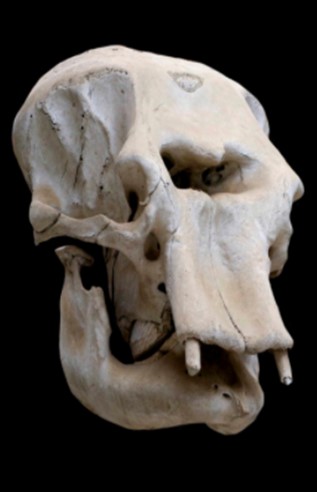
 

These skulls can easily be viewed as a horrific mono-visual monster. Ancient Greece had two different species of elephants roaming the area: The Cyprus Dwarf Elephant and the Cretan Dwarf Mammoth. Such large skulls would have to be supported by tremendous bodies. These skulls sported massive tusks and teeth which were perfect for crunching the bones of men.  

In the early 20th century, Paleontologist Othenio Abel suggested that the inspiration of cyclops comes from the fossilized skulls of pygmy elephants found in the ancient Greek region. Found on Cyprus, Crete and many other surrounding Grecian islands, these ancient dwarf elephants died around 11,000 BCE. These elephants had a shoulder height of five feet, with an averaged- size femur of over two feet. Anatomically, elephant and human femurs look similar, which is a proposed explanation to the human element of the cyclops. From these basic anatomical parallels, the cyclops could have been born. When the image of the cyclops was mixed with human fear and superstition, the cyclops became the monster we know today: a giant cannibal terror. 
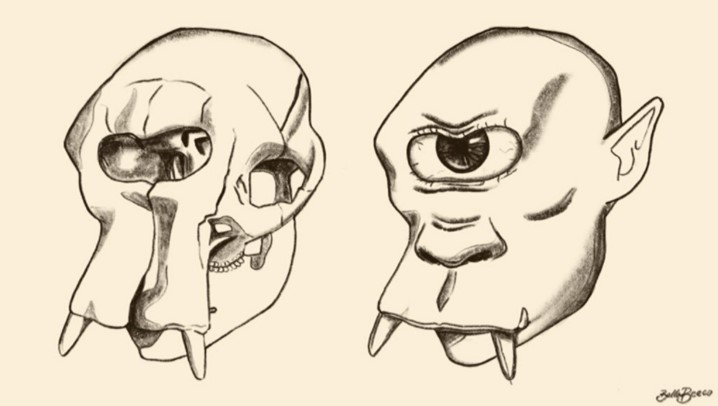
 

Courtesy of Bella Beeco
Elephant Skull transforming into a Cyclops Skull, Courtesy of Bella Beeco

THE YACUMAMA:

The Yacumama is a South American tale that derives its nature from the Amazon river. Meaning “The Water Mother” in Peruvian, the tale dates back to that of the Incan civilization in the 13th century. A massive 30 meter serpent monster, the Yacumama had jaws that could swallow a man whole. In her legends, any animal or man that disturbed her waters became her prey. The local indigenous people would blow on conch horns to protect themselves before entering the water, believing the Yacumama would reveal herself if present. 

South America has many depictions and lore of snakes. The Aztec and Incan civilizations both had powerful gods depicted as these slithering creatures. The Aztecs had Quetzalcoatl who created mankind. The Incas had Amaru who was the water God and protector of the rivers. The legend of the Yacumama can be traced back to the 15th century when it was told to the Spanish Conquistadors. 

A modern depiction of the Yacumama: 

Photo of a Yacumama Statue in Parque Tematico Peru. Courtesy of Mike Dreckschmidt

As anacondas and rivers in South America are mutually inclusive, the pairing of Yacumama and her watery home was natural. South America is home to thousands of rivers including the Amazon, and is home to 169 species of snakes, including the world’s heaviest species: the Green Anaconda. The largest Green Anaconda recorded weighed over 500lbs and was nearly 20 feet long. The longest snake species, the Reticulated Python, which measured over 25 feet long, is not native to South America but is a related species to the Anaconda. While these are the largest snakes ever measured in current day, the largest snake ever found hails from South America: The Titanoboa.

Titanoboa fossil size model. Courtesy of Darren Pepper

The Titanoboa fossil found in Colombia created a fear of all ancient snakes. Weighing in at over 2,500 lbs. and reaching up to nearly 50 feet in length, this behemoth snake truly could have swallowed a man whole. This dinosaur-sized serpent could strangle and crush every living organism that came within striking distance until its extinction 56 million years ago. If these snake fossils had been found by natives in South America prior to the official paleontological discovery, a giant water serpent named Yacumama could have certainly been created to explain the phenomena. The Yacumama is possibly an exaggeration of a sighting of a large wild anaconda, or it could have been a fossil based explanation from an earlier find of a titanoboa fossil. A massive serpent, a man eater, and a terrifying hunter from the depths, the Yacumama was definitely a monster that inspired fear, but it is also a monster that can be flushed into explanation. 


References:

  • Aym, Terrence. “History Mysteries: The Legendary Yacumama, Mysterious Monster of the Amazon.” Salem-News.com, Salem-News.com, 16 Aug. 2010, www.salem-news.com/articles/august162010/monster-amazon-ta.php.
  • Combing, Beach. “Cyclops Origins.” Beachcombing’s Bizarre History Blog, Beachcombing’s Bizarre History Blog, 8 July 2011, www.strangehistory.net/2011/06/07/cyclops-origins/.
  • Dreckschmidt, Mike. “Terrifying Legends of Peru #3: Yacumama and Sachamama.” Traveling and Living in Peru, Peru Exprience S.A.C, 6 Aug. 2020, www.livinginperu.com/terrifying-legends-peru-3-yacumama-sachamama/.
  • “Green Anaconda: National Geographic.” Animals, National Georgraphic, 10 Oct. 2018, www.nationalgeographic.com/animals/reptiles/g/green-anaconda/.
  • Hennings, Julie, and Harry Lynch. “Birth of a Monster.” EarthDate, Burea of Economic Geology, www.earthdate.org/birth-of-a-monster.
  • Juran, Nathan, director. Seventh Voyage of Sinbad. Columbia Pictures, 1958.
  • Pepper, Darren. Titanoboa, Www.prehistoric-Wildlife.com., 2011, www.prehistoric-wildlife.com/species/t/titanoboa.html.

Your journey starts here! Let’s talk!

ThemeRex © 2026. All rights reserved.
  Timothy Durham was convicted of rape when a test showed his DNA genotype matched the DNA recovered from the crime scene. Eye witnesses testified that Durham was in a different state at the time of the incident, but he wasn’t exonerated from his 3000 year sentence until follow up DNA analysis showed that the preliminary forensic analysis used in the trial was misinterpreted (Thomas et al.). DNA testing serves an invaluable part in our criminal justice system, but it comes with complications and bias that can lead to wrongful convictions and misinformed juries.  

Background:

Forensic genetics aims to identify the origin of a biological sample. It can be traced back to Karl Landsteiner who discovered human ABO blood groups. With blood groups, suspects could be eliminated based on their blood type. For example, if a suspect had type A blood and there was type B blood left at the scene by the perpetrator, the investigators could rule out the suspect. Unfortunately, the reverse didn’t work. If the suspect and perpetrator both had the same blood type, it can’t be concluded that the suspect was guilty. Blood identifiers evolved into 8 distinct categories which improved the ability to eliminate suspects, but could only conclude that (if the system matched) it might be the perpetrator or this person might be related to the perpetrator (Jobling and Gill). The field evolved in the 1980s with the discovery of Minisatellites, lines of repetitive DNA that don’t encode proteins. Minisatellite patterns in DNA create what we know today as the DNA fingerprint, and it has a much higher accuracy rate than previous methods (Augustyn et al.). Around the same time, a breakthrough for victims of sexual assault was discovered. In the case of assault, bodily fluids of both the victim and the assaulter can get mixed. A process called differential lysis was created which could selectively increase the concentration of sperm in a fluid sample thereby allowing for accurate DNA testing (Jobling and Gill). Forensics evolved to use single-locus probe testing after several years because of its ease of interpretation. It looked at specific minisatellites that had high variability between subjects. This was the first DNA-based method to be used in a criminal investigation. Two murder homicides from several years apart were connected using DNA evidence. The evidence was then used to exonerate an innocent man, and the guilty party was found when he tried to evade mandatory DNA testing for all men in the small town. His guilt was then reinforced when the DNA profiles matched, and he gave a confession (Jobling and Gill). Finding DNA at a crime scene doesn’t guarantee that you’ll find a murderer. There are issues with non-pure samples and limited samples that make DNA work difficult, and accreditation of facilities and new techniques and take time (Jobling and Gill).  

Subjectivity of DNA Interpretation:

In a 2009 publication, the National Academy of Science discusses the possibility for subjective influence in lab based forensics. The interpretation bias happens in complex cases where, for example, there could be a mixture of DNA. A study published in 2011 looked specifically at this issue. A gang rape happened in Georgia, and the mixture in DNA from the case was used to prosecute one suspect after another suspect took a plea bargain to testify against him. With DNA mixtures, there are three possible conclusions: suspect excluded, suspect cannot be excluded, and inconclusive. If the suspect is excluded, it means that there’s little to no possibility that his DNA is part of the sample. If the suspect cannot be excluded, it means that there’s a possibility that his DNA is part of the sample. In the trial, the DNA examiners who knew the context of the case concluded that the suspect being prosecuted could not be excluded. The 2011 study gave the DNA evidence from this case and the DNA profiles of the suspects to 17 forensic examiners. These examiners had no context of the case, and they all worked independently. Of the 17, only 1 came to the same conclusion (suspect cannot be excluded) as the examiners who knew the context of the case. Twelve of the 17 concluded that the suspect who was prosecuted and convicted had no relation to the DNA found in the sample. Not only does this show that subjectivity occurs due to the context of the case, but the 17 examiners came up with different findings based on their past experiences meaning that not all DNA analysis is objective. Some organizations like the Scientific Working Group on DNA Analysis Methods say that quantitative statistical evidence should be presented with every categorical conclusion, but the US doesn’t require this (Dror and Hampikian).

False Positives:

There are two categories that cause wrongful identification in a DNA report: coincidental matches and false positives. Coincidental matches are DNA matches between two unrelated people. The probability of these matches is about 1 to 500,000 for white individuals and about 1 to 350,000 for black individuals. This small probability of coincidental matches makes people feel confident in DNA evidence. False positives, on the other hand, are matches between DNA and test DNA that result from issues in the forensics lab. There have been multiple cases of forensics labs accidentally switching victim and suspected rapist DNA which lead to convictions that were later overturned when the lab realized the error. There are also cases of misreading or misunderstanding a sample. In a case from 1993, a man was convicted of rape because someone interpreted a mixed sample of victim and perpetrator DNA as an individual sample. The conviction was again overturned. To prevent false convictions, retesting DNA is allowed, but it’s not an efficient solution. Many people are pushing for statistical information on the probability of false positives, so that the jurors can make accurate judgements based on DNA evidence (Thomas et al.).  

Conclusion:

DNA analysis is a useful tool for the criminal justice system, but subjectivity can be an issue in forensic testing. To combat wrongful convictions, there are organizations like The Innocence Project who use DNA testing to free the innocent, but reformed forensic testing standards should be put in place to prevent subjectivity and to ensure juries are correctly informed during trials. https://www.innocenceproject.org/    

Citation:

Augustyn , Adam, et al. “DNA Finerprinting.” Encyclopedia Britannica , 26 Apr. 2018, www.britannica.com/science/DNA-fingerprinting#ref153186. Dror, Itiel E., and Greg Hampikian. “Subjectivity and Bias in Forensic DNA Mixture Interpretation.” Science & Justice, vol. 51, no. 4, 2011, pp. 204–208., doi:10.1016/j.scijus.2011.08.004. Jobling, Mark A., and Peter Gill. “Encoded Evidence: DNA in Forensic Analysis.” Nature Reviews: Genetics, vol. 5, no. 10, Oct. 2004, pp. 739–751., doi:10.1038/nrg1455. Thompson, William C, et al. “How the Probability of a False Positive Affects the Value of DNA Evidence.” Journal of Forensic Sciences, vol. 48, no. 1, Jan. 2003, pp. 1–8., doi:10.1520/jfs2001171.