Written by Julia Raver and Lauren Mellinger
Coffee – an integral part of your morning routine. You wake up and groggily walk to the kitchen to make your morning cup. It has become so integral to our morning routine that a lot of people can’t function without it. Especially in the mornings, having your order messed up at Starbucks or Dunkin Donuts can change the trajectory of your entire day. But how does coffee keep you awake all day? Caffeine is the secret to coffee’s success.
Part 1 – The Chemistry
Caffeine, or C8H10N4O2, is a drug known for its ability to give you energy and boost metabolism. It functions very similarly to xanthine, which is a crystalline drug that is often found in chocolates and teas. This provides an increase in stimulation and wakefulness, the ability to sustain intellectual activity, and decrease in reaction times. In the image below, you can see the similarities between the xanthine and caffeine molecules. The main differences are that caffeine has extra methyl (or CH3 groups) attached to its two rings (National Academy Press, 2001).
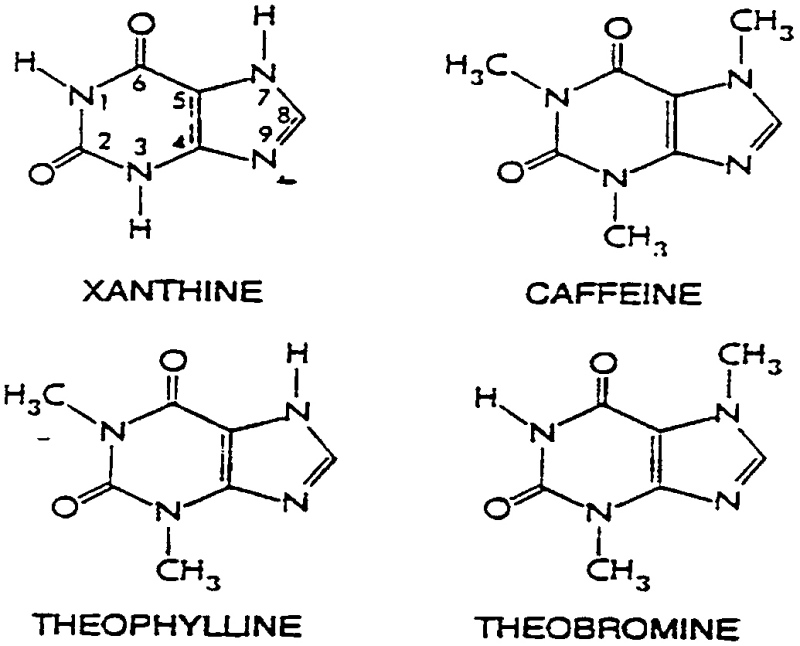
Due to the polarity in caffeine molecules, or difference in strength between the nitrogen and oxygen bonds, caffeine exhibits unique bonding forces. It can bond via dipole-dipole forces, where positive and negative atoms of different molecules bond together. Caffeine also bonds via hydrogen bonding with water, which is a strong bonding of hydrogen atoms with carbon atoms of water and caffeine respectively. In layman’s terms, caffeine reacts in the bloodstream by bonding via its nitrogen and oxygen atoms.
Absorption in the Bloodstream
We can now dive deeper into how caffeine is absorbed in the bloodstream. People absorb caffeine within 45 minutes of ingestion but has an elimination half-life of anywhere from 1.5 to 9.5 hours. This means that if you drink your morning coffee at 8 am, it could still be in your system at 5:30! When absorbed, caffeine undergoes the hepatic first-pass effect, meaning it is not removed by the liver and heads straight for the bloodstream. There, due to the presence of carbons within the structure, caffeine acts as a hydrophilic (or water-liking) molecule and can bond with the water in your tissues. Once bonded with this tissue water, caffeine works with proteins and begin to give you that energy boost you so desperately needed when you drank it at 7am (National Academy Press, 2001).
Now remembering that caffeine is in fact a drug, it is important to note that it also comes with a certain toxicity level. Luckily for coffee drinkers however, caffeine only becomes fatal when around 10-14g are ingested daily. To get an idea of how much this really is, divide 150 or 200 by your total body weight in kilograms. This gives the toxicity level based on your weight per day (National Academy Press, 2001). For example, if you weigh 110 pounds (or 50kg), 7500 milligrams or 7.5 g of caffeine is your daily toxic dosage of caffeine. An average cup of coffee contains around 100 mg of caffeine so you would need to drink 75 cups of coffee in a day to die of caffeine overdose (Dews, 1982).
Caffeine Appearance
Caffeine is what helps coffee give you energy in the morning but what makes coffee look and taste how it does? Melanoidin, or heterogeneous polymer with a brown pigment, is formed when sugars and amino acids combine at high temperatures (Merriam-Webster). This melanoidin is what gives coffee its nice rich brown color. Depending on the temperature to which the coffee beans are heated, the coffee can taste differently. Once heated above 180 °C, exothermic reactions (that release heat) within coffee beans occur (Rao, Fuller, & Grim, 2020).
The reactions occurring at these high temperatures are called Maillard reactions, which are defined as reactions between amino acids and sugars. Basically, sugars and amino acids reacted at high temperatures produce brown products, or these melanoidin molecules that create brown pigments (Ellis, 1959). Therefore, different roasting temperatures cause these reactions to go to either more or less completion and are responsible for both the color and taste of your morning beverage. Now that we understand the chemistry behind caffeine, we can look at flavor preferences.
Part 2 – The Psychology
Cold beverages have accounted for 75% of Starbucks’ sales in the past quarter (Creswell, 2022). All across the world, coffee drinkers prefer the mellow, balanced flavors of cold coffees. Hot coffee, on the other hand, can only be enjoyed for the fleeting moments between scalding and sour. But why is it that the same beans can produce such different flavors?
The Making
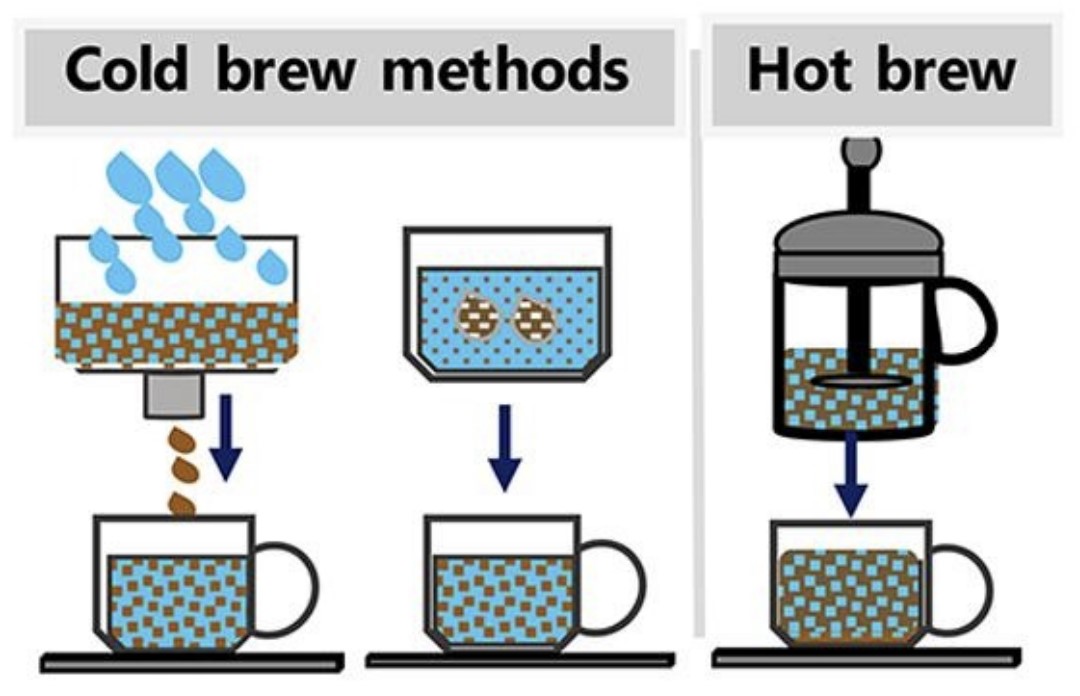
The final cup of coffee is affected by the extraction method — the way water pulls flavor, aroma, and caffeine from the grounds. This is strongly influenced by temperature and time.
For example, in a pour over, water moves over the coffee and produces a brighter tasting coffee. Immersion brews result in a fuller extraction leaving more body in the cup (Kelly, 2018). The cold brew method taking the coffee world by storm involves lower temperatures than your typical drip coffee. To compensate, it needs a much longer extraction time (between 8 and 24 hours) (Córdoba et al., 2021).
Coffee and the Senses
The ability of substances to dissolve out of the grounds and into the water increases with temperature. This causes acids to extract more efficiently in hot brewing. In turn, more sour and bitter elements are released. (Córdoba et al., 2021). Using a lower temperature better retains those delicate flavor components that would degrade or evaporate with exposure to heat (Lane et al., n.d.). Plus, hours of contact with water causes the fats in the beans to emulsify, creating that creamy mouthfeel. Therefore, higher temperatures lead to more nutty, roasty notes — and possibly some unsavory ones as well. Colder temperatures retain flavor compounds and generate a smoother, sweeter beverage (Córdoba et al., 2019).
When you walk into a coffee shop, you are guaranteed to be welcomed by the scent of roasted beans. But you might notice that your cup of cold brew doesn’t smell very strong at all. Since the oils that carry aromas remain in the water, they stay in your coffee. You’ll perceive these as cold brew’s characteristic floral and fruity flavor (Oden, n.d.). Your drink might not have a strong fragrance or bite, but cold brew rewards those who wait (Alkin, 2014).
Is Cold Brew Better?
The novel brewing method also extracts more caffeine with time, which means cold brew is a concentrate. This allows coffee drinkers to adjusted it to their preferred strength and endlessly customize it to their liking. In addition, the lack of acidity may mean cold brew is a better alternative for those with sensitive teeth, heartburn, or GI issues (Rao & Fuller, 2018).
Whether you crave the smokiness of an automatic drip, or the natural sweetness from an hours-long immersion, ultimately, the choice of brew is up to you.
Reference List
- https://www.scienceandfood.org/coffee-brewing-chemistry-hot-brew-and-cold-brew/
- https://www.sciencedirect.com/science/article/pii/S0924224419305692
- https://www.nytimes.com/2022/08/02/business/starbucks-quarterly-earnings.html
- https://www.sciencedirect.com/science/article/pii/S0963996921000387
- https://www.sciencedirect.com/science/article/pii/S0023643821005168
- https://doi.org/10.1146/annurev.nu.02.070182.001543
- https://doi.org/10.1016/s0096-5332(08)60223-4
- https://blog.lacolombe.com/2018/09/19/brewing-method-affects taste/#:~:text=Immersion%20and%20pourover%20brewing%20each,%E2%80%9D%2Dtasting%2C%20brighter%20coffee
- https://journals.uvic.ca/index.php/arbutus/article/view/16816
- https://www.merriam-webster.com/medical/melanoidin
- https://www.ncbi.nlm.nih.gov/books/NBK223808/
- https://www.javapresse.com/blogs/cold-brew/hot-brewed-vs-cold-brewed-coffee
- https://www.nature.com/articles/s41598-018-34392-w
- https://doi.org/10.3390/foods9070902