Fast Fashion and Greek Life: Overconsumption in Style

As I walk around Georgia Tech’s campus, I cannot help but notice the student body’s diverse range of outfits. Many, like myself, opt for sweatpants or jeans coupled with a sweater for chillier days. The more fashionable may choose a statement piece, such as bright pants or a bold shoe. But one consistent theme I have seen is the consistency of Greek Life merchandise. A shirt bearing the phrases Alpha Delta Pi or Sigma Chi can be seen on almost every street corner. There is nothing inherently different about these stylish t-shirts until you begin to recognize how many you see. There are roughly ten variations of the exact same t-shirt from the same sorority only differing by theme. As the community becomes more aware of the plight of fast fashion, it is easier to recognize fast fashion in everyday life. This article will aim to break down the impacts of fast fashion as a whole, and how students at Georgia Tech can change our behavior patterns to limit our consumption of fast fashion.


Fast fashion as an industry has grown exponentially in recent years. Fast fashion is the business of producing low-quality and cost garments at a rapid pace in order to generate profit as trends appear. From brands such as Shein and Zara, there is a large variety of quality and prices that are classified as fast fashion. However, one theme remains consistent with fast fashion: waste. Much of the clothing purchased through fast fashion is donated or thrown in a landfill. Of the clothing donated, only about one-fifth is resold (Claudio, 2007). This means the rest of the pieces end up in the garbage further polluting the Earth. Fashion and textiles are the second most polluting industries, contributing roughly 20% of global water waste (Bailey et al., 2022). This mass amount of waste contributes heavily to the pollution of our earth and the changing climate that we experience. Additionally, the quality of fabrics has significantly decreased over time. Polyester is a very commonly used material to make clothes because it is cheap and can be mass-produced. However, polyester is made of microplastics, meaning it will not break down as easily as natural fibers (Weber et al., 2017). All of these factors contribute to the growing piles of discarded clothing in our landfills. However, fast fashion seems unavoidable in our society, as exemplified by merchandising in Greek life. 
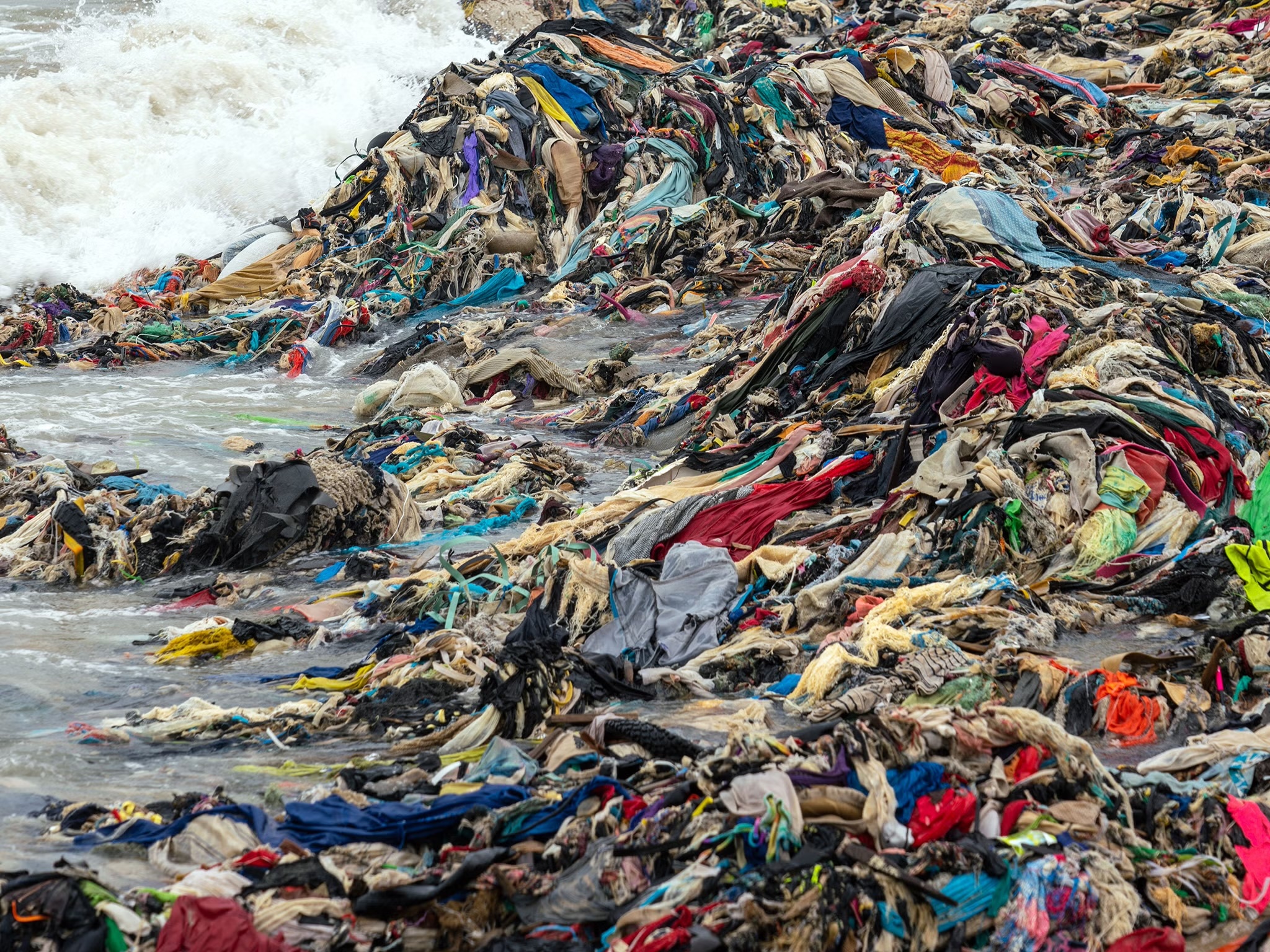
Fast fashion dumping site in Accra, Ghana

I interviewed the Director of Merchandise for Alpha Omega Epsilon to collect information about consumption in Greek Life on Georgia Tech’s Campus. She says thus far this academic year she has received five t-shirts from the sorority, as well as a multitude of other merchandise, including a crewneck, a pair of sweatpants, a hoodie, and a keychain among other items. However, she also explained to me the ways that Alpha Omega Epsilon attempts to mitigate any waste they create if they order extra t-shirts or merchandise. She says that all extra merchandise is kept and offered to new members in the following years. It is great to see that these organizations have solutions to excess consumption. However, Greek life still creates a significant amount of excess waste, which as stated previously contributes significantly to the pollution of our Earth.


Although this article focuses mostly on Greek life, it is up to us to limit our own consumption patterns in an attempt to make a difference. We are constantly given free t-shirts by the university, which inevitably end up in landfills. Every person consumes more than they need to, as it is almost impossible for an individual to remain carbon neutral. It is important to ask yourself as you purchase items: Do I need this? Do I have something similar to this? Can I purchase something like this second-hand? All of these questions may assist consumers in making smart decisions that could save them money and help save the planet.


Sources

Bailey, K., Basu, A., & Sharma, S. (2022). The Environmental Impacts of Fast Fashion on Water Quality: A Systematic Review. Water, 14(7), 1073.

Claudio, L.. (2007). Waste Couture: Environmental Impact of the Clothing Industry. Environmental Health Perspectives, 115(9), A449–A454. https://doi.org/10.1289/ehp.115-a449

Weber, S., Lynes, J., & Young, S. B.. (2017). Fashion interest as a driver for consumer textile waste management: reuse, recycle or disposal. International Journal of Consumer Studies, 41(2), 207–215. https://doi.org/10.1111/ijcs.12328

Your journey starts here! Let’s talk!

ThemeRex © 2026. All rights reserved.
  Timothy Durham was convicted of rape when a test showed his DNA genotype matched the DNA recovered from the crime scene. Eye witnesses testified that Durham was in a different state at the time of the incident, but he wasn’t exonerated from his 3000 year sentence until follow up DNA analysis showed that the preliminary forensic analysis used in the trial was misinterpreted (Thomas et al.). DNA testing serves an invaluable part in our criminal justice system, but it comes with complications and bias that can lead to wrongful convictions and misinformed juries.  

Background:

Forensic genetics aims to identify the origin of a biological sample. It can be traced back to Karl Landsteiner who discovered human ABO blood groups. With blood groups, suspects could be eliminated based on their blood type. For example, if a suspect had type A blood and there was type B blood left at the scene by the perpetrator, the investigators could rule out the suspect. Unfortunately, the reverse didn’t work. If the suspect and perpetrator both had the same blood type, it can’t be concluded that the suspect was guilty. Blood identifiers evolved into 8 distinct categories which improved the ability to eliminate suspects, but could only conclude that (if the system matched) it might be the perpetrator or this person might be related to the perpetrator (Jobling and Gill). The field evolved in the 1980s with the discovery of Minisatellites, lines of repetitive DNA that don’t encode proteins. Minisatellite patterns in DNA create what we know today as the DNA fingerprint, and it has a much higher accuracy rate than previous methods (Augustyn et al.). Around the same time, a breakthrough for victims of sexual assault was discovered. In the case of assault, bodily fluids of both the victim and the assaulter can get mixed. A process called differential lysis was created which could selectively increase the concentration of sperm in a fluid sample thereby allowing for accurate DNA testing (Jobling and Gill). Forensics evolved to use single-locus probe testing after several years because of its ease of interpretation. It looked at specific minisatellites that had high variability between subjects. This was the first DNA-based method to be used in a criminal investigation. Two murder homicides from several years apart were connected using DNA evidence. The evidence was then used to exonerate an innocent man, and the guilty party was found when he tried to evade mandatory DNA testing for all men in the small town. His guilt was then reinforced when the DNA profiles matched, and he gave a confession (Jobling and Gill). Finding DNA at a crime scene doesn’t guarantee that you’ll find a murderer. There are issues with non-pure samples and limited samples that make DNA work difficult, and accreditation of facilities and new techniques and take time (Jobling and Gill).  

Subjectivity of DNA Interpretation:

In a 2009 publication, the National Academy of Science discusses the possibility for subjective influence in lab based forensics. The interpretation bias happens in complex cases where, for example, there could be a mixture of DNA. A study published in 2011 looked specifically at this issue. A gang rape happened in Georgia, and the mixture in DNA from the case was used to prosecute one suspect after another suspect took a plea bargain to testify against him. With DNA mixtures, there are three possible conclusions: suspect excluded, suspect cannot be excluded, and inconclusive. If the suspect is excluded, it means that there’s little to no possibility that his DNA is part of the sample. If the suspect cannot be excluded, it means that there’s a possibility that his DNA is part of the sample. In the trial, the DNA examiners who knew the context of the case concluded that the suspect being prosecuted could not be excluded. The 2011 study gave the DNA evidence from this case and the DNA profiles of the suspects to 17 forensic examiners. These examiners had no context of the case, and they all worked independently. Of the 17, only 1 came to the same conclusion (suspect cannot be excluded) as the examiners who knew the context of the case. Twelve of the 17 concluded that the suspect who was prosecuted and convicted had no relation to the DNA found in the sample. Not only does this show that subjectivity occurs due to the context of the case, but the 17 examiners came up with different findings based on their past experiences meaning that not all DNA analysis is objective. Some organizations like the Scientific Working Group on DNA Analysis Methods say that quantitative statistical evidence should be presented with every categorical conclusion, but the US doesn’t require this (Dror and Hampikian).

False Positives:

There are two categories that cause wrongful identification in a DNA report: coincidental matches and false positives. Coincidental matches are DNA matches between two unrelated people. The probability of these matches is about 1 to 500,000 for white individuals and about 1 to 350,000 for black individuals. This small probability of coincidental matches makes people feel confident in DNA evidence. False positives, on the other hand, are matches between DNA and test DNA that result from issues in the forensics lab. There have been multiple cases of forensics labs accidentally switching victim and suspected rapist DNA which lead to convictions that were later overturned when the lab realized the error. There are also cases of misreading or misunderstanding a sample. In a case from 1993, a man was convicted of rape because someone interpreted a mixed sample of victim and perpetrator DNA as an individual sample. The conviction was again overturned. To prevent false convictions, retesting DNA is allowed, but it’s not an efficient solution. Many people are pushing for statistical information on the probability of false positives, so that the jurors can make accurate judgements based on DNA evidence (Thomas et al.).  

Conclusion:

DNA analysis is a useful tool for the criminal justice system, but subjectivity can be an issue in forensic testing. To combat wrongful convictions, there are organizations like The Innocence Project who use DNA testing to free the innocent, but reformed forensic testing standards should be put in place to prevent subjectivity and to ensure juries are correctly informed during trials. https://www.innocenceproject.org/    

Citation:

Augustyn , Adam, et al. “DNA Finerprinting.” Encyclopedia Britannica , 26 Apr. 2018, www.britannica.com/science/DNA-fingerprinting#ref153186. Dror, Itiel E., and Greg Hampikian. “Subjectivity and Bias in Forensic DNA Mixture Interpretation.” Science & Justice, vol. 51, no. 4, 2011, pp. 204–208., doi:10.1016/j.scijus.2011.08.004. Jobling, Mark A., and Peter Gill. “Encoded Evidence: DNA in Forensic Analysis.” Nature Reviews: Genetics, vol. 5, no. 10, Oct. 2004, pp. 739–751., doi:10.1038/nrg1455. Thompson, William C, et al. “How the Probability of a False Positive Affects the Value of DNA Evidence.” Journal of Forensic Sciences, vol. 48, no. 1, Jan. 2003, pp. 1–8., doi:10.1520/jfs2001171.