

Are you currently laying in bed in the wee-hours of the morning and are wondering… what even is life?? Why on EARTH am I here? If aliens exist, then why haven’t we made contact with them yet?….. Or maybe extraterrestrial life has already attempted to make contact with humans, but our technology is not advanced enough to detect them…
Well, look no further in your search for some interesting and deep, philosophical questions. If you are scrolling through your phone in bed, these questions might help you fall asleep — but not because they are boring, rather, they will have your mind thinking deeply, to the point where your brain will be thinking so deeply that it will get tired, and thus, you might fall asleep from mental and intellectual exhaustion.
These four questions are all about the universe, and will surely make your head spin like a spiral galaxy. Some of the questions have been supported by research, others are too complicated or abstract to conduct studies on. Hopefully some day in the future, scientists will be able to answer some of these questions with complete assurance.
1) WHAT CAME BEFORE THE “BIG BANG”?
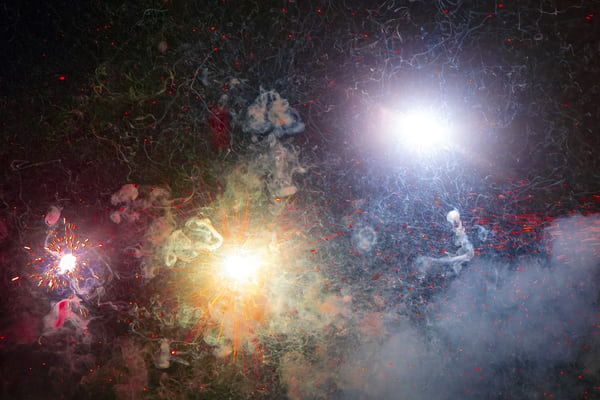
Depending on your belief of how the universe became, there are two most popular beliefs: the Big Bang, or that simply God created all of the universe and life. The Big Bang hypothesis states that about 13.8 billion years ago, all of the current and past matter in the universe came into existence at the same time. But, have you ever thought of what happened before the Big Bang? If nothing existed before the Big Bang, then how can something can just come from nothing? And how did that nothing become something?? According to Stephen Hawking,
“Asking what came before the Big Bang is meaningless, according to the no-boundary proposal, because there is no notion of time available to refer to. It would be like asking what lies south of the South Pole.”
He proposed that there’s no end, or beginning, at all.
Take a second and try to grasp that idea… Can’t grasp it? Me neither.
In relation to Hawking’s “no-boundary” principle, it is like looking at the tip of a pencil. Take the example picture of my pencil below:
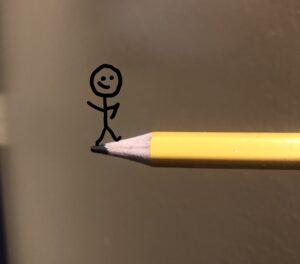
Just as the tip of the pencil has a diameter of zero at its top-most point and gradually widens as you move to the right — the universe smoothly expanded from a point of zero size. Very peculiar and mind-blowing, isn’t it?!?
2) ARE WE ALONE IN THE UNIVERSE?
To many people, there is no way that extraterrestrial beings cannot exist, even if they cannot see them. To others, aliens are a fantasy that has never, currently does not, and will never exist (except for E.T.). Dr. Zank and his colleagues from the University of Alabama in Huntsville within the Department of Space Science are among some of the scientists looking for the factors that make conditions optimal for exoplanets to fall into the “Goldilocks Zone”. The Goldilocks zone is where the planets are not too cold, nor too hot — but juuust right to possibly foster life.

There are lots of stars, called G-type or G-class stars, that are similar to our Sun. They radiate more light toward the infrared spectrum and they look promising for hosting exoplanetary life. Our nearest neighbors, Alpha Centauri A and Alpha Centauri B, look promising.
The Fermi paradox offers an interesting perspective about the absence of evidence for extraterrestrial beings. Italian-American physicist Enrico Fermi created the Fermi paradox, which is the apparent contradiction between high estimates for the probability of extraterrestrial civilizations and the lack of evidence, thereof. However, various solutions to the Fermi paradox belong to different categories, such as the ones included below, regarding aliens:
-
-
- They Are Here: Aliens visited Earth in the past and they left evidence, via Alien Artifacts/Hieroglyphics, UFO’s, and witnesses.
- They Are Us: We– the humans– are the descendents of them ancient alien civilizations and we are the aliens.
- They Exist, But Have Not Communicated With Us, Yet: Aliens do indeed exist, but they either have not had enough time to reach us, are signaling but we do not know how to interpret the signaling, they have no desire to communicate with us (because humans are dumb, duh), their technology is too advanced, or they are all dead because of various catastrophes (that humans will eventually face).
- They Obviously Do Not Exist: Life is extremely rare, planets with the “perfect” conditions are rare, and humans are the superior race.
-
Pick and choose your fighter as you will. I am not going to tell you which one to believe, but I will say that they can all be true — because we have not found evidence (or a lack thereof) of each possible solution.
3) IS THERE INHERENT ORDER IN NATURE, OR IS IT ALL JUST RANDOMNESS AND CHANCE?
The recognition of randomness and apparent chance can be outwardly shown through things like galactic evolution (ie: the formation of the Universe), biological evolution (ie: development of early life), and geologic phenomena (ie: volcanos, mountains, rivers, etc). However, these phenomena can also be described via the perspective that there is inherent order in nature. For example, some Darwinistic-like theories suggest that through natural selection, life and everything that exists on the planet now is the result of deterministic principles.
However, both are important to describe nature. Nature is neither chaotic nor orderly; and neither random nor deterministic. In classical physics, things are observed as the same result every time given the same initial conditions. However, also in physics, the Big Bang theory suggests that the universe was created suddenly, by chance of the right conditions.
So what gives? → A paradox.
A paradox such that chaos is deterministic, created by precise rules that do not involve any elements of chance. With this paradox, the future is completely determined by the past, but through time, small uncertainties accumulate upon each other — thus, even if a particular behavior is predictable in the short term, it remains unpredictable in the long run.

“Essentially, there is order in chaos: underlying chaotic behavior there are elegant geometric forms that create randomness in the same way as a card dealer shuffles a deck of cards or a blender mixes cake batter.” — Chaos, Scientific American Journal
Opposites truly do attract, in this case. I would have never thought of how order and chaos could mesh together so … naturally.
4) DO WE LIVE IN A SIMULATION?

The idea that we could be virtual beings living in a computer simulation means that our simulated environment would create perceptions of reality on demand, rather than simulate all of reality all the time. This is similar to a video game where only parts of a scene are rendered to be visible to a player.
According to Neil deGrasse Tyson, “Maybe that’s why we can’t travel faster than the speed of light, because if we could, we’d be able to get to another galaxy… So the programmer put in that limit”. A new analysis by Nick Bostrom of the University of Oxford shows that ‘the odds that we are living in base reality—meaning an existence that is not simulated—are pretty much even’.
Bostrom’s simulation argument showed that at least one of the following scenarios must be true:
1. Humans almost always go extinct before reaching the simulation-savvy stage.
2. Even if humans make it to that stage, they are unlikely to be interested in simulating their own ancestral past.
3. The probability that we are living in a simulation is close to one.
If you think that perspective is interesting, take a look further. On November 12, 2019, professors at the Georgia Institute of Technology debated on the question: “Do we live in a simulation?”. There were lots of interesting answers, including the one below by professor Hans Klein in the School of Public Policy:
“It’s a simulated world that we live in to the extent that we live in this world that arrives to us through media the nature of the simulation is that institutions have interests and the interests of the media corporations and the interests of the entities that are being reported on by the media corporations. They’re all actively shaping the information flows that come to the public, it’s quite significant […] A lot of effort is made to influence how our knowledge of the world is mediated and it’s done in such a way so that we will so we end up living in if we live on critically we live in a world that’s a bit of a bit of a fantasy world and it’s a fantasy world that reflects off in the interests of media institutions and powerful societal interests.”
In a sense, Klein is saying that we, as humans, are creating our own simulating reality through the media and information we consume and the powerful interests of society that media corporations help perpetuate. With this perspective, maybe we are living in base reality after all…
ALAS,
As mysterious as the universe can be, hopefully one day humans will be able to answer these questions with impeccable certainty. Maybe the universe or some higher power does not want us to know the truth about our universe… Or maybe simply, humans just are not advanced enough yet to grasp the true notions of our reality, origin, or purpose. Hopefully you are asleep by now (if you wanted to be), but if not, may the Universe always be with you!
SOURCES:
Ananthaswamy, Anil. “Do We Live in a Simulation? Chances Are about 50–50 – Scientific American.” Scientific American, Scientific American, 13 Oct. 2020, https://scientificamerican.com/article/do-we-live-in-a-simulation-chances-are-about-50-50/.
“Before the Big Bang: The Prehistory of Our Universe – Brian Clegg – Google Books.” Google Books, Brian Clegg, Aug. 2009, https://books.google.com/books?hl=en&lr=&id=3fZ0SM78LFsC&oi=fnd&pg=PP2&dq=what+happened+before+the+big+bang&ots=6aaH7pfy8I&sig=Gw6XKD59ZborhgRoidXqEaSqb88#v=onepage&q=what%20happened%20before%20the%20big%20bang&f=false. Accessed 10 Feb. 2021.
C. JOHN MANN; Randomness in Nature. ‘GSA Bulletin’ 1970;; 81 (1): 95–104. https://pubs.geoscienceworld.org/gsabulletin/article-lookup/81/1/95 Accessed 2 Mar. 2021.
Chaos. Scientific American, 1986, https://www.jstor.org/stable/pdf/24976102.pdf?refreqid=excelsior%3A9e5867f32c36ce9d2401f9b76c3af1cc. Accessed 26 Feb. 2021.
Cvitanović, Predrag, et al., editors. Professor Debate on the Topic – Do We Live In a Simulation? Georgia Tech Library, 12 Nov. 2019, https://smartech.gatech.edu/handle/1853/62045. Accessed 3 Feb. 2021.
Fermi’s Paradox.http://abyss.uoregon.edu/~js/cosmo/lectures/lec28.html. Accessed 18 Feb. 2021.
“If the Universe Is Teeming with Aliens … WHERE IS EVERYBODY?: Fifty … – Stephen Webb – Google Books.” Google Books, https://books.google.com/books?hl=en&lr=&id=Kp6g79LuKWEC&oi=fnd&pg=PA2&dq=do+aliens+exist&ots=aAMZyI0X6s&sig=0DONvBxxF8VTV6N37huhr3X5M5c#v=onepage&q=do aliens exist&f=false. Accessed 6 Mar. 2021.
“Physicists Debate Hawking’s Idea That the Universe Had No Beginning.” Quanta Magazine, Natalie Wolchover, 6 June 2019, https://www.quantamagazine.org/physicists-debate-hawkings-idea-that-the-universe-had-no-beginning-20190606/. Accessed 2 Mar. 2021.


