Step inside any novelty shop or theme park souvenir stand and you’re likely to find an assortment of rings that claim to do the impossible: reveal your innermost moods. But how in the world would a ring be able to tell?
Inside the ring
The magic inside a prototypical mood ring lies underneath a protective glass or plastic dome: a sealed capsule containing a thin layer of thermochromic liquid crystals (U.S. Patent No. 3,802,945, 1974). Liquid crystals exist at the border between liquid and solid phases, flowing and pouring like a liquid, but are structured as a crystalline, ordered, molecular arrangement. The liquid crystals in mood rings are thermochromic (thermo meaning heat and chromic meaning color), meaning the substance changes color on the macroscopic scale as heat is added to or taken away from the ring (University of Cambridge, n.d.).
The color change
There are many kinds of thermochromic liquid crystals, all with different applications e.g. display monitors and thermometers. However, the ones used in mood rings are specifically cholesterol-derived esters such as cholesteryl benzoate, cholesteryl nonanoate, and cholesteryl oleyl carbonate (Brown & Wolken, 1979).
Housed within a gel suspension inside the ring (LLNL, 2018), the molecular structure of these cholesterol derivatives acts as a microscopic diffraction grating, splitting incident white light into a variety of colors, as shown below.
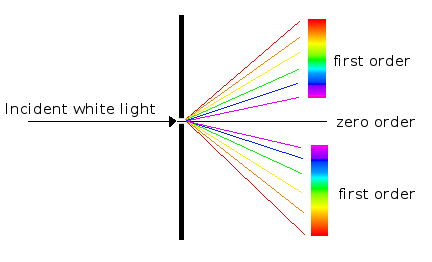
When heat from your body is transferred through the ring into the liquid crystal suspension, it causes the bonds within the molecule to twist, expand, and contract. As the bond lengths within the molecule shift, different wavelengths of light are reflected back to your eyes.
How are temperature and mood related?
While our bodies’ core temperatures remain a consistent 98.6°F, the slight shifts in temperature displayed within the mood rings are related to peripheral body temperature, the body temperature recorded at extremities. The temperature here fluctuates constantly depending on blood flow and environment (Campbell, 2008). For example, when you’re anxious, blood vessels in your hands become smaller (vasoconstriction), cooling your fingers down and causing the liquid crystal molecules to reflect amber or darker colors. When you’re relaxed or warm, blood rushes more freely to your fingertips (vasodilation), raising your skin temperature and allowing the liquid crystal display to reflect bright purples, greens, and blues (in a cholesterol-derivative based system).
Below is a video of thermochromic liquid crystals being prepared for use in heat-sensing films:
Sources
Brown, G. H., & Wolken, J. J. (1979). Liquid crystals and biological systems. Academic Press.
Campbell, I. (2008). Body temperature and its regulation. Anaesthesia & Intensive Care Medicine, 9(6), 259–263. https://doi.org/10.1016/j.mpaic.2008.04.009
Lawrence Livermore National Laboratory. (2018). A look back: LLNL and the mood ring. https://st.llnl.gov/news/look-back/llnl-and-mood-ring
National Center for Biotechnology Information. (n.d.). PubChem compound summary for CID 10874, Cholesteryl benzoate. PubChem. Retrieved from https://pubchem.ncbi.nlm.nih.gov/compound/Cholesteryl-benzoate
Reynolds, M. R., & Gruber, J. L. (1974). Liquid-crystal containing jewelry (U.S. Patent No. 3,802,945). U.S. Patent and Trademark Office. https://patents.google.com/patent/US3802945A/en
University of Cambridge. (n.d.). Liquid crystals [Teaching and Learning Package]. Dissemination of IT for the Promotion of Materials Science (DoITPoMS), Department of Materials Science & Metallurgy. Retrieved June 14, 2026, from https://www.doitpoms.ac.it/tlplib/liquid_crystals/printall.php