One of the most valuable experiences for any designer or innovator is the process of mastering new fields of knowledge to better guide and inform creative decisions. Almost every new problem or project requires designers to think of new ways to approach their solution or design. Manel Torres is the perfect example of this approach as he had to immerse himself in chemistry to develop what is now known as spray-on clothing. His work demonstrates how expanding beyond traditional design boundaries can lead to groundbreaking results with multiple applications! Torres’s invention really highlights how impactive ideas often emerge when disciplines intersect.
During Paris Fashion week in 2022 at the Coperni runway, Bella Hadid made a stunning performance as she stood there practically naked, while being sprayed with some white liquid material. Well, this material so happened to originate from the works of Manel Torres’ Fabrican. Inspired by silly string spray cans, Torres wanted to create a spray-on T-shirt from an aerosol can during his doctoral years at the Royal School of Art in London. With the help of Professor Paul Luckham from Imperial College’s department of Chemical Engineering and Chemical Technology, Torres was able to create the right formulation to produce something that can spray thin fabric onto a model (Melton, 2023). A featured article years back on the home page of the Guardian Newspaper, highlights the work of fashion designer Dr. Manel Torres who invented a spray that “forms a seamless fabric on contact with the body” (Amato, 2011). Along with the article was a video, showing Torres in a lab coat demonstrating his new innovation by spraying the torso of a male model with a liquid mix of fibers and polymers that instantly dried and solidified upon contact with the skin. The results came out to be a skintight t-shirt!
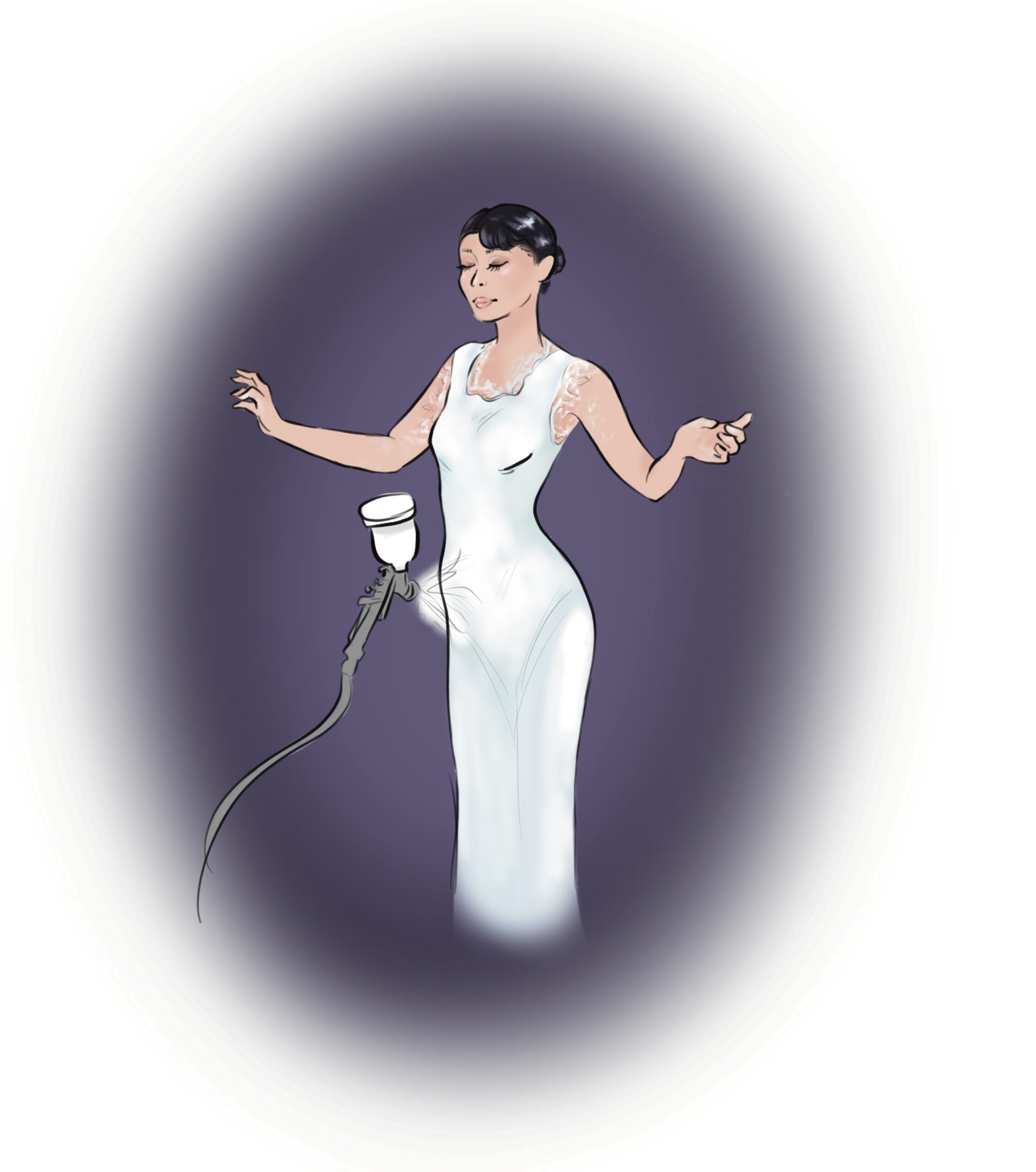
(source: drawn by An Truong)
So how is it possible for a liquid material to become something that you can actually wear?
Torres’ invention consists of a liquid mixture of short fibers that are suspended in a solvent that evaporates when exposed in the air, so that the spray turns into a solid non-woven non-knit material upon contact (Melton, 2023). It was made to be applied using an aerosol can or a spray gun that would be sprayed directly onto a person or onto a mannequin or mold, forming a fabric layer that can be thickened and strengthened by applying multiple layers. With this, you would be able to style, peel off, and shape the fabric as needed. The fibers themselves are biopolymers created from natural or synthetic sources such as corn starch, wool or mohair based keratin, hemp, or even collagen (Amato, 2023). Torres also experimented with various other kinds of fabrics and textures such as a paper-like texture, fleece, rubber, and lace. These fabrics and textures were able to be embossed, molded, and essentially patterned in any ways a designer wishes.
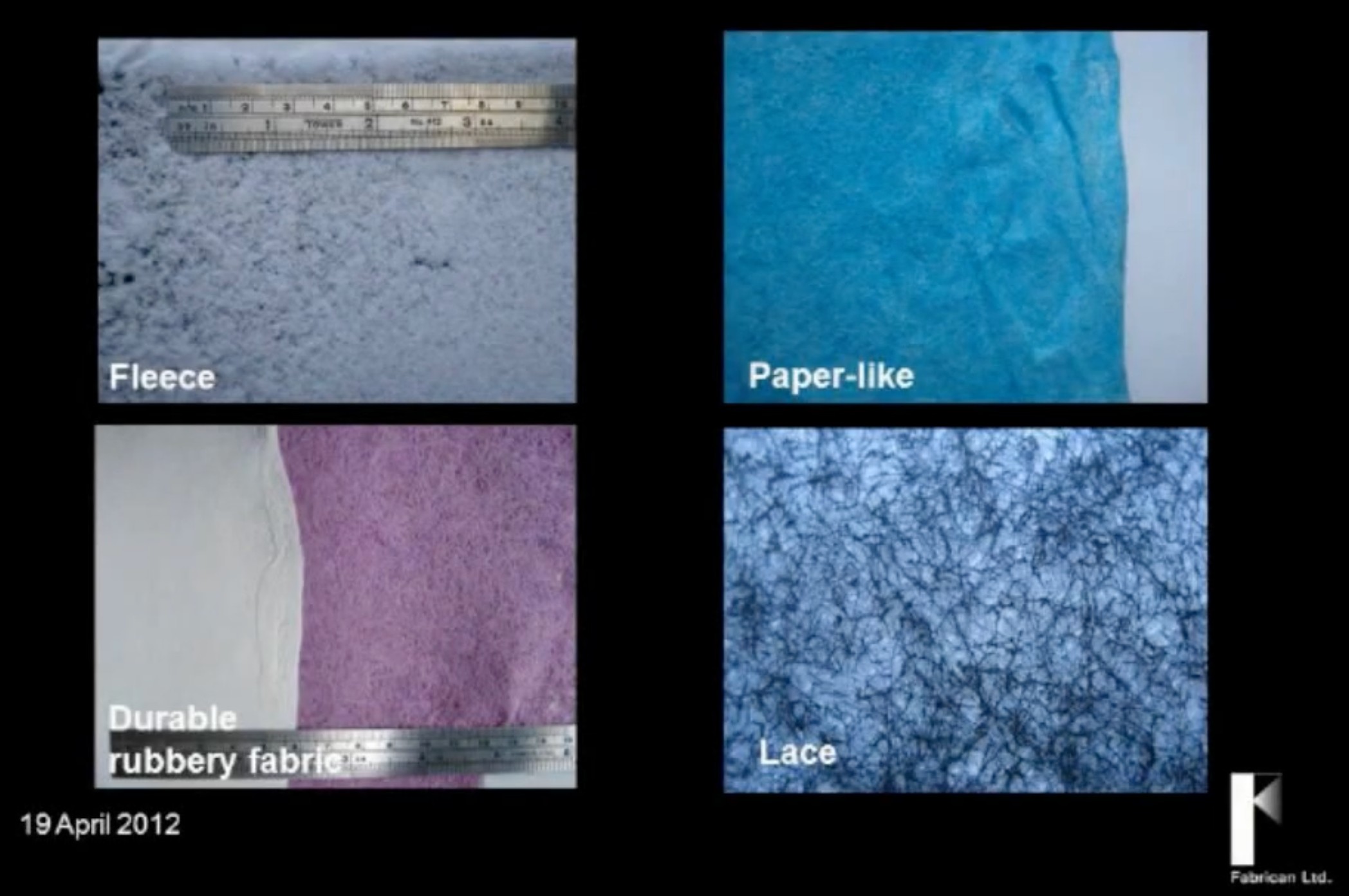
(source: TEDxTalk)
Further Application
Torres believes that his invention should be and can be used to create a wide range of products, including fashion, automotive components such as dashboards and interior fabrics, and for medical application such as bandages, instant sterile dressings, or drug delivery patches.
As any great designer and innovator would do, Manel Torres continues developing and improving his own works. In a TED TALK Torres gave in 2012, he mentions how he wants to push Fabrican to be fully reusable and sustainable as well as incorporate some kind of smart technology in the future. This is a great practice for designers and innovators alike as they should all reflect on their designs and continue to improve them even after its final outcome is presented.
Conclusion
Manel Torres’s work with Fabrican shows how innovation in design is truly never finished. It should evolve alongside new ideas, technologies, and needs. By continuing to refine his spray-on fabric with goals of sustainability, material and cost efficiency, and integration of smart technology, Torres sets a perfect example for future designers and innovators that creativity should not end at just the final invention or outcome, it instead continues to grow through constant iteration. Manel Torres’ process demonstrates how science and design can merge to create materials that are functional and adaptable. As Fabrican develops, it has great potential to reshape industries starting from fashion and expanding to fields such as medicine. Ultimately, Torres’s process and work encourages designers to think beyond traditional materials and to embrace experimentation and iteration. His brilliant vision for the future of clothing and textiles challenges the next generation to design with both imagination, experimentation, and research!
Citations:
Amato, Sarah. (2011). Fit to a T: Spray-On Clothing, Craft, Commodity Fetishism, and the Agency of Objects. Utopian Studies, 22(2), 285–302. https://doi.org/10.5325/utopianstudies.22.2.0285
Coperni. (2023, September 14). The making of a dress [Video]. YouTube. https://www.youtube.com/watch?v=YxObP6-ovdk
Melton, Lisa. The instant spray-on dress. Nat Biotechnol 41, 743 (2023). https://doi.org/10.1038/s41587-023-01829-1
TEDx Talks. (2012, April 26). Spray-On Fabric: Manel Torres at TEDxImperialCollege [Video]. YouTube. https://www.youtube.com/watch?v=EW6Gv-IoErw