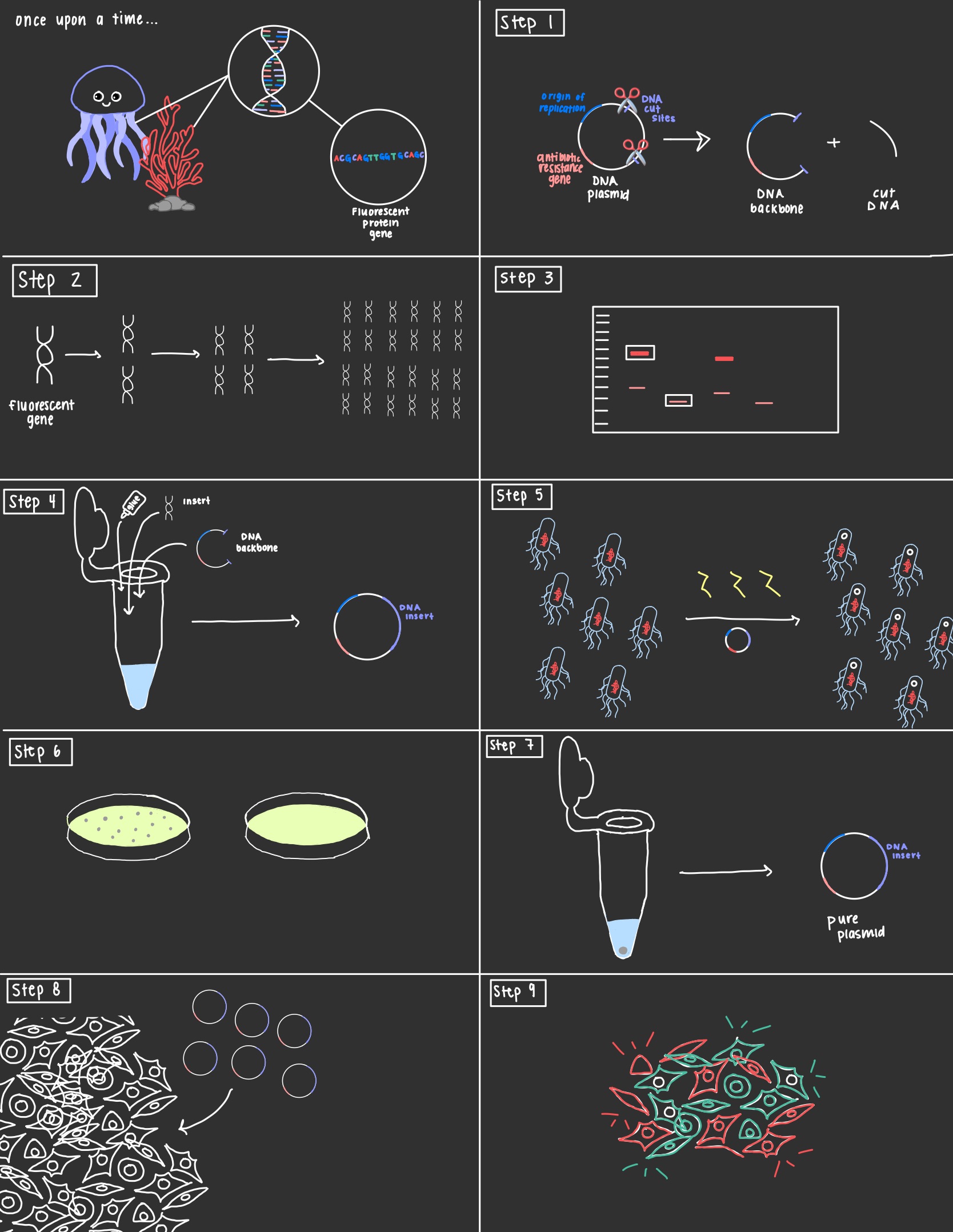
While these cells don’t technically glow in the dark, scientists have found ways to make cells fluorescent which means they glow when exposed to radiation such as UV light. When a cell has specific ions or proteins fluorescent proteins bind to these small molecules and make the cell appear as if it’s glowing.
These special proteins were first discovered in animals like jellyfish and plants like coral. Scientists were able to isolate the genes that were responsible for producing the fluorescent proteins and using a technique called molecular cloning can insert the DNA into our cells of choice.
Step 1: The first step is to choose a plasmid, a circular piece of DNA found in bacteria. The plasmid chosen must have an origin of replication where DNA replication begins, a gene for antibiotic resistance, and DNA cut sites. Restriction enzymes are proteins that act as molecular scissors and cut the plasmid at specific cut sites. This turns the circular plasmid DNA into a linear piece of DNA.
Step 2: This isn’t always necessary, but the fluorescent gene can be amplified using a technique known as polymerase chain reaction. In a PCR the DNA undergoes cycles of denaturation, annealing, and elongation where the DNA is first turned into single stranded DNA, then the primer tells the DNA where to start extending, and then finally the DNA is extended. At the end of each cycle the amount of DNA is doubled leading to millions of copies of DNA within an hour.
Step 3: By this point, we have our amplified PCR DNA and our plasmid DNA that has been cut to produce the backbone and pieces of cut DNA. In order to separate the backbone plasmid from the cut piece we will use gel electrophoresis. A gel electrophoresis separates DNA by size by passing an electric current through a gel containing DNA. Because DNA is negatively charged it will migrate towards the positively charged terminal of the gel with the smaller pieces traveling further than the larger pieces. Because our backbone is larger than the cut DNA, when the pieces separate we can cut out the band closer to the top, and purify it to get rid of the gel leaving just the DNA.
Step 4: It’s finally time to glue our DNA pieces together, and the key player is a protein known as DNA ligase. DNA ligase will be added to a tube with our DNA backbone and insert. Following a ligation reaction a plasmid will be re-formed that contains our original backbone with the fluorescent gene inserted in.
Step 5 and Step 6: The next two steps are crucial for ensuring that the final product is pure plasmid. This is important because the DNA ligase can make mistakes and may glue backbones together, fail to add in the insert, etc. In step 5 the plasmid is inserted into bacterial cells, usually e-coli cells through a heat shock. Once the bacteria take up the plasmid they are plated onto agar plates containing antibiotics and allowed to grow. Remember the three things every plasmid needs to include (hint: it’s an antibiotic resistance gene)? This is because when the cells are plated only those that have a fully formed plasmid will be able to grow.
Step 7: Now we can select a bacterial colony from our plate and using a process known as miniprep isolate the plasmid DNA from these cells.
Step 8: The plasmid DNA can then be introduced into your cells of choice. There are many techniques to accomplish this but a common one is called calcium phosphate transfection.
Step 9: TA-DA! Your cells should now glow under the right conditions!
Sources:
Ashwini, M., Murugan, S.B., Balamurugan, S. et al. Advances in molecular cloning. Mol Biol 50, 1–6 (2016). https://doi.org/10.1134/S0026893316010131