The Clock Within: Neurospora crassa
What is the science behind the clock?
How did the first person just acknowledge that “Oh it’s 12:00 p.m.”?
Wouldn’t it surprise you to realize that your body already knows time?
The human body has a natural mechanism to tell the precise time without any measuring device.
Even if a person was kept in complete darkness for many days, they won’t forget the time. They will still experience sleepiness and wakefulness but the cycle will gradually change without any synchronization with sunlight.
This question also aroused curiosity in the minds of researchers, but none could have predicted that bread mold would provide the solution.
In 1959, scientists began studying an orange bread mold by the name of Neurospora crassa.
I even did a test like this myself, leaving bread out for several days just to observe what happened to the mold (seen below).
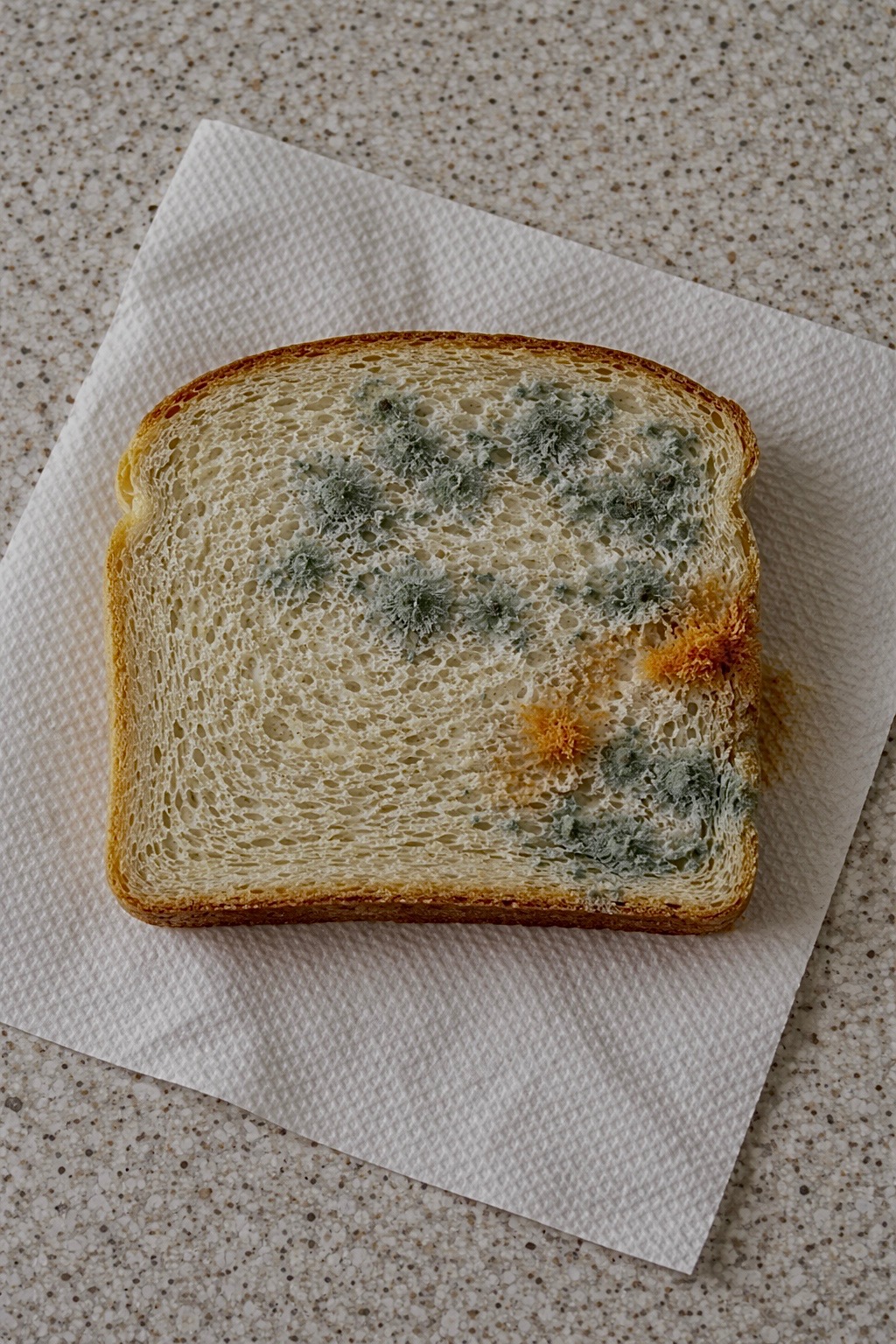
Somehow, this small organism allowed scientists to understand how living things, including humans, keep track of time using a biological clock.
It did not seem too important at first. But as soon as they took it into their laboratory, it did something rather unusual. They placed the fungus in complete darkness, with no sunlight, not even a single outside signal. The fungus could not tell what time it was. Even then, it still grew in certain patterns (Castro-Longoria et al., 2010). It repeated in a consistent cycle, as though the organism already knew what a day looked like.
This insight changed the perspective on time.
Scientists such as Jay C. Dunlap and Jennifer J. Loros concluded that organisms do not just respond to time but keep an internal clock that runs in cycles (Castro-Longoria et al., 2010). Such a system came to be called a circadian rhythm, meaning “biological rhythm occurring every 24 hours.”
Scientists later discovered that this clock runs through interactions among genes and proteins in a cycle. A vital part of this cycle includes a gene whose job is to create a certain type of protein named FRQ (frequency) (Baker et al., 2011).
When the FRQ protein accumulates in the body, it stops being produced. When this protein degrades, production resumes. Through this process, a continuous cycle is formed, allowing time to be regulated. This is known as a negative feedback loop, where a system turns itself on and off (Baker et al., 2011).
This system is not simple. However, there are other genes, which help the organism to sense light. These are collectively referred to as the “white collar” genes (WC-1 and WC-2). They work together in a cycle and are almost always around 24 hours in duration despite any change in the environment.
Humans function with a similar system.
The human brain has an intricate structure called the Suprachiasmatic Nucleus (SCN), which serves as the timekeeper for the organism, regulating physiological processes like sleep, hormone secretion, and body temperature. Just like in fungi, the circadian rhythm is regulated via protein-gene feedback loop mechanism.
Circadian rhythms have been observed across different organisms, suggesting that the biological mechanism for keeping time is ubiquitous and therefore fundamental for any living thing (Aramayo & Selker, 2013).
This was actually quite simple. Our internal clock had always been around.It was only when Neurospora crassa revealed itself that we realized its existence.
References:
Baker, C.L., Loros, J.J., & Dunlap, J.C. (2011). The circadian clock of Neurospora crassa.
https://pmc.ncbi.nlm.nih.gov/articles/PMC3203324/
Aramayo, R. & Selker, E.U. (2013). Neurospora crassa, a Model System for Epigenetics Research.
https://pmc.ncbi.nlm.nih.gov/articles/PMC3783048/
Case, M.E., Griffith, J., Dong, W., Tigner, I.L., Gaines, K., Jiang, J.C., Jazwinski, S.M., Arnold, J., (2005). The aging biological clock in Neurospora crassa.
https://pmc.ncbi.nlm.nih.gov/articles/PMC4228622/
Castro-Longoria, E., Ferry, M., Bartnicki-Garcia, S., Hasty, J., Brody, S. (2010). Circadian rhythms in Neurospora crassa: Dynamics of the clock component frequency visualized using a fluorescent reporter
https://www.sciencedirect.com/science/article/pii/S1087184509002242