Introduction:
You step outside on a warm summer night to see a dark sea with little, intermittent flashes of light. Catching fireflies is a nostalgic childhood memory for people all across the globe. But what allows these bugs to produce this soft glow?
Fireflies produce their light through bioluminescence, an efficient light production process resulting from a chemical reaction. While the light comes naturally from fireflies, scientists are trying to understand how to replicate this process for medical research applications with the same ease as fireflies.
How does this chemical reaction work?
While the chemical reaction itself is relatively straightforward, fireflies have to carefully control when to light up. This bioluminescent process takes place in a special light producing organ in the abdomen. Within this organ, adenosine triphosphate (ATP), which stores energy in living cells, combines with oxygen, calcium, and luciferin with luciferase, the fireflies emit light (Branham, 2005).
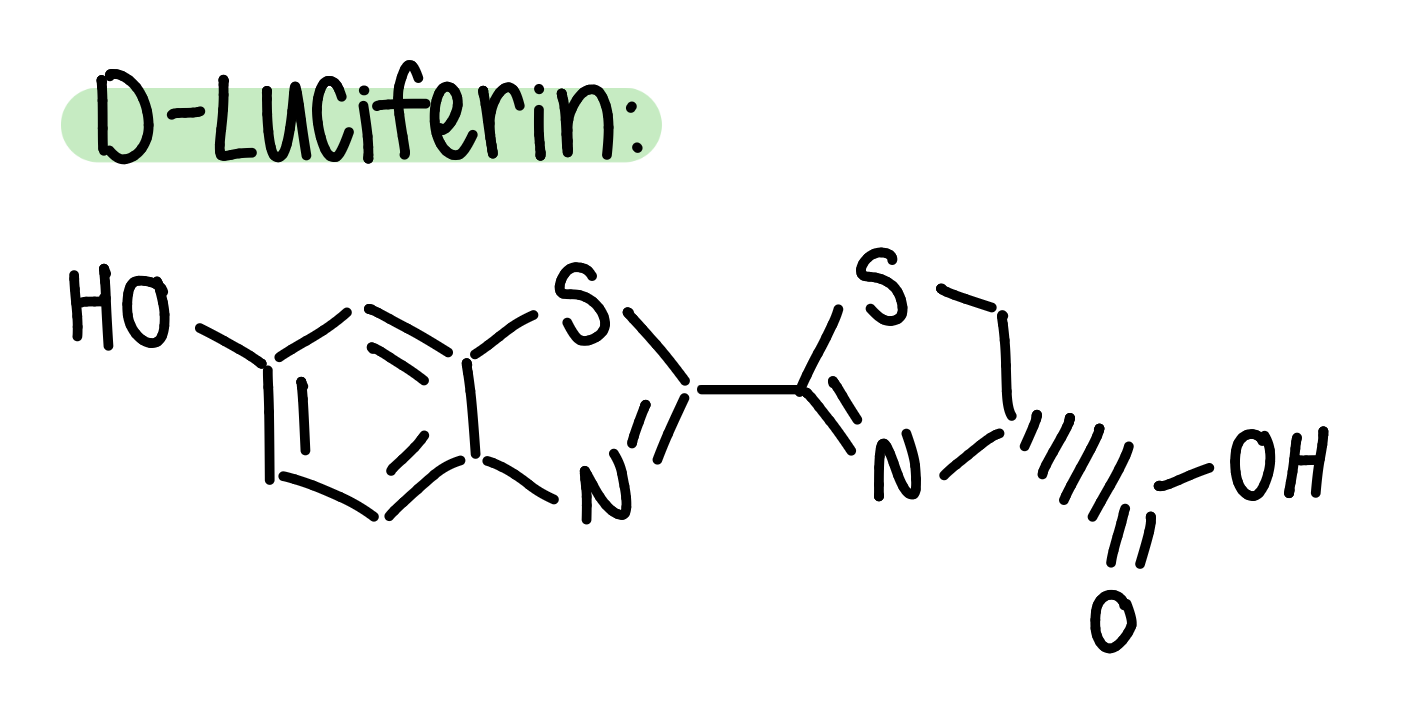
Fireflies can control the flow of oxygen into the photocytes, which is part of the light-producing organ. When oxygen enters the photocytes, it reacts with the luciferin in the presence of luciferase, an enzyme, and ATP and produces light (Martin, n.d.). When oxygen is allowed to flow into the photocytes, light is emitted.
Recent studies suggest that fireflies evolved to have biochemical pathways for the production of luciferin and the regulation of the reaction (Zhang et al., 2020). This allows for the fireflies’ bioluminescent system to be highly effective as the energy dissipated from this reaction is emitted as light instead of heat (Zhang et al., 2020). This efficiency has proven to be difficult to replicate without these adaptations, which is why scientists are trying to recreate the process in a laboratory.
How does this Chemical Reaction Work in the Lab?
Researchers at Nagoya University in Japan have created a six-step synthesis for D-Luciferin, which is the specific stereoisomer, or orientation, of luciferin that binds with luciferase to produce light using p-benzoquinone, L-cysteine methyl ester, and D-cysteine (Kato et al., 2025).
This synthesis is designed to replicate the natural production of luciferin with greater efficiency and lower costs. The synthesis is done in a one-pot reaction to streamline the process and make it applicable on a larger scale (Kato et al., 2025). While this synthesis has successfully yielded D-luciferin, creating an artificial version of the full biological system of fireflies, especially with the control of oxygen flow, remains a challenge.
The efforts of the researchers at Nagoya University show the complexity of replicating a naturally optimized biochemical process. But why are scientists investing so much into recreating firefly bioluminescence?
Why are Scientists Studying this Process?
Scientists have investigated the mechanism of the bioluminescent process of fireflies due to the emission’s application in medical imaging, including cancer research as a way to locate tumors (Martin, n.d.). However, the cost of producing the same reaction that fireflies do every night, every summer for free is quite expensive, driving the motivation for scientists to create the most efficient, cost and time-wise, synthesis for D-Luciferin (Kato et al., 2025).
Conclusion
What appears to be a piece of summer nostalgia is actually a highly optimized biochemical process. By controlling the reaction between luciferin, luciferase, ATP, and oxygen, fireflies are able to make a chemical reaction a mesmerizing scene.
Scientists are studying the process of firefly light production to make the synthesis of D-luciferin more accessible for research and medical applications. The same soft glow that lights up a warm summer night is now contributing to science and medicine, showing how even the smallest of animals and insects can lead to scientific progress.
References:
Branham, M. (2005, September 5). How and why do fireflies light up? Scientific American. Retrieved April 17, 2026, from https://www.scientificamerican.com/article/how-and-why-do-fireflies/
Kato, M., Tsuchihashi, K., Kanie, S., Oba, Y., & Nishikawa, T. (2025, December 25). A practical, biomimetic, one-pot synthesis of firefly luciferin. Nature Science Reports, 14(1). https://doi.org/10.1038/s41598-024-82996-2
Martin, K. (n.d.). Everything About Luciferin and Luciferase. GOLDBIO. Retrieved April 17, 2026, from https://www.goldbio.com/blogs/articles/everything-about-luciferin-luciferase?srsltid=AfmBOoo5RwdWL6Aa1C7Lu7UK2e9LLM0KLTmjIYMHJmoU7DI5741Ww0Qa
Zhang, R., He, J., Dong, Z., Liu, G., Yin, Y., Zhang, X., Li, Q., Ren, Y., Yang, Y., Liu, W., Chen, X., Xia, W., Duan, K., Hao, F., Lin, Z., Yang, J., Chang, Z., Zhao, R., Wan, W., … Li, X. (2020, September 28). Genomic and experimental data provide new insights into luciferin biosynthesis and bioluminescence evolution in fireflies. Nature Science Reports, 10(1). https://doi.org/10.1038/s41598-020-72900-z