Marie Tharp: An Idol for Female Scientists

You’ve all heard about the theory of continental drift, right? You’ve heard of Pangaea and how the tectonic plates move around? This is something I remember learning about in elementary school and have always thought of as a theory that has been accepted universally for hundreds of years or so. When we look at world maps, it’s so obvious that the continents would fit together like a puzzle. I recently learned on a visit to Columbia University about the work of Marie Tharp, a woman who worked at the university and made breakthrough ocean floor mapping discoveries that started this theory.
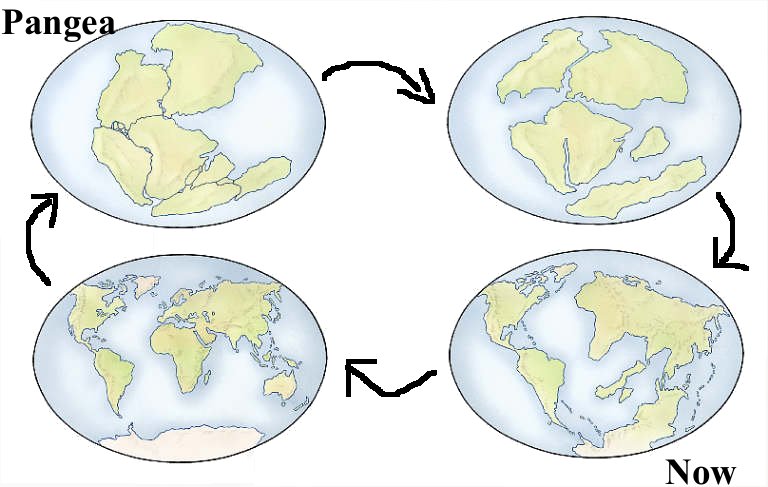
A simple model of the supercontinent Pangaea turning into the 7 continents we have today via continental drift

Marie’s map wasn’t published until 1959. This was one year after my father was born. He was born into a world that didn’t know about tectonic plate movement or that the seven continents used to be one big continent. To me that’s like being born into a world where most people still think the Earth is flat. In addition to Marie’s work dramatically improving human knowledge of the Earth, her work was impressive because she did it during a time that belittled any ground breaking work done by a female. Whether people realize it or not, she drastically changed the way we understand the Earth and the way people look at the work of females.

As a female researcher who wants to get my PhD and spend the rest of my life studying the Earth, I find it hard at times just to motivate myself to keep going down this path of endless studying, reading, and working. I realize my struggles are trivial compared to Marie’s. She conducted great science all while battling sexism. Before 1970, women made up less than 4% of all doctorate earth scientists, as they were discouraged from studying geoscience. Despite society telling her to pursue other work, Marie did what she could to contribute to geoscience. She worked as a drafter at Columbia University. Because she was not allowed on the ships that were gathering data in the field, she stayed in New York where the men would send the data they were collecting from the ship. The men on the ship, which set sail in 1953, were collecting sonar data to determine how deep the ocean floor was and to understand ocean floor topography. At the time, they assumed the ocean floor was flat because they had no data to believe otherwise.
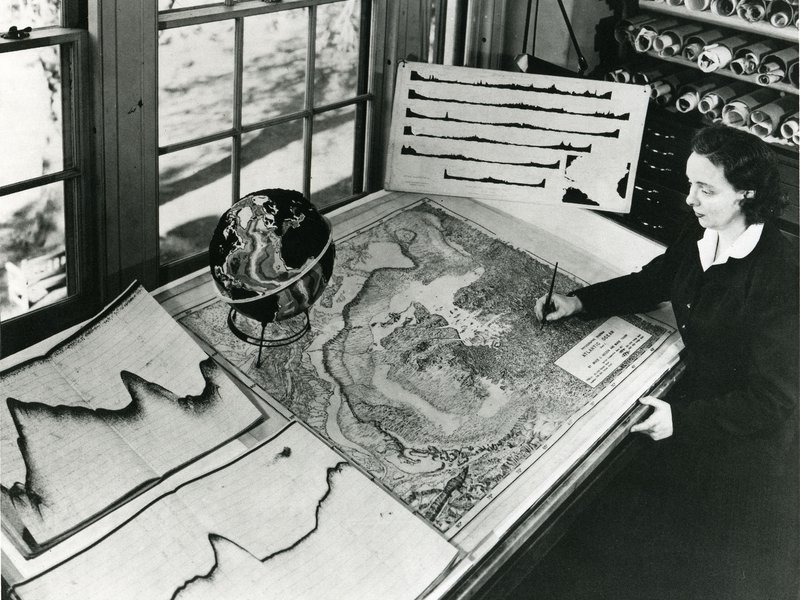
Marie hard at work turning sonar data into a map of the ocean floor

The ship spent years sailing around the world and sending data to Columbia. Marie spent just as much time back in New York crunching the numbers and turning the data into a map of the ocean floor. Because this was a time before computers, Marie mapped out each point by hand. Her first major discovery was the giant rift valley down the bottom of the Atlantic Ocean–what is now called the mid-Atlantic ridge. This had never been previously discovered but is now known as the fault line where the Eurasian and North American tectonic plates are pulling apart. As she continued to draw out the data, she saw more of these large topographic features on the ocean floor. When Marie completed the map, she showed it to the men that were on the ship and they dismissed the theory of continental drift as “girl talk” and refused to believe that she analyzed the data correctly. A few decades earlier, Alfred Wegener proposed the idea of continental drift but it was largely rejected due to lack of sufficient data. Even now, with a map of ocean topography showing robust evidence for continental drift, the theory was still rejected because the evidence was proposed by a woman.

Marie was forced to check and recheck her work for months due to their pessimism of the quality of her work. It was not until over a year later that people started to accept her map and her theory, when seismic data was collected at the bottom of the Atlantic Ocean supporting her map of the mid-Atlantic ridge. By 1959, the map was widely accepted and published. However even when her map was accepted, she was largely cheated out of credit for her work. The collectors of the sonar data were the primary owners of the map, with Marie receiving partial credit for her years and years of analysis and mapping. Not only did she solely calculate and draft the topographic data, but she was responsible for igniting the acceptance of the theory of continental drift. She revolutionized the way we see the Earth today, yet received minimal credit, pay, and status in the scientific community.

Only within the last few decades has Tharp been credited for her significant contributions to geological sciences. Her name is now the primary author on most ocean bathymetry maps, as it should be. These maps are seen all over the world and are used to understand tectonic plate dynamics, predict earthquakes, and so much more, to better understand both the past and future of our beloved planet Earth.
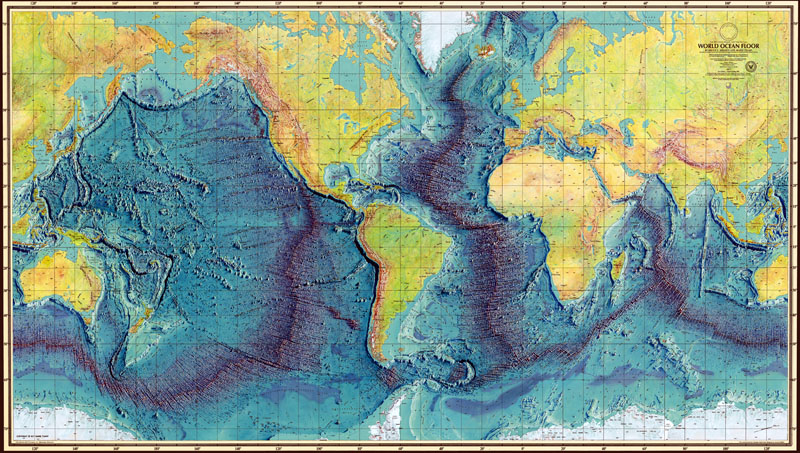
The final published version of a Marie Tharp ocean bathymetry map

Your journey starts here! Let’s talk!

ThemeRex © 2026. All rights reserved.
  Timothy Durham was convicted of rape when a test showed his DNA genotype matched the DNA recovered from the crime scene. Eye witnesses testified that Durham was in a different state at the time of the incident, but he wasn’t exonerated from his 3000 year sentence until follow up DNA analysis showed that the preliminary forensic analysis used in the trial was misinterpreted (Thomas et al.). DNA testing serves an invaluable part in our criminal justice system, but it comes with complications and bias that can lead to wrongful convictions and misinformed juries.  

Background:

Forensic genetics aims to identify the origin of a biological sample. It can be traced back to Karl Landsteiner who discovered human ABO blood groups. With blood groups, suspects could be eliminated based on their blood type. For example, if a suspect had type A blood and there was type B blood left at the scene by the perpetrator, the investigators could rule out the suspect. Unfortunately, the reverse didn’t work. If the suspect and perpetrator both had the same blood type, it can’t be concluded that the suspect was guilty. Blood identifiers evolved into 8 distinct categories which improved the ability to eliminate suspects, but could only conclude that (if the system matched) it might be the perpetrator or this person might be related to the perpetrator (Jobling and Gill). The field evolved in the 1980s with the discovery of Minisatellites, lines of repetitive DNA that don’t encode proteins. Minisatellite patterns in DNA create what we know today as the DNA fingerprint, and it has a much higher accuracy rate than previous methods (Augustyn et al.). Around the same time, a breakthrough for victims of sexual assault was discovered. In the case of assault, bodily fluids of both the victim and the assaulter can get mixed. A process called differential lysis was created which could selectively increase the concentration of sperm in a fluid sample thereby allowing for accurate DNA testing (Jobling and Gill). Forensics evolved to use single-locus probe testing after several years because of its ease of interpretation. It looked at specific minisatellites that had high variability between subjects. This was the first DNA-based method to be used in a criminal investigation. Two murder homicides from several years apart were connected using DNA evidence. The evidence was then used to exonerate an innocent man, and the guilty party was found when he tried to evade mandatory DNA testing for all men in the small town. His guilt was then reinforced when the DNA profiles matched, and he gave a confession (Jobling and Gill). Finding DNA at a crime scene doesn’t guarantee that you’ll find a murderer. There are issues with non-pure samples and limited samples that make DNA work difficult, and accreditation of facilities and new techniques and take time (Jobling and Gill).  

Subjectivity of DNA Interpretation:

In a 2009 publication, the National Academy of Science discusses the possibility for subjective influence in lab based forensics. The interpretation bias happens in complex cases where, for example, there could be a mixture of DNA. A study published in 2011 looked specifically at this issue. A gang rape happened in Georgia, and the mixture in DNA from the case was used to prosecute one suspect after another suspect took a plea bargain to testify against him. With DNA mixtures, there are three possible conclusions: suspect excluded, suspect cannot be excluded, and inconclusive. If the suspect is excluded, it means that there’s little to no possibility that his DNA is part of the sample. If the suspect cannot be excluded, it means that there’s a possibility that his DNA is part of the sample. In the trial, the DNA examiners who knew the context of the case concluded that the suspect being prosecuted could not be excluded. The 2011 study gave the DNA evidence from this case and the DNA profiles of the suspects to 17 forensic examiners. These examiners had no context of the case, and they all worked independently. Of the 17, only 1 came to the same conclusion (suspect cannot be excluded) as the examiners who knew the context of the case. Twelve of the 17 concluded that the suspect who was prosecuted and convicted had no relation to the DNA found in the sample. Not only does this show that subjectivity occurs due to the context of the case, but the 17 examiners came up with different findings based on their past experiences meaning that not all DNA analysis is objective. Some organizations like the Scientific Working Group on DNA Analysis Methods say that quantitative statistical evidence should be presented with every categorical conclusion, but the US doesn’t require this (Dror and Hampikian).

False Positives:

There are two categories that cause wrongful identification in a DNA report: coincidental matches and false positives. Coincidental matches are DNA matches between two unrelated people. The probability of these matches is about 1 to 500,000 for white individuals and about 1 to 350,000 for black individuals. This small probability of coincidental matches makes people feel confident in DNA evidence. False positives, on the other hand, are matches between DNA and test DNA that result from issues in the forensics lab. There have been multiple cases of forensics labs accidentally switching victim and suspected rapist DNA which lead to convictions that were later overturned when the lab realized the error. There are also cases of misreading or misunderstanding a sample. In a case from 1993, a man was convicted of rape because someone interpreted a mixed sample of victim and perpetrator DNA as an individual sample. The conviction was again overturned. To prevent false convictions, retesting DNA is allowed, but it’s not an efficient solution. Many people are pushing for statistical information on the probability of false positives, so that the jurors can make accurate judgements based on DNA evidence (Thomas et al.).  

Conclusion:

DNA analysis is a useful tool for the criminal justice system, but subjectivity can be an issue in forensic testing. To combat wrongful convictions, there are organizations like The Innocence Project who use DNA testing to free the innocent, but reformed forensic testing standards should be put in place to prevent subjectivity and to ensure juries are correctly informed during trials. https://www.innocenceproject.org/    

Citation:

Augustyn , Adam, et al. “DNA Finerprinting.” Encyclopedia Britannica , 26 Apr. 2018, www.britannica.com/science/DNA-fingerprinting#ref153186. Dror, Itiel E., and Greg Hampikian. “Subjectivity and Bias in Forensic DNA Mixture Interpretation.” Science & Justice, vol. 51, no. 4, 2011, pp. 204–208., doi:10.1016/j.scijus.2011.08.004. Jobling, Mark A., and Peter Gill. “Encoded Evidence: DNA in Forensic Analysis.” Nature Reviews: Genetics, vol. 5, no. 10, Oct. 2004, pp. 739–751., doi:10.1038/nrg1455. Thompson, William C, et al. “How the Probability of a False Positive Affects the Value of DNA Evidence.” Journal of Forensic Sciences, vol. 48, no. 1, Jan. 2003, pp. 1–8., doi:10.1520/jfs2001171.