Livestock and agriculture produce roughly 10% of global greenhouse gas emissions.
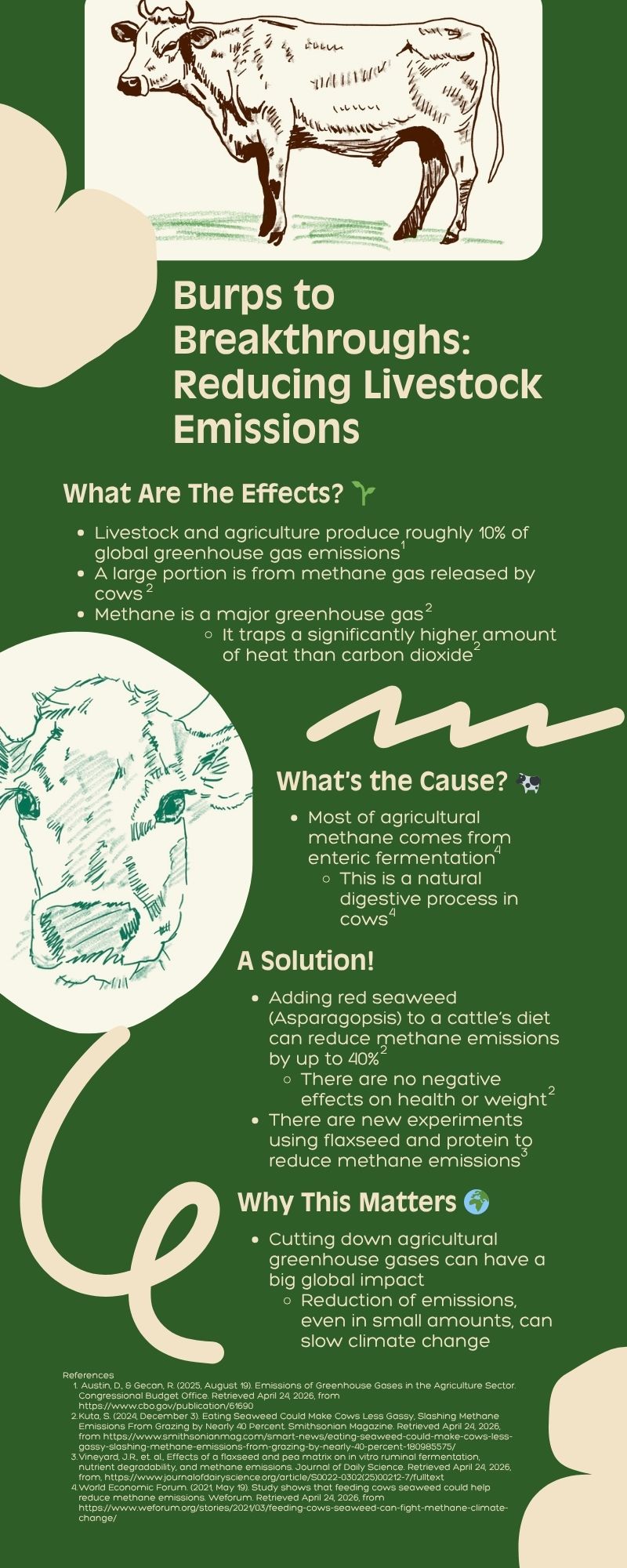
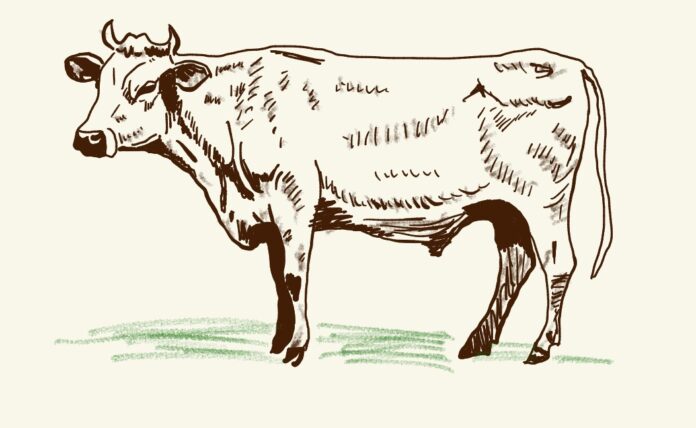
A large portion is from methane gas released by cows.
Methane is a major greenhouse gas
It traps a significantly higher amount of heat than carbon dioxide.
What’s the Cause? 🐄
Most of agricultural methane comes from enteric fermentation.
This is a natural digestive process in cows.
A Solution!
Adding red seaweed (Asparagopsis) to a cattle’s diet can reduce methane emissions by up to 40%.
There are no negative effects on health or weight.
There are new experiments using flaxseed and protein to reduce methane emissions.
Why This Matters 🌍
Cutting down agricultural greenhouse gases can have a big global impact.
Reduction of emissions, even in small amounts, can slow climate change.
References
Austin, D., & Gecan, R. (2025, August 19). Emissions of Greenhouse Gases in the Agriculture Sector. Congressional Budget Office. Retrieved April 24, 2026, from https://www.cbo.gov/publication/61690
Kuta, S. (2024, December 3). Eating Seaweed Could Make Cows Less Gassy, Slashing Methane Emissions From Grazing by Nearly 40 Percent. Smithsonian Magazine. Retrieved April 24, 2026, from https://www.smithsonianmag.com/smart-news/eating-seaweed-could-make-cows-less-gassy-slashing-methane-emissions-from-grazing-by-nearly-40-percent-180985575/
Vineyard, J.R., et. al., Effects of a flaxseed and pea matrix on in vitro ruminal fermentation, nutrient degradability, and methane emissions. Journal of Daily Science. Retrieved April 24, 2026, from, https://www.journalofdairyscience.org/article/S0022-0302(25)00212-7/fulltext
World Economic Forum. (2021, May 19). Study shows that feeding cows seaweed could help reduce methane emissions. Weforum. Retrieved April 24, 2026, from https://www.weforum.org/stories/2021/03/feeding-cows-seaweed-can-fight-methane-climate-change/