When scientists or politicians begin to talk about climate change, most people become scared by the severity of the issue at hand, thinking there’s not a lot left for us to do. This fear-mongering tactic typically discourages individual actions like recycling or moving away from meat-focused diets. Scientists surely don’t want to scare the public with the truth, but the fact of the matter is that if we don’t do something now, our generation and all generations to follow will not have a safe or even comfortable planet to live on. This leads us to the question: what exactly can we do to prepare for and mitigate the coming decades of destruction and chaos?
The first step to approaching the threat of climate change is to understand the impact we’re facing. To do so, we consider contributing factors in their current capacity that are predicted to change; by observing these patterns early on, it will be easier to assess the risk to infrastructure and communities. Variables that have the capability to become dangerous in the future include global sea level, atmospheric temperatures, ocean acidification, and glacial stability [4, 6]. The severity of predicted impact depends on the response of all of these variables to atmospheric carbon dioxide and other pollutant levels that have already increased global temperature. Scientists anticipate a 68% likelihood of 1-4 feet of sea level rise as a result, with 10 feet being the worst case scenario [1, 4]. With these predictions come the growing probability of worse hurricane seasons due to increased storm surge and extreme precipitation [4]. Even now we see worsening severity of weather events compared to 20 years prior and flooding during high tides in areas below sea level [1].
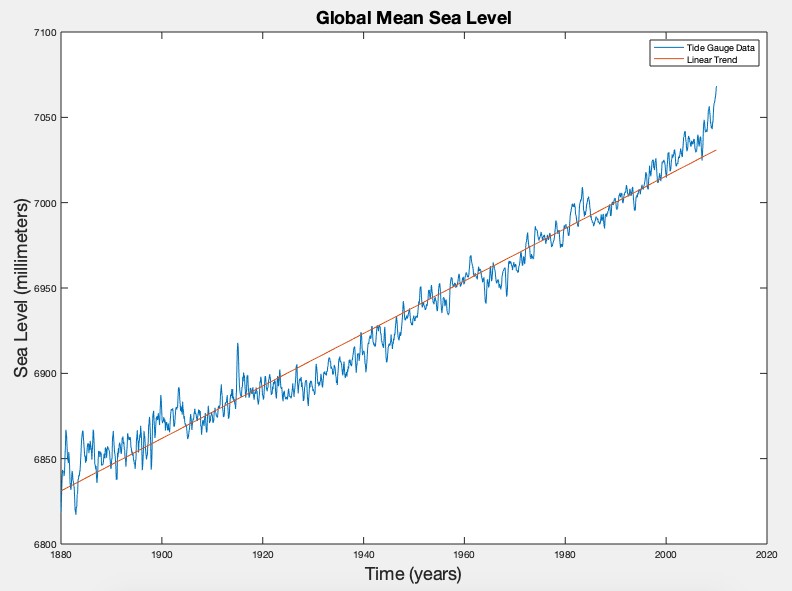
Conveniently, scientists have been monitoring sea level globally for nearly 200 years. However, gauging sea level is a bit more difficult than sticking a ruler somewhere on the coast and guessing the relative position over time. In 1807, Thomas Jefferson ordered a systematic survey utilizing “tide staffs”, or long poles that researchers used to compare sea level with a fixed point on nearby land [2]. It wasn’t until 1851 that the US coast guard implemented self recording tide gauges, but the device was still difficult to maintain and expensive to install [2]. Today’s advanced technology records the sea surface height via radar, or microwaves, with respect to the position of the gauge above the water. These gauges are a step up from acoustic gauges that must be protected from inclement weather, and cost upwards of $1300 [1, 2]. Although we have about 200 years of global sea level data, moving onto more reliable and cost efficient methods of measuring current and future sea level change is necessary for any chance of adaptation.
Dr. Kim Cobb and Dr. Russ Clark of Georgia Tech have spearheaded a project as a key initiative of the Global Change Program to provide low-cost tide gauges for Georgia coastlines. The Smart Sea Level venture is focused on particularly high risk regions, such as Chatham county. These $300 devices currently measure the relative sea level, air temperature, and barometric pressure, with planned capabilities to observe ocean properties, air quality, and inland flooding [5]. The smart sea level sensors use the roundtrip travel time of ultrasonic waves to measure the distance from the sensor to the water level. They log measurements every ten minutes, enabling their batteries to last one year or longer [5]. Already Georgia Tech scientists and collaborators can simulate tides, hurricanes, and extreme weather events via 43 strategically placed sensors [1, 5]. With this data, we’re moving towards predicting the flood patterns linked to severe weather events as atmospheric temperatures and sea levels continue to rise.
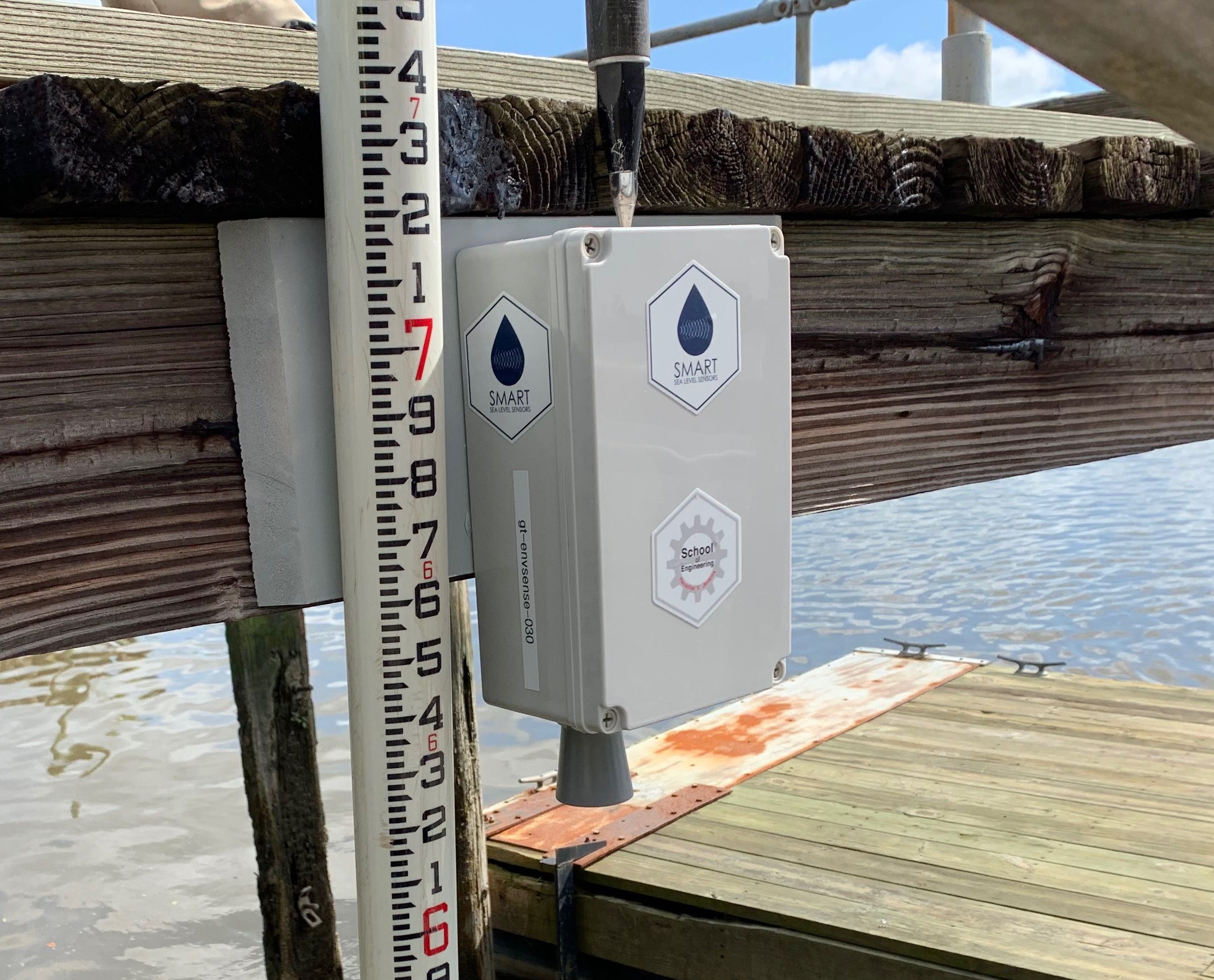
As storm surge severity increases, so does the compounded risk of damaging communities beyond repair, which is the true threat of forthcoming extreme weather events. Many low income areas don’t have the resources to assist with evacuation or the infrastructure resilient enough to survive mass flooding. The smart sea level sensor project has led to close collaboration with these communities to provide information on the regions they’re most concerned with: air quality, temperature changes, and the future safety of family neighborhoods and K-12 school grounds [1]. Already the team has joined up with H. V. Jenkins School and Oglethorpe Charter Middle School [7] to recruit volunteers for engineering and installation, and test a climate literacy curriculum, respectively.
Now the question is to ask, what’s left to do? My personal answer would be to riot and do all we can to support this initiative, but that seems a little drastic. Increasing educational partnerships with high schools and elementary programs would improve awareness amongst the younger generations who are bound to be affected more by climate related concerns. Furthermore, getting into contact with legislators, particularly within the Georgia General Assembly would provide useful in terms of allocating funds towards this cause. With legislators on board, it’s possible legal action could be taken to prevent further damage towards vulnerable communities in areas like Chatham County. Programs such as incentivizing corporate relocation or the mitigation of current industrial hazards, could go a long way in establishing baselines for future climate change strategy. While most legislation to be passed will need to be from within the county, or even at the state level , it wouldn’t hurt to reach national recognition. By promoting climate literacy across the United States, we can increase the number of volunteers assisting with future adaptation, and motivate Congress to aid in the process of protecting these at risk communities [8].
If you’re interested in supporting this cause, check out the following volunteer and educational opportunities:
- Implement climate literacy educational programs in your high schools or middle schools
- Volunteer or intern for the Smart Sea Level Program
- Contact your local representatives to ask about tide gauge installation
References:
- Cobb, K. (2019, January 24). Smart Sea Level Sensors – Chatham County. Retrieved from http://smartcities.gatech.edu/sites/default/files/GA-Smart-Webinar_Smart-Sea-Level-Sensors_1-24-2019.pdf
- Dusto, A. (2014, August 4). Reading between the tides: 200 years of measuring global sea level: NOAA Climate.gov. Retrieved from https://www.climate.gov/news-features/climate-tech/reading-between-tides-200-years-measuring-global-sea-level
- Georgia, S. (n.d.). Office of Sustainability. Retrieved from https://www.savannahga.gov/507/Office-of-Sustainability
- Lindsey, R. (2019, November 19). Climate Change: Global Sea Level: NOAA Climate.gov. Retrieved from https://www.climate.gov/news-features/understanding-climate/climate-change-global-sea-level
- Matthews, R., Cobb, K., & Clark, R. (2019). FAQ. Retrieved from https://www.sealevelsensors.org/faq/
- Ocean Acidification. (n.d.). Retrieved from https://www.noaa.gov/education/resource-collections/ocean-coasts-education-resources/ocean-acidification
- Jarvis, K. (2019, May 16). Smart Sea Sensors Expo Highlights Accomplishments and Shares Future Plans. Retrieved from https://www.news.gatech.edu/2019/05/16/smart-sea-sensors-expo-highlights-accomplishments-and-shares-future-plans
- US Department of Commerce, & National Oceanic and Atmospheric Administration. (2005, December 19). NOS Education Offering. Retrieved from https://oceanservice.noaa.gov/education/literacy.html