Should We Be Worried About Zombie Pathogens?

In the summer of 2016, Arctic regions such as Siberia and Greenland were hit with an unusual heat wave. As plants grew and water levels rose, a thick layer of permafrost that had accumulated from winters prior began to thaw, revealing something extremely concerning: anthrax-infected reindeer carcasses (Fox-Skelly, 2017).

That summer a 12-year-old boy in rural Siberia died of anthrax. Dozens of people were hospitalized for the same disease (Goudarzi, 2016). The region had not seen a surge in anthrax cases for over 75 years—so what brought on the sudden outbreak?

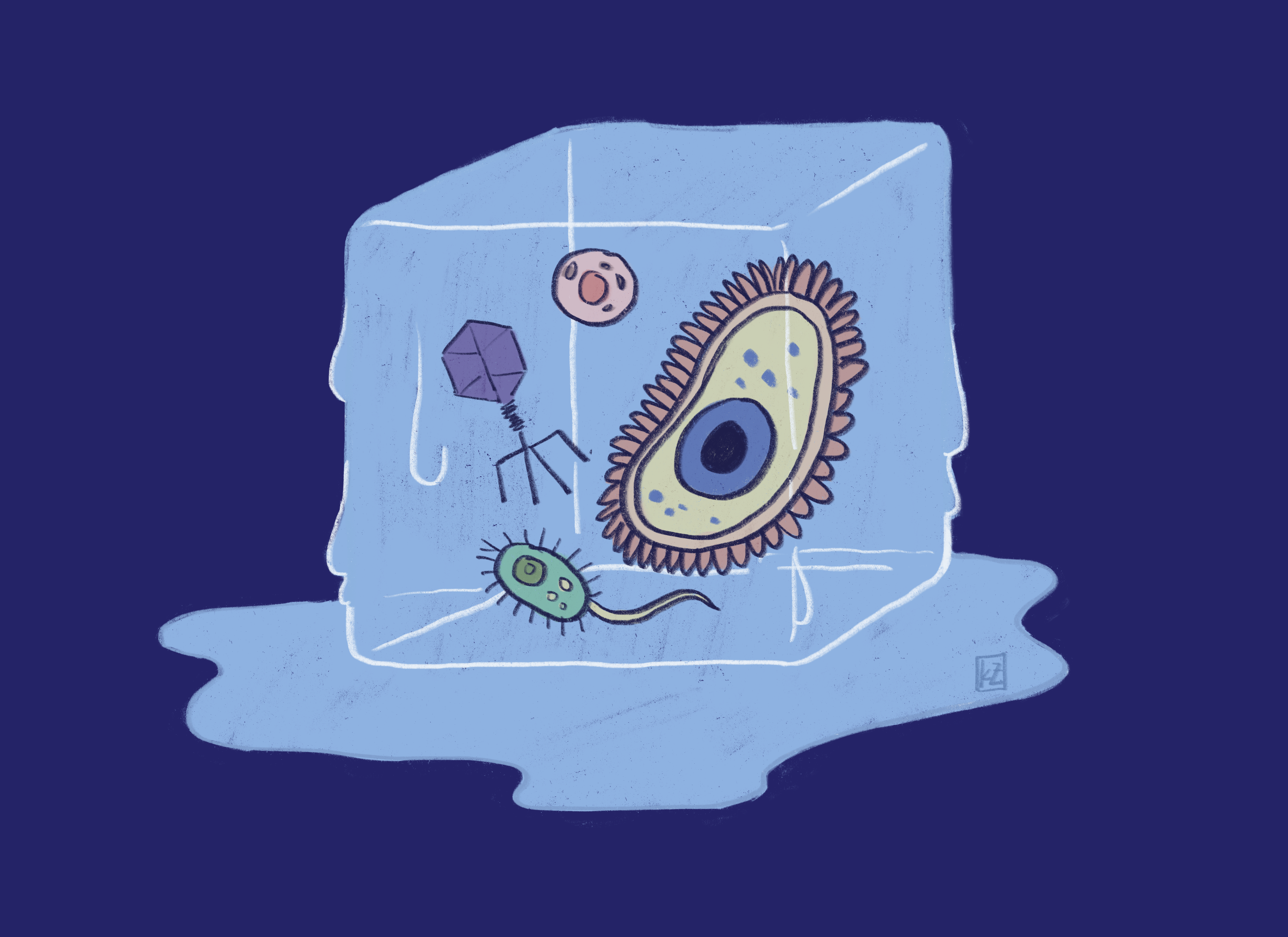
The consensus amongst researchers and Russian officials was that it was caused by the thawing of permafrost (the frozen layer of soil underneath ice and snow) induced by unusually high temperatures. The region saw temperatures around 35 degrees Celsius that summer, or 95 degrees Fahrenheit—much warmer than the usual ten degrees Celsius (Goudarzi, 2016). The warmer the weather the deeper the thaw, potentially releasing decades-old microorganisms from the soil. These microorganisms could be anything from harmless amoeba-consuming “giant” viruses to long-eradicated pathogens such as the smallpox virus—unfortunately in this case, what was unearthed were the carcasses of reindeer that had died from anthrax, allowing the pathogen to leech into food stores and water sources.

As soon as this story broke out, media outlets took it and ran with it. Suddenly we were faced with what seemed to be a new existential threat to humanity: ancient bacteria and viruses frozen in the ground, coming “back to life” as the earth continues to warm from climate change. “Zombie” pathogens that lied dormant in the ground would infect humans with bygone diseases such as 1918 influenza, smallpox, and bubonic plague. While the idea of dormant bacteria re-infecting humans is terrifying, how valid is it and how concerned should we really be?

In 2014, evolutionary biologists Jean-Michel Claverie and Chantal Abergel at the Aix-Marseille University in France were able to revive a giant virus, Pithovirus sibericum, that had been dormant in ice for 30,000 years. The virus is 1.5 micrometers long—the largest ever found (Yong, 2014). While it is infectious, its preferred hosts are amoebas and are harmless to humans. This discovery has prompted both the researchers and general public alike to acknowledge the possibility that other more dangerous viruses may also be capable of resurfacing as the Arctic continues to warm.

However, it’s important to note that Claverie and Abergel’s research pertains to viruses that target amoebas, not ones that targets humans (Doucleff, 2018). While P. sibericum may have been evolutionarily equipped to survive in frozen soil, that may not be the case for viruses responsible for influenza or smallpox that had evolved to thrive in warm human flesh.

Another piece of information to consider is that Bacillus anthracis, the bacteria that causes anthrax infections, seeping out from the soil and infecting animals is not new. In fact, there are French accounts of anthrax-laden fields wiping out entire flocks of sheep dating back to the medieval period, until Louis Pasteur developed a vaccine against B. anthracis in 1881 (Jones, 2010).

It’s not as if researchers haven’t tried to revive decades-old human-infecting viruses. There have been multiple attempts to revive the 1918 influenza and smallpox viruses using tissue samples from well-preserved arctic mummies, with varying degrees of success. While the attempt to isolate a living 1918 influenza virus proved unsuccessful, a Russian attempt to revive smallpox did result in their recovering parts of the virus (Taunbenberger, Hultin, & Morens, 2007; Doucleff, 2018).

At the present moment, the threat of another outbreak of smallpox or Spanish flu is unlikely. These viruses are maladapted to the cold and unable to survive without a warm mammalian host. We may not known what the future holds as climate change uncovers more microorganisms from newly thawed soil, but perhaps we should be more concerned about what goes on in the lab with our attempts to revive long-dead viruses, rather than fixate on the idea of zombie pathogens.

—

References

Doucleff, M. (2018). Are there zombie viruses in the thawing permafrost? https://www.npr.org/sections/goatsandsoda/2018/01/24/575974220/are-there-zombie-viruses-in-the-thawing-permafrost

Fox-Skelly, J. (2017). There are diseases hidden in ice, and they are waking up. http://www.bbc.com/earth/story/20170504-there-are-diseases-hidden-in-ice-and-they-are-waking-up

Goudarzi, S. (2016). What lies beneath. Scientific American, 315, 11-12.

Jones, S. D. (2010). Death in a Small Package: A Short History of Anthrax. Johns Hopkins University Press.

Taubenberger, J. K., Hultin, J. V., & Morens, D. M. (2007). Discovery and characterization of the 1918 pandemic influenza virus in historical context. Antiviral therapy, 12(4 Pt B), 581–591.

Yong, E. (2014). Giant virus resurrected from 30,000-year-old-ice. https://www.nature.com/news/giant-virus-resurrected-from-30-000-year-old-ice-1.14801#/ref-link-1

Your journey starts here! Let’s talk!

ThemeRex © 2026. All rights reserved.
  Timothy Durham was convicted of rape when a test showed his DNA genotype matched the DNA recovered from the crime scene. Eye witnesses testified that Durham was in a different state at the time of the incident, but he wasn’t exonerated from his 3000 year sentence until follow up DNA analysis showed that the preliminary forensic analysis used in the trial was misinterpreted (Thomas et al.). DNA testing serves an invaluable part in our criminal justice system, but it comes with complications and bias that can lead to wrongful convictions and misinformed juries.  

Background:

Forensic genetics aims to identify the origin of a biological sample. It can be traced back to Karl Landsteiner who discovered human ABO blood groups. With blood groups, suspects could be eliminated based on their blood type. For example, if a suspect had type A blood and there was type B blood left at the scene by the perpetrator, the investigators could rule out the suspect. Unfortunately, the reverse didn’t work. If the suspect and perpetrator both had the same blood type, it can’t be concluded that the suspect was guilty. Blood identifiers evolved into 8 distinct categories which improved the ability to eliminate suspects, but could only conclude that (if the system matched) it might be the perpetrator or this person might be related to the perpetrator (Jobling and Gill). The field evolved in the 1980s with the discovery of Minisatellites, lines of repetitive DNA that don’t encode proteins. Minisatellite patterns in DNA create what we know today as the DNA fingerprint, and it has a much higher accuracy rate than previous methods (Augustyn et al.). Around the same time, a breakthrough for victims of sexual assault was discovered. In the case of assault, bodily fluids of both the victim and the assaulter can get mixed. A process called differential lysis was created which could selectively increase the concentration of sperm in a fluid sample thereby allowing for accurate DNA testing (Jobling and Gill). Forensics evolved to use single-locus probe testing after several years because of its ease of interpretation. It looked at specific minisatellites that had high variability between subjects. This was the first DNA-based method to be used in a criminal investigation. Two murder homicides from several years apart were connected using DNA evidence. The evidence was then used to exonerate an innocent man, and the guilty party was found when he tried to evade mandatory DNA testing for all men in the small town. His guilt was then reinforced when the DNA profiles matched, and he gave a confession (Jobling and Gill). Finding DNA at a crime scene doesn’t guarantee that you’ll find a murderer. There are issues with non-pure samples and limited samples that make DNA work difficult, and accreditation of facilities and new techniques and take time (Jobling and Gill).  

Subjectivity of DNA Interpretation:

In a 2009 publication, the National Academy of Science discusses the possibility for subjective influence in lab based forensics. The interpretation bias happens in complex cases where, for example, there could be a mixture of DNA. A study published in 2011 looked specifically at this issue. A gang rape happened in Georgia, and the mixture in DNA from the case was used to prosecute one suspect after another suspect took a plea bargain to testify against him. With DNA mixtures, there are three possible conclusions: suspect excluded, suspect cannot be excluded, and inconclusive. If the suspect is excluded, it means that there’s little to no possibility that his DNA is part of the sample. If the suspect cannot be excluded, it means that there’s a possibility that his DNA is part of the sample. In the trial, the DNA examiners who knew the context of the case concluded that the suspect being prosecuted could not be excluded. The 2011 study gave the DNA evidence from this case and the DNA profiles of the suspects to 17 forensic examiners. These examiners had no context of the case, and they all worked independently. Of the 17, only 1 came to the same conclusion (suspect cannot be excluded) as the examiners who knew the context of the case. Twelve of the 17 concluded that the suspect who was prosecuted and convicted had no relation to the DNA found in the sample. Not only does this show that subjectivity occurs due to the context of the case, but the 17 examiners came up with different findings based on their past experiences meaning that not all DNA analysis is objective. Some organizations like the Scientific Working Group on DNA Analysis Methods say that quantitative statistical evidence should be presented with every categorical conclusion, but the US doesn’t require this (Dror and Hampikian).

False Positives:

There are two categories that cause wrongful identification in a DNA report: coincidental matches and false positives. Coincidental matches are DNA matches between two unrelated people. The probability of these matches is about 1 to 500,000 for white individuals and about 1 to 350,000 for black individuals. This small probability of coincidental matches makes people feel confident in DNA evidence. False positives, on the other hand, are matches between DNA and test DNA that result from issues in the forensics lab. There have been multiple cases of forensics labs accidentally switching victim and suspected rapist DNA which lead to convictions that were later overturned when the lab realized the error. There are also cases of misreading or misunderstanding a sample. In a case from 1993, a man was convicted of rape because someone interpreted a mixed sample of victim and perpetrator DNA as an individual sample. The conviction was again overturned. To prevent false convictions, retesting DNA is allowed, but it’s not an efficient solution. Many people are pushing for statistical information on the probability of false positives, so that the jurors can make accurate judgements based on DNA evidence (Thomas et al.).  

Conclusion:

DNA analysis is a useful tool for the criminal justice system, but subjectivity can be an issue in forensic testing. To combat wrongful convictions, there are organizations like The Innocence Project who use DNA testing to free the innocent, but reformed forensic testing standards should be put in place to prevent subjectivity and to ensure juries are correctly informed during trials. https://www.innocenceproject.org/    

Citation:

Augustyn , Adam, et al. “DNA Finerprinting.” Encyclopedia Britannica , 26 Apr. 2018, www.britannica.com/science/DNA-fingerprinting#ref153186. Dror, Itiel E., and Greg Hampikian. “Subjectivity and Bias in Forensic DNA Mixture Interpretation.” Science & Justice, vol. 51, no. 4, 2011, pp. 204–208., doi:10.1016/j.scijus.2011.08.004. Jobling, Mark A., and Peter Gill. “Encoded Evidence: DNA in Forensic Analysis.” Nature Reviews: Genetics, vol. 5, no. 10, Oct. 2004, pp. 739–751., doi:10.1038/nrg1455. Thompson, William C, et al. “How the Probability of a False Positive Affects the Value of DNA Evidence.” Journal of Forensic Sciences, vol. 48, no. 1, Jan. 2003, pp. 1–8., doi:10.1520/jfs2001171.