Should We Be Ignoring Duolingo’s Threats? A Look at the Sapir-Whorf Hypothesis

The recent year has brought to the forefront an unexpected, slightly unhinged new pop-culture icon: Duo, the Duolingo owl. Duolingo is a popular language-learning app that allows users to learn a variety of languages and sends daily notifications to encourage them to keep a language-learning streak. And while the messages coming from the Duo TikTok posts and comments range from threatening to completely out of pocket, the Duo owl seems to recognize the value of learning a second language. And with 3.1 million followers on the brand’s TikTok, this message seems to be reaching the world. Duo definitely has the science to back them up. It’s been thoroughly proven that as you age, multilingualism is a better predictor of cognitive ability than age, education, and gender (Kavé et al., 2008; Mohamed Zied et al., 2004).

But why does bilingualism have this effect on your brain? Many recent studies have confirmed that you regularly use more regions of your brain if you’re bilingual or multilingual, as compared to someone who is monolingual. What’s known as the Sapir-Whorf hypothesis could help to explain it. 

Sapir-Whorf hypothesizes that the language you speak influences how you perceive reality. This idea seems to have caught on, as there have been many research studies and fictional pieces that explore it.  

“Story of Your Life and Others” by Ted Chiang (as well as its 2016 film adaptation, The Arrival) is my favorite example of the hypothesis. Key point: An alien species arrives on Earth. Unlike us humans, who have reflectional symmetry, the aliens had rotational symmetry – think extraterrestrial octopus. In the story, these aliens communicate very differently from humans. While we write in lines and process information sequentially/linearly, the aliens wrote all at once in a nested circular pattern and processed information all at once. 

The aliens’ writing, as depicted in The Arrival (2016).

Once basic communication was established, the linguists wanted to set up a frame of communication, so they started with what we assume is constant throughout the universe: physics. The aliens could very easily understand certain physics theories that humans had a difficult time grasping, because the aliens, unlike us, didn’t perceive time sequentially. Because their language communicated information all at once, they thought about information all at once and didn’t have the same sense of past, present, and future that we have.  

The effect of language on perceived reality can be seen in the real world as well. The Hopi language, spoken by the Hopi people in northeastern Arizona, doesn’t grammatize time the same way as English and refers to it as a verb instead of a noun. This slightly alters how they perceive time. The Himba tribe in Nambia is able to differentiate between more shades of green than the average English speaker because they have words for more different shades.

The right side is easily discernible to an English speaker, whereas the left side would be just as easily discernible to a Himba speaker.

As can be seen by the RBG values in the image, the square in the same position as the blue square is a different shade of green. Most Americans have a very hard time distinguishing it. 

These differences, on a lesser scale, are present between all languages. As aptly discussed in another very interesting linguistical read, “The Idiot”, by Elif Bautman, the main character explains how she “knew [she] thought differently in Turkish and in English — not because thought and language were the same, but because different languages forced you to think about different things”. 

Given that one language influences, to some extent, how we perceive the world, it’s not a big leap to see how multilingualism would affect the way we think. While there will be some overlap, especially between similarly structured languages like the Romance Languages, each new language learned expands the areas of your brain that are regularly used and may affect how your brain processes information, even when you’re using your native language. 
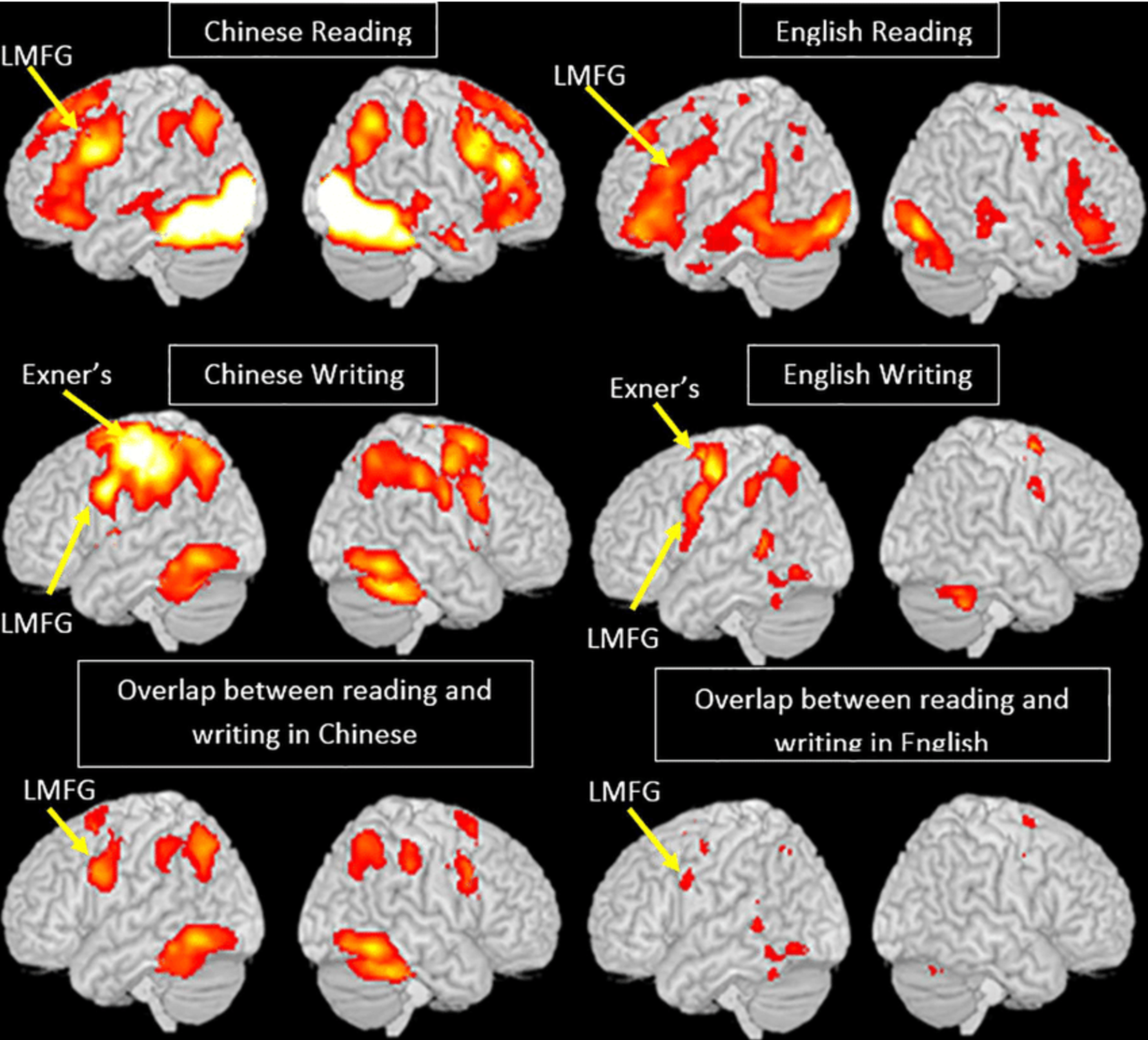
The difference between brain regions used when reading and writing in Chinese and English (Cao, 2016)

Different languages use different locations and quantities of the brain. As can be seen from the image above, key examples of this are the LMFG region and Exner’s region. The LMFG region, short for the left middle frontal gyrus, plays a key role in literacy. Exner’s region helps you to process numbers and language. Multilingualism strengthens alternative brain networks within these regions to those that you usually use, allowing your brain to circuit around any deterioration that occurs with aging. This explains the strong correlation between multilingualism and cognitive ability as you age.

With this in mind, recent studies have been exploring the use of language study for those 65+, and, as expected, it is working to help reduce the deterioration (Antinou, 2013). Moral of the story: if you’re planning on outliving the Duo owl, stepping up your language learning game (or reversing some of the threats Duo regularly levels at its users) is probably your best bet.

References:

Antinou, M., Foreign language training as cognitive therapy for age-related cognitive decline: A hypothesis for future research. https://pubmed.ncbi.nlm.nih.gov/24051310/ . 

Cao, F. (PDF) neural signatures of the reading-writing connection … https://www.researchgate.net/publication/311759524_Neural_Signatures_of_the_Reading-Writing_Connection_Greater_Involvement_of_Writing_in_Chinese_Reading_than_English_Reading . 

Kavé, G., Eyal, N., Shorek, A., & Cohen-Mansfield, J. (2008). Multilingualism and cognitive state in the oldest old. Psychology and Aging, 23(1), 70–78. https://doi.org/10.1037/0882-7974.23.1.70 

Lucy, J. A. Sapir–Whorf hypothesis. https://www.sciencedirect.com/science/article/pii/B0080430767030424 . 

Newton, M. It’s not easy seeing green. https://6thfloor.blogs.nytimes.com/2012/09/04/its-not-easy-seeing-green/ (accessed Mar 2, 2022). 

Skibba, R. How a Second language can boost the brain. https://knowablemagazine.org/article/mind/2018/how-second-language-can-boost-brain .


Your journey starts here! Let’s talk!

ThemeRex © 2026. All rights reserved.
  Timothy Durham was convicted of rape when a test showed his DNA genotype matched the DNA recovered from the crime scene. Eye witnesses testified that Durham was in a different state at the time of the incident, but he wasn’t exonerated from his 3000 year sentence until follow up DNA analysis showed that the preliminary forensic analysis used in the trial was misinterpreted (Thomas et al.). DNA testing serves an invaluable part in our criminal justice system, but it comes with complications and bias that can lead to wrongful convictions and misinformed juries.  

Background:

Forensic genetics aims to identify the origin of a biological sample. It can be traced back to Karl Landsteiner who discovered human ABO blood groups. With blood groups, suspects could be eliminated based on their blood type. For example, if a suspect had type A blood and there was type B blood left at the scene by the perpetrator, the investigators could rule out the suspect. Unfortunately, the reverse didn’t work. If the suspect and perpetrator both had the same blood type, it can’t be concluded that the suspect was guilty. Blood identifiers evolved into 8 distinct categories which improved the ability to eliminate suspects, but could only conclude that (if the system matched) it might be the perpetrator or this person might be related to the perpetrator (Jobling and Gill). The field evolved in the 1980s with the discovery of Minisatellites, lines of repetitive DNA that don’t encode proteins. Minisatellite patterns in DNA create what we know today as the DNA fingerprint, and it has a much higher accuracy rate than previous methods (Augustyn et al.). Around the same time, a breakthrough for victims of sexual assault was discovered. In the case of assault, bodily fluids of both the victim and the assaulter can get mixed. A process called differential lysis was created which could selectively increase the concentration of sperm in a fluid sample thereby allowing for accurate DNA testing (Jobling and Gill). Forensics evolved to use single-locus probe testing after several years because of its ease of interpretation. It looked at specific minisatellites that had high variability between subjects. This was the first DNA-based method to be used in a criminal investigation. Two murder homicides from several years apart were connected using DNA evidence. The evidence was then used to exonerate an innocent man, and the guilty party was found when he tried to evade mandatory DNA testing for all men in the small town. His guilt was then reinforced when the DNA profiles matched, and he gave a confession (Jobling and Gill). Finding DNA at a crime scene doesn’t guarantee that you’ll find a murderer. There are issues with non-pure samples and limited samples that make DNA work difficult, and accreditation of facilities and new techniques and take time (Jobling and Gill).  

Subjectivity of DNA Interpretation:

In a 2009 publication, the National Academy of Science discusses the possibility for subjective influence in lab based forensics. The interpretation bias happens in complex cases where, for example, there could be a mixture of DNA. A study published in 2011 looked specifically at this issue. A gang rape happened in Georgia, and the mixture in DNA from the case was used to prosecute one suspect after another suspect took a plea bargain to testify against him. With DNA mixtures, there are three possible conclusions: suspect excluded, suspect cannot be excluded, and inconclusive. If the suspect is excluded, it means that there’s little to no possibility that his DNA is part of the sample. If the suspect cannot be excluded, it means that there’s a possibility that his DNA is part of the sample. In the trial, the DNA examiners who knew the context of the case concluded that the suspect being prosecuted could not be excluded. The 2011 study gave the DNA evidence from this case and the DNA profiles of the suspects to 17 forensic examiners. These examiners had no context of the case, and they all worked independently. Of the 17, only 1 came to the same conclusion (suspect cannot be excluded) as the examiners who knew the context of the case. Twelve of the 17 concluded that the suspect who was prosecuted and convicted had no relation to the DNA found in the sample. Not only does this show that subjectivity occurs due to the context of the case, but the 17 examiners came up with different findings based on their past experiences meaning that not all DNA analysis is objective. Some organizations like the Scientific Working Group on DNA Analysis Methods say that quantitative statistical evidence should be presented with every categorical conclusion, but the US doesn’t require this (Dror and Hampikian).

False Positives:

There are two categories that cause wrongful identification in a DNA report: coincidental matches and false positives. Coincidental matches are DNA matches between two unrelated people. The probability of these matches is about 1 to 500,000 for white individuals and about 1 to 350,000 for black individuals. This small probability of coincidental matches makes people feel confident in DNA evidence. False positives, on the other hand, are matches between DNA and test DNA that result from issues in the forensics lab. There have been multiple cases of forensics labs accidentally switching victim and suspected rapist DNA which lead to convictions that were later overturned when the lab realized the error. There are also cases of misreading or misunderstanding a sample. In a case from 1993, a man was convicted of rape because someone interpreted a mixed sample of victim and perpetrator DNA as an individual sample. The conviction was again overturned. To prevent false convictions, retesting DNA is allowed, but it’s not an efficient solution. Many people are pushing for statistical information on the probability of false positives, so that the jurors can make accurate judgements based on DNA evidence (Thomas et al.).  

Conclusion:

DNA analysis is a useful tool for the criminal justice system, but subjectivity can be an issue in forensic testing. To combat wrongful convictions, there are organizations like The Innocence Project who use DNA testing to free the innocent, but reformed forensic testing standards should be put in place to prevent subjectivity and to ensure juries are correctly informed during trials. https://www.innocenceproject.org/    

Citation:

Augustyn , Adam, et al. “DNA Finerprinting.” Encyclopedia Britannica , 26 Apr. 2018, www.britannica.com/science/DNA-fingerprinting#ref153186. Dror, Itiel E., and Greg Hampikian. “Subjectivity and Bias in Forensic DNA Mixture Interpretation.” Science & Justice, vol. 51, no. 4, 2011, pp. 204–208., doi:10.1016/j.scijus.2011.08.004. Jobling, Mark A., and Peter Gill. “Encoded Evidence: DNA in Forensic Analysis.” Nature Reviews: Genetics, vol. 5, no. 10, Oct. 2004, pp. 739–751., doi:10.1038/nrg1455. Thompson, William C, et al. “How the Probability of a False Positive Affects the Value of DNA Evidence.” Journal of Forensic Sciences, vol. 48, no. 1, Jan. 2003, pp. 1–8., doi:10.1520/jfs2001171.