

PART ONE: WHAT IS SYNESTHESIA?
Read this sentence.
Now stop. Go back, and read it again, but this time, listen to that sentence as well. No, it’s alright, there is no need to read it aloud, and you don’t need to enunciate carefully with your internal voice either. That’s not quite what I mean. I want you to hear the sentence, listen to each letter’s tone as it comes, observe the unique melody evoked by that specific combination of written symbols and shapes. Hear the sentence.
If that task seems impossible, that’s okay.
We can try another if you like.
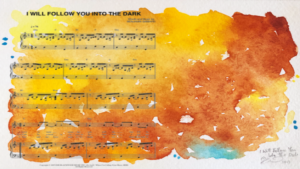
For the Etsy artist Sigourney Young, this task would be perfectly intuitive. Young has color-music synesthesia, and creates beautiful watercolor pieces based on what she sees during a song. My best friend commissioned this painting, inspired by the song “I”ll Follow You into the Dark by Death Cab for Cutie, for me in 2017, and I’ve overlaid the sheet music of the piece on an image of the painting to illustrate how the two are inextricably intertwined.
Think of a song, perhaps your favorite song. Pick a song that is rich and full, with a vibrant soundscape to immerse yourself in. Now, I want you to go and listen to that song. Yes, right now is fine. Go ahead and close this article- I’ll wait for you right here. Take your time and enjoy the music.
Back already? Good. Now, I want you to paint that song for me. I need you to paint that song for me and show me what you saw as you listened. Show each note as it appeared, every melody, countermelody, chord and harmony, laid out in vivid pigments. Recreate what you saw as you heard, each color and shape singing out clearly.
That didn’t make sense to you either? What about tasting the texture of the nearest object? Or perhaps smelling that first sentence?
What if I told you that these weren’t just the strange, hypothetical conjuring of an online article, but a genuine way of experiencing the world?
For the roughly 4% of the world’s population that have synesthesia, an integration of seemingly separate sensations is simply a part of their reality. Synesthesia is a broad categorization of neurological phenomena in which the stimulation of one sensory system, such as the visual or auditory systems, triggers a correlated response in another. This blending or “bleeding” together of sensations is involuntary and unconscious, simply elicited by whatever stimulus was present. The word “synesthesia”, a combination of two Greek words, syn, meaning together or conjoined, and aesthesis, meaning perception, forms a remarkable accurate description of the condition (Phillips, Gross).
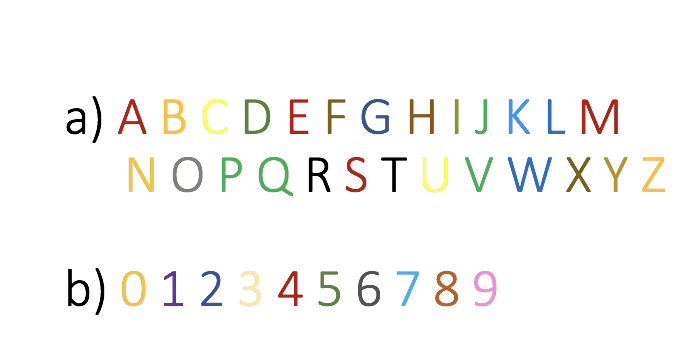
There are many different types of synesthesia, but they all have some traits in common. There are at least three fundamental requirements commonly used to define the condition in general. First, as I mentioned earlier, it is an involuntary reaction, one that is unconsciously elicited by the stimulus (Phillips). This means that the synesthete, as people with synesthesia are called, doesn’t have control over what is perceived, or when. It is just like any other sensory experience- you can’t “unhear” or “unsee” something, nor change the color of an object you are looking at (Gross). Additionally, the associations must be consistent. For example, someone with color-auditory synesthesia will always perceive the same color in response to the same sound, and if the number 4 is red to a color-grapheme synesthete, it must always be red. Finally, the experience is the “adding” of sensory input, not replacing or substituting it. That means that the synesthete is still able to perceive the stimuli in the original sense as well, so if a person has auditory-gustatory, or sound-taste, synesthesia, they will be still be able to taste the food as well as hear it (Ward).
Aside from those three requirements, the synesthetic experience is extremely varied and idiosyncratic. Typically, the secondary sensation, referred to as the “concurrent” to the stimulus’s “inducer”, is best described as a “projected” experience. This just means that it isn’t felt as something imagined, but as the perception of something outside the body. For example, if you had lexical-gustatory synesthesia, you would actually have the sensation of tasting something specific when you heard or read certain letters, rather than just associating a taste with it mentally. However, it isn’t always that clear-cut, particularly with color-graphemic synesthesia, the association of numbers or letters with particular colors. Although all will perceive the color as something inherent to the grapheme, the color may not appear to physically overlay with the normal visual field. Dixon et al. 2004 splits people with this type of synesthesia into two groups, projectors and associators. Projectors will see the color physically overlaid on a space in their visual field, while associators will see the color in their mind’s eye, as if on an internal screen (Ward). Contrary to the initial definition, synesthesia is also not always the combination of two separate sensory systems, but simply different aspects of them. Using color-graphemic synesthesia again as the example, both the visually-presented character and the color are different facets of the same visual sense (Ward). It has also been shown that for some synesthetes, the concept of the stimulus is enough to trigger the secondary sensory experience. Dixon et al. 2000 found, for instance, that for individuals with color-number synesthesia, giving them sums equal to 7, like 5+2, can often be enough to make them see the color associated with 7 (Ward). It has also been observed that if the inducing word is “inaccessible, as in a tip-of-the-tongue state”, people with lexical-gustatory synesthesia may be able to taste it.
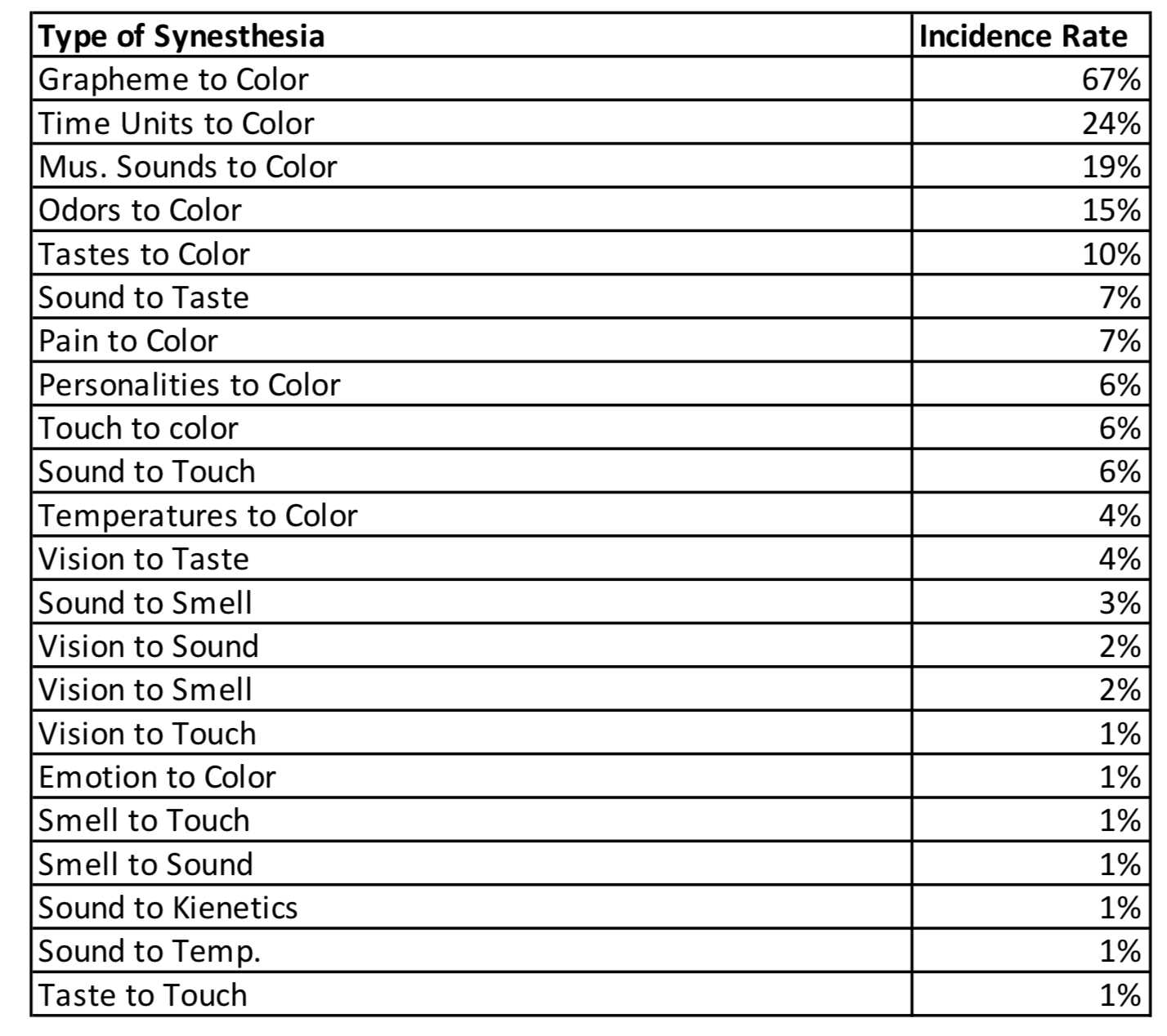
There are, theoretically, as many different forms of synesthesia as there are possible combinations of sensory experiences, and it is estimated that there are upwards of 35 different variants documented so far (Gross). In addition to the ones mentioned, this includes auditory-touch synesthesia, where a physical touch or other tactile sensation also produces a sound, mirror or touch-visual synesthesia, where seeing another person receive a tactile stimulus (e.g. get touched or touch something) makes the synesthete feel that touch as well, and variations that include spatial and/or temporal experiences. The most prevalent forms are color-graphemic and color-auditory, and even within these, there is a ton of individuality. Synesthetes will have their own colors for each stimulus, and for some people, each individual character will have a color, while others may have one sensation for an entire word.
An interesting point to make here, is that thus far (and for the remainder of these articles), we are discussing synesthesia that an individual has always experienced, sometimes called “developmental synesthesia”. While it a topic of debate whether they should be considered synesthesia and/or arise from the same biological mechanisms, there are other related conditions known collectively as “acquired synesthesia” (Gross). These include synesthesia/synesthetic-like experiences that occur later in life, usually due to some form of physical injury or change that results in the loss of sensory input from one area or sense. The fairly well-known Phantom Limb Syndrome, during which the individual perceives pain and other somatosensations from the area where an amputated limb used to be, is actually linked to some very intriguing cases of acquired synesthesia! People in these cases report perceiving touch from visual input, like seeing something touch either the location of the phantom limb or touch on the corresponding location of another person. This seems to parallel the experiences of mirror synesthesia (Ramachandran). There has also been research on acquired auditory-visual and tactile-visual synesthesia following the onset of blindness, as well as touch-auditory synesthesia after the loss of hearing, and following damage to the thalamus (Ramachandran, Ward). In these cases, the general hypothesis seems to be that the sensory cortex implicated for the lost/damaged sense is still active and able to function, but no longer getting the sensory input from receptor sites as before. It therefore may begin to respond to another sensory system, through some change in neural communication, which can create the dual sensory experiences of synesthesia (Ward).
If you, like me, are a nonsynesthete, this all may seem incredibly overwhelming and perhaps even a bit difficult to believe. But while the neurological basis of synesthesia isn’t completely understood, there is a substantial body of experimental research and data on the subject. A study by Baron-Cohen et al. in 1987 provided the first experimental evidence that the synesthetic associations of specific stimuli are consistent over time. Working with a control group of people without synesthesia as well as a participant with color-lexical synesthesia, they recorded the color each person reported being triggered by each word on a 100-word list. The control group was asked to repeat the test 2 weeks later, and only retained consistency with the word-color pairing 20 percent of the time. By contrast, when the synesthete was asked, 1 year later and without any prior warning, to repeat the test, she showed a consistency over 90% (Ward). Further investigations by this research team also found that brain imaging technology can measure a difference in brain activity during synesthetic perception. Using PET and fMRI imaging to measure brain activity in different regions, they were able to observe that people with color-auditory synesthesia have increased activation in area V4, which is correlated to color, than nonsynesthetes do when listening to sounds.
Another experimental technique used to test for synesthesia is a modified version of the Stroop test. The original Stroop test is something you’ve probably done at some point, and involves reading the color name or identifying the ink color of color names that are either printed in a congruent color, like the word red written in RED, or in an incongruent color, such as like this word RED printed in green ink. Normally, you are able to respond much faster and more accurately when the word and the color are congruent- this is known as the Stroop Effect and is extremely well-established amongst the scientific community. In the experiments involving synesthesia, the same principle is applied to the inducing stimulus and the concurrent perceptual effect: for people with color-grapheme synesthesia who perceive the number 4 as blue, the congruent task would have a blue 4, while the incongruent would have 4 printed in a different color, like purple. This has been done with color-grapheme, gustatory-auditory, color-auditory, and even spatial synesthesia, and the Stroop Effect has been markedly present for all (Ward).
Neat, you’ve made it this far! That was my initial look into the phenomena that is synesthesia and what really defines it. While researching, I kept finding out more and more, so if you want to learn about research into the biological basis of synesthesia, or any of the other interesting facts I found out, check out Part Two here:
https://chargedmagazine.org/2019/10/painting-with-al…he-wind-part-two/
References
Day, S. (2007). Types of Synesthesia. Retrieved from http://www.daysyn.com/Types-of-Syn.html
Gross, V. (n.d.). Synesthesia Project: FAQ. Retrieved from https://www.bu.edu/synesthesia/faq/
Grossenbacher, P. G., & Lovelace, C. T. (2001). Mechanisms of synesthesia: Cognitive and physiological constraints. Trends in Cognitive Sciences,5(1), 36-41. doi:10.1016/s1364-6613(00)01571-0
Phillips, E. L. (n.d.). What is synesthesia? Retrieved from https://faculty.washington.edu/chudler/syne.html
Ramachandran, V.S., Hubbard, E.M. and Butcher, P.A. (2004). Synesthesia, CrossActivation, and the Foundations of Neuroepistemology. In G. Calvert, C. Spence and B. E. Stein (eds), The Handbook of Multisensory Processes (pp. 867-83). Cambridge, Mass.: The MIT Press.
Ward, J. (2013). Synesthesia. Annual Review of Psychology,64(1), 49-75. doi:10.1146/annurev-psych-113011-143840


