Origami & Bio-inspired Design

You’ve probably seen pictures of origami before, or even folded some yourself! Origami is an ancient art form that originated in China in the 2nd century AD. It made its way to Japan around the 6th century, where it became an art for both recreation & decorating shrines. In the centuries since, it’s evolved into a complicated craft that produces beautiful art from a very simple medium—a single sheet of square paper. What you might not realize, however, is how closely origami is linked with science and math.

The Mathematical Basis of Origami

Whenever you fold a piece of paper, you’re performing an action that’s incredibly mathematical. The rules of geometry govern origami, and you can describe all possible folds in six axioms. These axioms tell you what kinds of geometric constructions & proofs are possible with origami and can be used to determine if a set of folds is even physically possible. If you want to learn more about these axioms, check out this webpage by origamist Robert J. Lang!

Bio-inspired design is an interdisciplinary approach to design that takes inspiration from nature to design new technologies. You can combine the mathematical principles of origami with bio-inspired design to create novel robot inventions. Today, we’ll go through a few examples that span a wide spectrum of species!

Worms, Snakes, and Other Slithery Ones

Engineers are currently trying to develop better rescue robots that can navigate complex terrain. Worms, snakes, and other slithering & slinking creatures cross crazy (relative to them) terrain on a day-to-day basis, and are a great source of inspiration for scientists.

Some robotics labs have taken inspiration from the movements of snakes, and have created robot origami snakes that slither around and replicate the moving patterns of their natural counterparts. These multi-segment robot prototypes have a versatile range of movement.

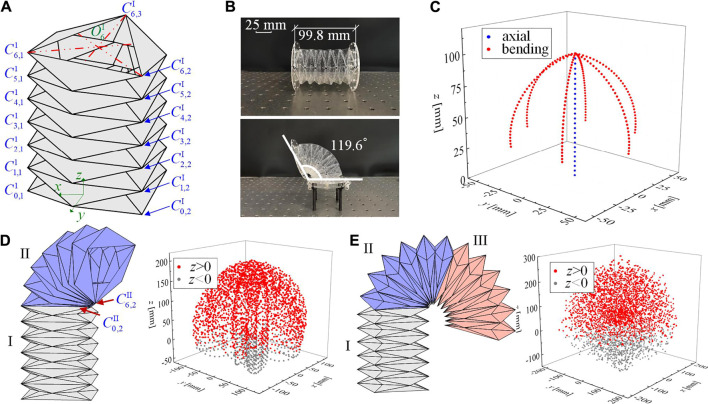
Other labs have also mimicked the slinking movement of worms! Each of the segments in these worm-bots is made up of Yoshimura-Ori folds. You can see the crease pattern below in (A) of figure 1. The Yoshimura-Ori fold is a series of repeating triangles that can be collapsed into a cylindrical structure. They can be folded into an “open” or “closed” configuration which determines how compressed the unit is. A sequence of these folds is highly compressible & deformable while still maintaining its rigidity. It allows for a wide range of motion, which you can see in figure 2 of the movement of an earthworm inspired robot.
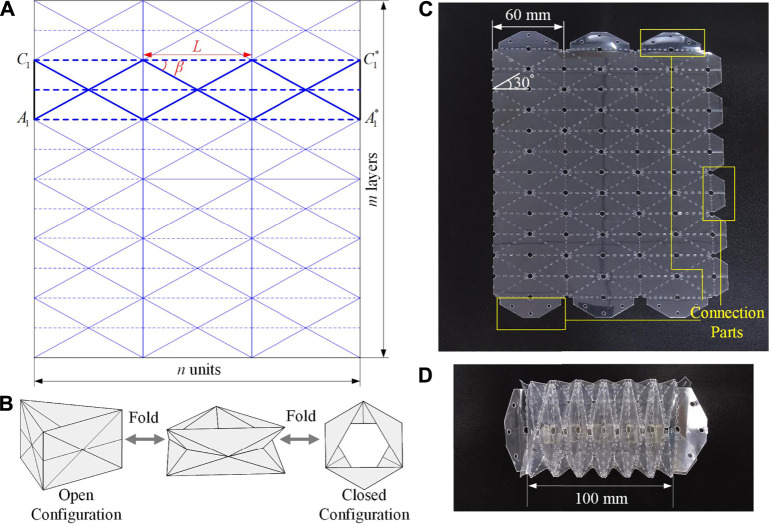
Creaese diagram for yoshimura-ori folds, with diagrams of it expanded/contracted.
Figure 1. Crease pattern of yoshimura-ori earthworm robot
sequence of diagrams and photos showing the degree of motion of the worm robot
Figure 2. Range of motion of yoshimura-ori folds

The Yoshimura-ori structure allows the robot to mimic both the crawling motion that earthworms take as well as sharp directional turns. This technique holds a lot of promise for the future of all-terrain robots!

Jellyfish & Aquatic Robots

The land isn’t the only place origami is impacting robotics. The undulating motions that jellyfish swim with are both pretty and inspire researchers to develop new modes of underwater movement.

Jellyfish are a type of organism called a medusa, which means that their body is umbrella shaped. Medusae are recognized to be the earliest multicellular organisms to have evolved muscular swimming, and while jellyfish generally float along ocean currents wherever they might go, they can use their hydrostatic skeleton to control vertical movement in a pinch. Prolate (long) medusae use jet propulsion to rapidly accelerate and avoid predators.

They do this by contracting a water pouch in their bodies. The water expelled propels them in the opposite direction. They then expand their pouch and fill it with water again, ready to repeat for another burst of movement.

Researchers are attempting to mimic this motion by combining soft-body robotics and origami engineering. The idea is that by creating a flexible origami polyhedral (a flexiball) they can motorize it in the same way medusae use jet propulsion underwater. The resulting flexiball they went with is known as a rhombic triacontahedron, and has 30 faces.

Below is a picture of their 3D printed flexiball and how it changes shape after contraction.
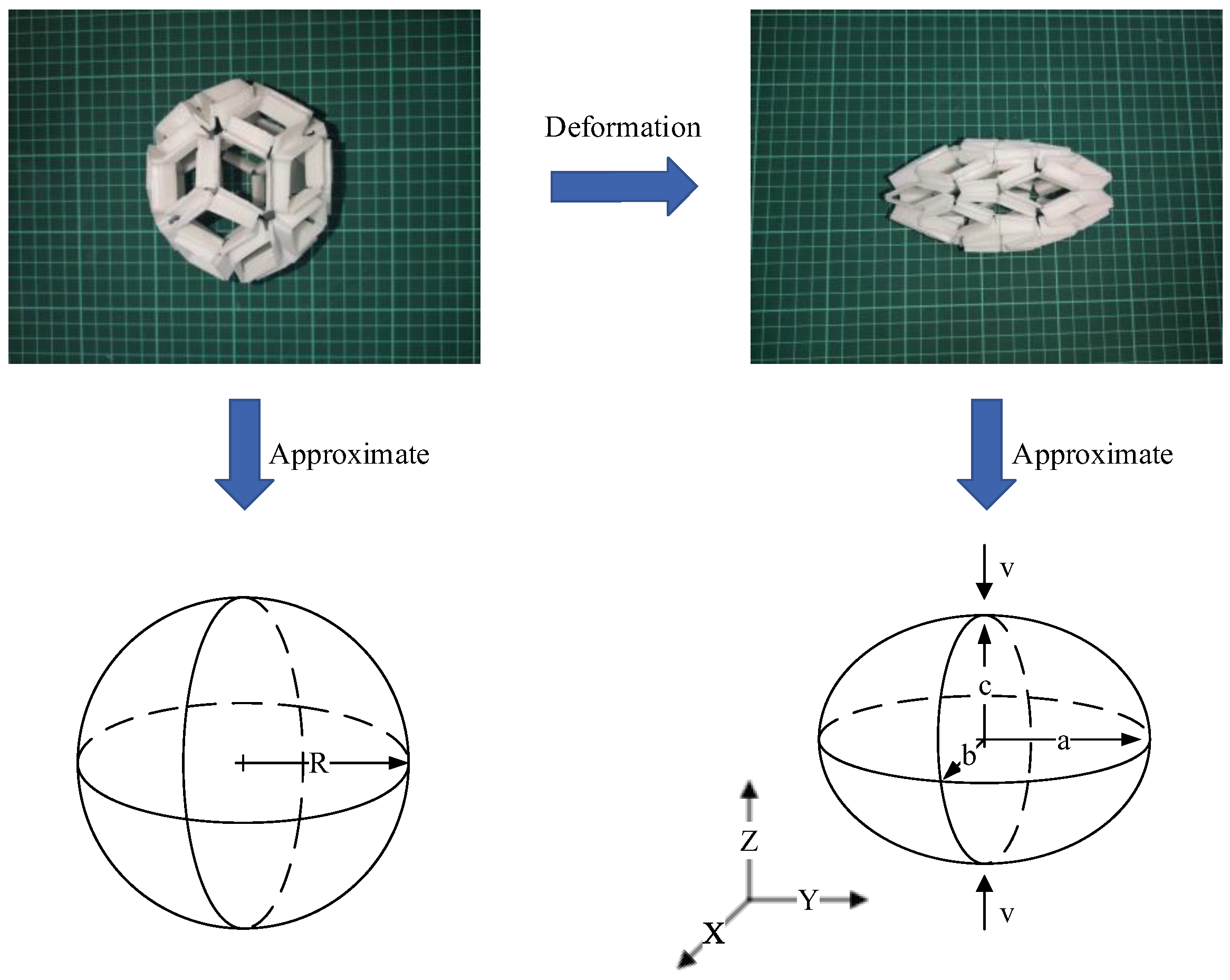
a before and after image of a 3d printed flexible triacontahedron being deformed
Figure 3. Rhombic triacontahedtron flexiball

The researchers then designed a lightweight, waterproof enclosure for the flexiball. The flexiball is contracted using three ropes connected to the grooves of the polyhedra’s edges.
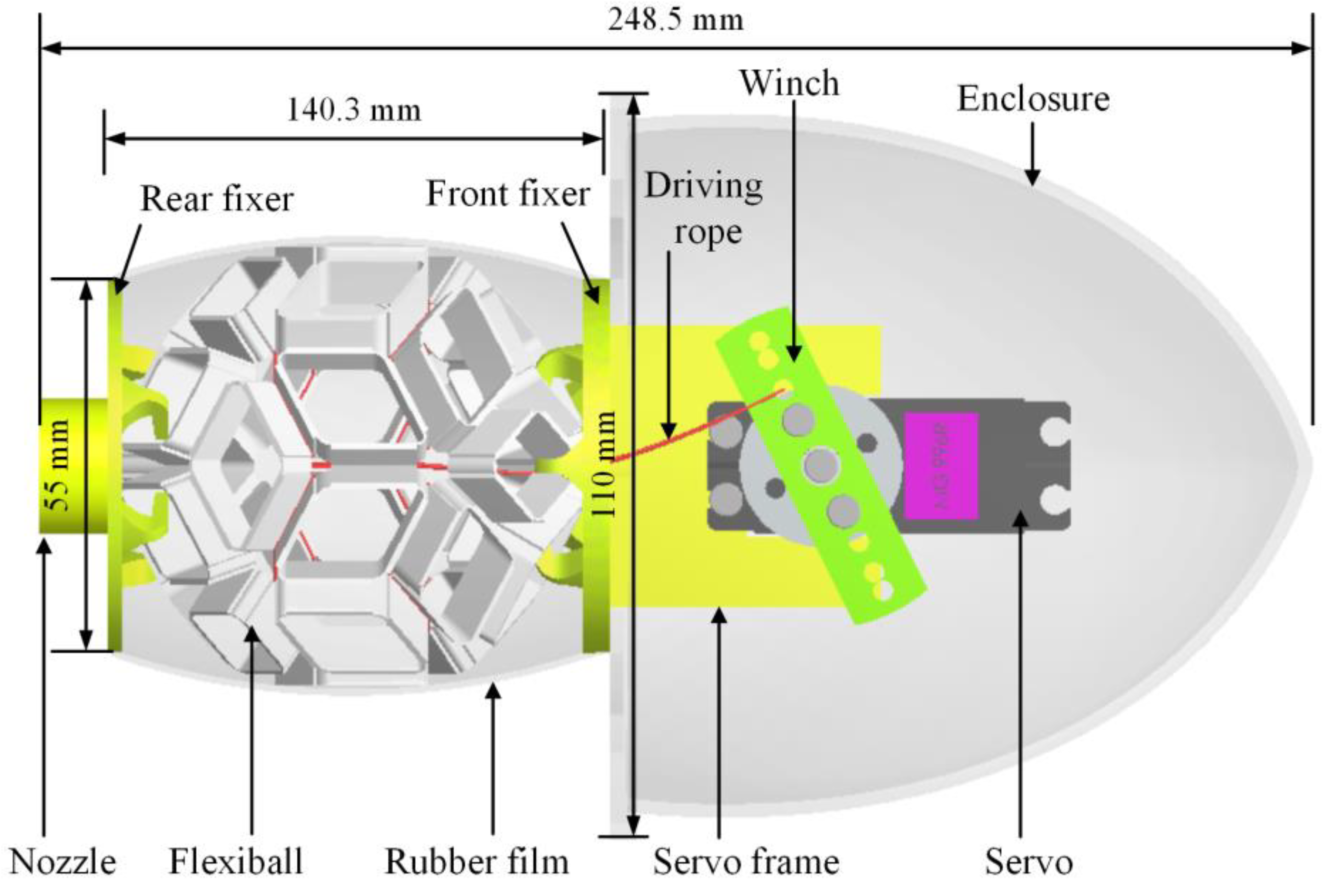
side profile diagram of jellyfish robot
Figure 4. Side profile of jellyfish bot mechanisms

Make your own!

You don’t have to be an engineer to explore origami & science yourself! Try folding your own tessellation using the template below! Fold all the blue/dashed lines in one direction, and the red/dotted lines in the opposite direction.

miura ori crease pattern
Miura ori template! Try folding it yourself
gif of miura ori fold expanding and contracting
What your miura ori fold should do!


Sources:

Hu et al., “An Origami Flexiball-Inspired Soft Robotic Jellyfish.”

Qiu et al., “Design and parameter optimization of a biomimetic jellyfish origami mechanism (BJOM) based on waterbomb tessellation.”

Luo et al., “OriSnake: Design, Fabrication, and Experimental Analysis of a 3-D Origami Snake Robot.”

Zhang et al., “Yoshimura-origami Based Earthworm-like Robot With 3-dimensional Locomotion Capability.”

Schroeder, et al., “An electric-eel-inspired soft power source from stacked hydrogels.”

Miura-ori crease pattern & GIF from Wikipedia Commons

Your journey starts here! Let’s talk!

ThemeRex © 2026. All rights reserved.
  Timothy Durham was convicted of rape when a test showed his DNA genotype matched the DNA recovered from the crime scene. Eye witnesses testified that Durham was in a different state at the time of the incident, but he wasn’t exonerated from his 3000 year sentence until follow up DNA analysis showed that the preliminary forensic analysis used in the trial was misinterpreted (Thomas et al.). DNA testing serves an invaluable part in our criminal justice system, but it comes with complications and bias that can lead to wrongful convictions and misinformed juries.  

Background:

Forensic genetics aims to identify the origin of a biological sample. It can be traced back to Karl Landsteiner who discovered human ABO blood groups. With blood groups, suspects could be eliminated based on their blood type. For example, if a suspect had type A blood and there was type B blood left at the scene by the perpetrator, the investigators could rule out the suspect. Unfortunately, the reverse didn’t work. If the suspect and perpetrator both had the same blood type, it can’t be concluded that the suspect was guilty. Blood identifiers evolved into 8 distinct categories which improved the ability to eliminate suspects, but could only conclude that (if the system matched) it might be the perpetrator or this person might be related to the perpetrator (Jobling and Gill). The field evolved in the 1980s with the discovery of Minisatellites, lines of repetitive DNA that don’t encode proteins. Minisatellite patterns in DNA create what we know today as the DNA fingerprint, and it has a much higher accuracy rate than previous methods (Augustyn et al.). Around the same time, a breakthrough for victims of sexual assault was discovered. In the case of assault, bodily fluids of both the victim and the assaulter can get mixed. A process called differential lysis was created which could selectively increase the concentration of sperm in a fluid sample thereby allowing for accurate DNA testing (Jobling and Gill). Forensics evolved to use single-locus probe testing after several years because of its ease of interpretation. It looked at specific minisatellites that had high variability between subjects. This was the first DNA-based method to be used in a criminal investigation. Two murder homicides from several years apart were connected using DNA evidence. The evidence was then used to exonerate an innocent man, and the guilty party was found when he tried to evade mandatory DNA testing for all men in the small town. His guilt was then reinforced when the DNA profiles matched, and he gave a confession (Jobling and Gill). Finding DNA at a crime scene doesn’t guarantee that you’ll find a murderer. There are issues with non-pure samples and limited samples that make DNA work difficult, and accreditation of facilities and new techniques and take time (Jobling and Gill).  

Subjectivity of DNA Interpretation:

In a 2009 publication, the National Academy of Science discusses the possibility for subjective influence in lab based forensics. The interpretation bias happens in complex cases where, for example, there could be a mixture of DNA. A study published in 2011 looked specifically at this issue. A gang rape happened in Georgia, and the mixture in DNA from the case was used to prosecute one suspect after another suspect took a plea bargain to testify against him. With DNA mixtures, there are three possible conclusions: suspect excluded, suspect cannot be excluded, and inconclusive. If the suspect is excluded, it means that there’s little to no possibility that his DNA is part of the sample. If the suspect cannot be excluded, it means that there’s a possibility that his DNA is part of the sample. In the trial, the DNA examiners who knew the context of the case concluded that the suspect being prosecuted could not be excluded. The 2011 study gave the DNA evidence from this case and the DNA profiles of the suspects to 17 forensic examiners. These examiners had no context of the case, and they all worked independently. Of the 17, only 1 came to the same conclusion (suspect cannot be excluded) as the examiners who knew the context of the case. Twelve of the 17 concluded that the suspect who was prosecuted and convicted had no relation to the DNA found in the sample. Not only does this show that subjectivity occurs due to the context of the case, but the 17 examiners came up with different findings based on their past experiences meaning that not all DNA analysis is objective. Some organizations like the Scientific Working Group on DNA Analysis Methods say that quantitative statistical evidence should be presented with every categorical conclusion, but the US doesn’t require this (Dror and Hampikian).

False Positives:

There are two categories that cause wrongful identification in a DNA report: coincidental matches and false positives. Coincidental matches are DNA matches between two unrelated people. The probability of these matches is about 1 to 500,000 for white individuals and about 1 to 350,000 for black individuals. This small probability of coincidental matches makes people feel confident in DNA evidence. False positives, on the other hand, are matches between DNA and test DNA that result from issues in the forensics lab. There have been multiple cases of forensics labs accidentally switching victim and suspected rapist DNA which lead to convictions that were later overturned when the lab realized the error. There are also cases of misreading or misunderstanding a sample. In a case from 1993, a man was convicted of rape because someone interpreted a mixed sample of victim and perpetrator DNA as an individual sample. The conviction was again overturned. To prevent false convictions, retesting DNA is allowed, but it’s not an efficient solution. Many people are pushing for statistical information on the probability of false positives, so that the jurors can make accurate judgements based on DNA evidence (Thomas et al.).  

Conclusion:

DNA analysis is a useful tool for the criminal justice system, but subjectivity can be an issue in forensic testing. To combat wrongful convictions, there are organizations like The Innocence Project who use DNA testing to free the innocent, but reformed forensic testing standards should be put in place to prevent subjectivity and to ensure juries are correctly informed during trials. https://www.innocenceproject.org/    

Citation:

Augustyn , Adam, et al. “DNA Finerprinting.” Encyclopedia Britannica , 26 Apr. 2018, www.britannica.com/science/DNA-fingerprinting#ref153186. Dror, Itiel E., and Greg Hampikian. “Subjectivity and Bias in Forensic DNA Mixture Interpretation.” Science & Justice, vol. 51, no. 4, 2011, pp. 204–208., doi:10.1016/j.scijus.2011.08.004. Jobling, Mark A., and Peter Gill. “Encoded Evidence: DNA in Forensic Analysis.” Nature Reviews: Genetics, vol. 5, no. 10, Oct. 2004, pp. 739–751., doi:10.1038/nrg1455. Thompson, William C, et al. “How the Probability of a False Positive Affects the Value of DNA Evidence.” Journal of Forensic Sciences, vol. 48, no. 1, Jan. 2003, pp. 1–8., doi:10.1520/jfs2001171.