Legend of Sumeria – Exploring science in a new way

I had the privilege to interview Biju Parakkeden; one of the co-creators of Legend of Sumeria, a thrilling new sci-fi graphic novel. Biju is a professor of bioengineering, and along with co-creator Jay Webb, and many of their illustrators,  they brought to life their views of modern development in science and how a possible future may play out.
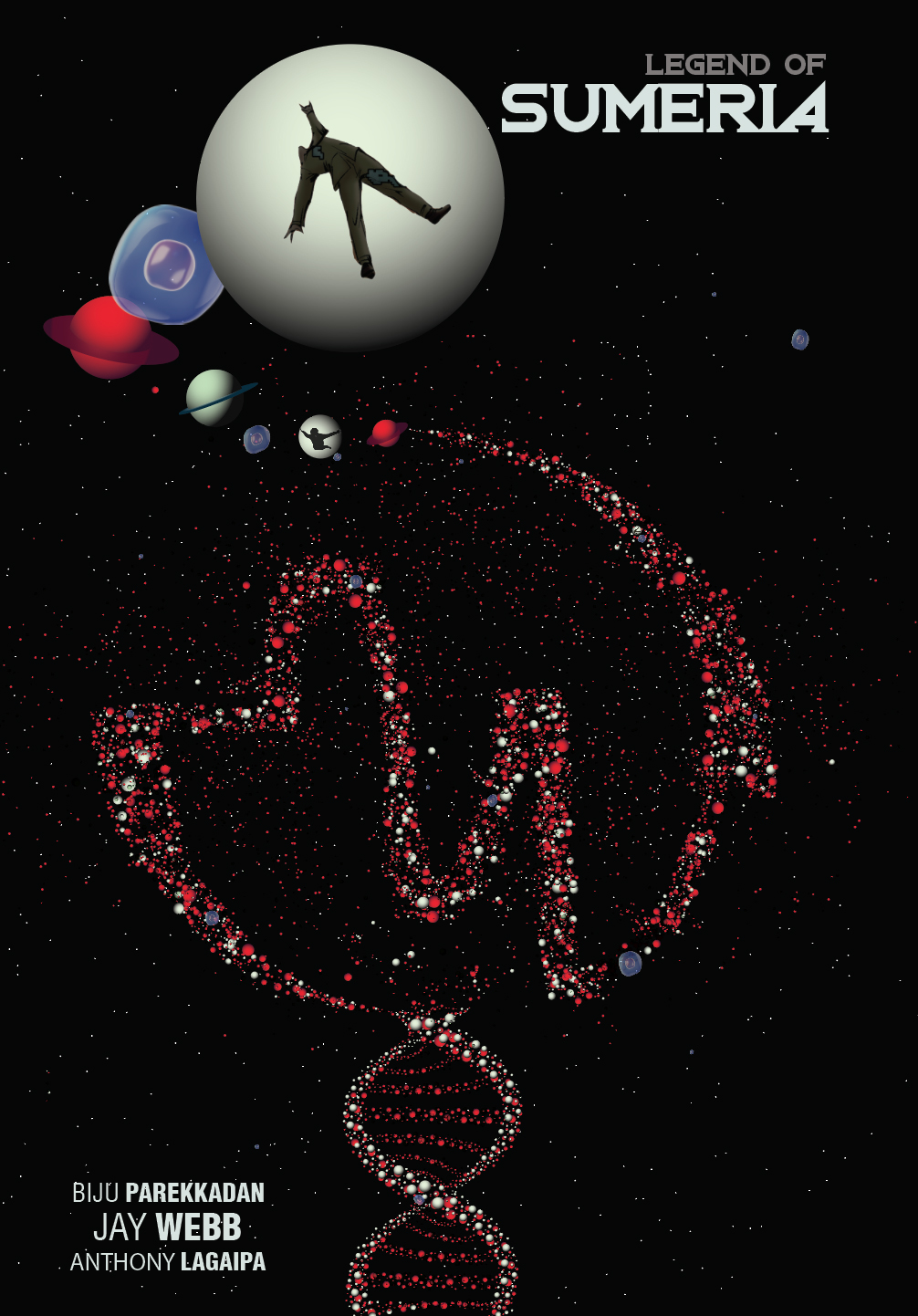
Add this to your summer reading list!


Ok, so a good place to start off would be a summary. For someone unfamiliar with Legend of Sumeria what would you tell them?

A brief summary: Sumeria asks the question of what happens to society if powerful technology gets into the wrong hands. We use real science to dramatize current events so that readers understand that the innovations of today can potentially be the source of our own demise, without ethical and moral guidance by the public.

Why did you decide to take on this project? How was the idea created?

It started as a fun exploration of the question, what would happen to society if there was a cure-all treatment for the one thing that provides evolutionary pressure on the human species: infectious disease. With the help of Jay, who has experience with film production, we broadened the story greatly and made a set of characters with relatable struggles as they navigate through this alternate reality where technologies (especially genetic technologies) have become extremely pervasive. We hope it can spur public discussion about the ethics of these futuristic projects before they really become engrained in society by the might of those who are pushing these limits.

In that initial phase, did you have a target audience? If so how did that shape your decisions?

We wanted to target scientists and cerebral readers given the topics. These folks are inherently visual learners and are embracing the story. Moreover, we are finding great enthusiasm from the bioethics and philosophy community and this looks like a great niche for us to be.

What were some of the challenges in communicating science in this art form?

We wanted to balance real science with something that was understandable to a non-scientific audience. In many cases there were story arcs that needed a scientific theory to drive it and we couldn’t come up with a viable theory then we moved on. We really wanted to stay true to the science as much as possible and not provide fluff.

How did your partnership with Jay Webb come about, and how was that collaboration?

Jay and I are best friends and have always written creatively though independently. This was our first venture together and his contribution really enriched the story and characters with a unique world view and exciting plot twists that I myself did not have experience in. I balanced his artistic vision with instilling modern, current events on the technology side and we had many great discussions to marry the two in a narrative way.
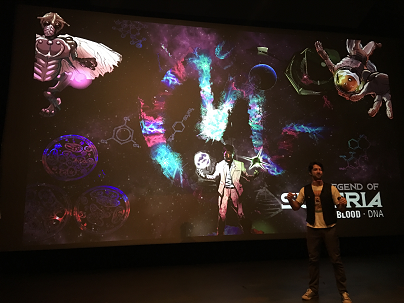
 

IMG_4992


What are your thoughts on educating others in this way? (In regards to communicating science)

We are highly motivated to work with other professors and scientists to take this concept of making science fiction and embed it within educational programs. I continue to be encouraged by the interest in the bioethics community to use this approach as a tool to introduce a bioethics case for students to then discuss in class. There are clearly a lot of creative scientists out there and we would like to support them with a professional illustration and narration team to have their stories come to life through partnering with Dream Novels LLC, our publishing entity.

Was there anything you had to exclude, or what was your process in deciding what should/should not be included?

We excluded areas that were not supported by a viable scientific theory. Furthermore, we tried to not alienate any group and created a diverse set of characters to be inclusive of all. These technologies and diseases in our story are agnostic to race, creed, or religion so we made sure that we showed how many backgrounds reacted to this new society.

Science fiction of today is like the science of tomorrow? Do you feel like some of the ideas explored in sci-fi and the ideas explored in Legend of Sumeria are possible? And what is the benefit of exploring science fiction in this way?

Absolutely, many are rooted in real technologies of today. I think the benefit of science fiction is that it enables creativity to really broaden what is possible. In many ways, it is the starting point of many the projects in my lab that start with a “sci-fi” idea and then reduce it to practice through a series of experiments.
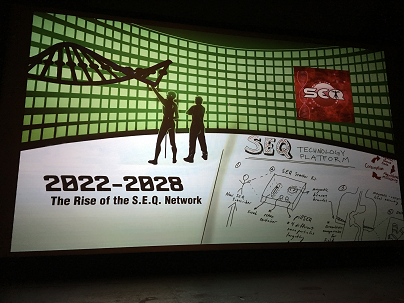
 

IMG_5001

In your opinion, what is the future of using art or other creative media as a way to communicate and educate others about science?

I strongly believe that artists and scientists should come together more to communicate complex ideas. By their nature, artists are story tellers in ways that spark an emotional response in their audience and I feel the science community can benefit from this fact rather than purely a factual presentation that lacks that human touch.

Do you have any future plans? (Another graphic novel or a follow up to Legend of Sumeria)

This first book is one of a trilogy. Once we understand our fan base, we are excited to do the next book hopefully with the support of a large publishing group who recognizes the opportunity here.

What is the main concept you would want your audience to take away from Legend of Sumeria?

Before asking “can I do this?”, be mindful and first ask “should we do this?”


Parakkeden advises individuals in science-based fields to find new and inventive ways to communicate information. Zyndo, a product he developed, displays an augmented digital reality of the book. Parakkeden and Webb’s work shows the potential of science being communicated effectively to the mainstream, and hopefully inspiring people to learn more about the subject.


Your journey starts here! Let’s talk!

ThemeRex © 2026. All rights reserved.
  Timothy Durham was convicted of rape when a test showed his DNA genotype matched the DNA recovered from the crime scene. Eye witnesses testified that Durham was in a different state at the time of the incident, but he wasn’t exonerated from his 3000 year sentence until follow up DNA analysis showed that the preliminary forensic analysis used in the trial was misinterpreted (Thomas et al.). DNA testing serves an invaluable part in our criminal justice system, but it comes with complications and bias that can lead to wrongful convictions and misinformed juries.  

Background:

Forensic genetics aims to identify the origin of a biological sample. It can be traced back to Karl Landsteiner who discovered human ABO blood groups. With blood groups, suspects could be eliminated based on their blood type. For example, if a suspect had type A blood and there was type B blood left at the scene by the perpetrator, the investigators could rule out the suspect. Unfortunately, the reverse didn’t work. If the suspect and perpetrator both had the same blood type, it can’t be concluded that the suspect was guilty. Blood identifiers evolved into 8 distinct categories which improved the ability to eliminate suspects, but could only conclude that (if the system matched) it might be the perpetrator or this person might be related to the perpetrator (Jobling and Gill). The field evolved in the 1980s with the discovery of Minisatellites, lines of repetitive DNA that don’t encode proteins. Minisatellite patterns in DNA create what we know today as the DNA fingerprint, and it has a much higher accuracy rate than previous methods (Augustyn et al.). Around the same time, a breakthrough for victims of sexual assault was discovered. In the case of assault, bodily fluids of both the victim and the assaulter can get mixed. A process called differential lysis was created which could selectively increase the concentration of sperm in a fluid sample thereby allowing for accurate DNA testing (Jobling and Gill). Forensics evolved to use single-locus probe testing after several years because of its ease of interpretation. It looked at specific minisatellites that had high variability between subjects. This was the first DNA-based method to be used in a criminal investigation. Two murder homicides from several years apart were connected using DNA evidence. The evidence was then used to exonerate an innocent man, and the guilty party was found when he tried to evade mandatory DNA testing for all men in the small town. His guilt was then reinforced when the DNA profiles matched, and he gave a confession (Jobling and Gill). Finding DNA at a crime scene doesn’t guarantee that you’ll find a murderer. There are issues with non-pure samples and limited samples that make DNA work difficult, and accreditation of facilities and new techniques and take time (Jobling and Gill).  

Subjectivity of DNA Interpretation:

In a 2009 publication, the National Academy of Science discusses the possibility for subjective influence in lab based forensics. The interpretation bias happens in complex cases where, for example, there could be a mixture of DNA. A study published in 2011 looked specifically at this issue. A gang rape happened in Georgia, and the mixture in DNA from the case was used to prosecute one suspect after another suspect took a plea bargain to testify against him. With DNA mixtures, there are three possible conclusions: suspect excluded, suspect cannot be excluded, and inconclusive. If the suspect is excluded, it means that there’s little to no possibility that his DNA is part of the sample. If the suspect cannot be excluded, it means that there’s a possibility that his DNA is part of the sample. In the trial, the DNA examiners who knew the context of the case concluded that the suspect being prosecuted could not be excluded. The 2011 study gave the DNA evidence from this case and the DNA profiles of the suspects to 17 forensic examiners. These examiners had no context of the case, and they all worked independently. Of the 17, only 1 came to the same conclusion (suspect cannot be excluded) as the examiners who knew the context of the case. Twelve of the 17 concluded that the suspect who was prosecuted and convicted had no relation to the DNA found in the sample. Not only does this show that subjectivity occurs due to the context of the case, but the 17 examiners came up with different findings based on their past experiences meaning that not all DNA analysis is objective. Some organizations like the Scientific Working Group on DNA Analysis Methods say that quantitative statistical evidence should be presented with every categorical conclusion, but the US doesn’t require this (Dror and Hampikian).

False Positives:

There are two categories that cause wrongful identification in a DNA report: coincidental matches and false positives. Coincidental matches are DNA matches between two unrelated people. The probability of these matches is about 1 to 500,000 for white individuals and about 1 to 350,000 for black individuals. This small probability of coincidental matches makes people feel confident in DNA evidence. False positives, on the other hand, are matches between DNA and test DNA that result from issues in the forensics lab. There have been multiple cases of forensics labs accidentally switching victim and suspected rapist DNA which lead to convictions that were later overturned when the lab realized the error. There are also cases of misreading or misunderstanding a sample. In a case from 1993, a man was convicted of rape because someone interpreted a mixed sample of victim and perpetrator DNA as an individual sample. The conviction was again overturned. To prevent false convictions, retesting DNA is allowed, but it’s not an efficient solution. Many people are pushing for statistical information on the probability of false positives, so that the jurors can make accurate judgements based on DNA evidence (Thomas et al.).  

Conclusion:

DNA analysis is a useful tool for the criminal justice system, but subjectivity can be an issue in forensic testing. To combat wrongful convictions, there are organizations like The Innocence Project who use DNA testing to free the innocent, but reformed forensic testing standards should be put in place to prevent subjectivity and to ensure juries are correctly informed during trials. https://www.innocenceproject.org/    

Citation:

Augustyn , Adam, et al. “DNA Finerprinting.” Encyclopedia Britannica , 26 Apr. 2018, www.britannica.com/science/DNA-fingerprinting#ref153186. Dror, Itiel E., and Greg Hampikian. “Subjectivity and Bias in Forensic DNA Mixture Interpretation.” Science & Justice, vol. 51, no. 4, 2011, pp. 204–208., doi:10.1016/j.scijus.2011.08.004. Jobling, Mark A., and Peter Gill. “Encoded Evidence: DNA in Forensic Analysis.” Nature Reviews: Genetics, vol. 5, no. 10, Oct. 2004, pp. 739–751., doi:10.1038/nrg1455. Thompson, William C, et al. “How the Probability of a False Positive Affects the Value of DNA Evidence.” Journal of Forensic Sciences, vol. 48, no. 1, Jan. 2003, pp. 1–8., doi:10.1520/jfs2001171.