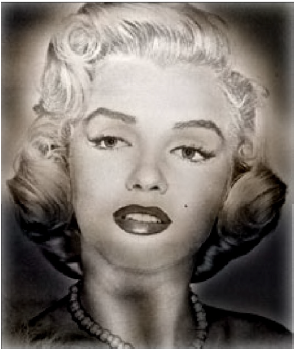
Is that Marilyn Monroe… or Albert Einstein?!

Look at this picture from up close and far away. What changes as you move further away from the screen?

What’s Computer Vision anyway?

When I hear the term “computer vision”, the first thing that comes to mind is a computer with eyes that enable it to have a sense of vision. Although this is not the exact definition the computer science industry would agree with, my train of thought is on the right path. Computer vision is a subfield of computer science that concerns itself with the problem of matching up how humans see and how computers see. I know what you’re thinking- computers can’t see! That’s precisely the issue! However, after a few weeks in CS 4476 at Georgia Tech, I have begun to learn a few things about how the scientific community has worked to solve this disconnect between machines and humans. In this reflection, I will present a brief walkthrough of my experience completing CS 4476 Project 1 and some of its important concepts with corresponding pictures. If you enjoy optical illusions, get ready for hybrid images!

There is a common misconception among people outside of the computer science (CS) community that computers are extremely smart and adept- the reason being that computers can do difficult tasks at lightning speed while a human would likely take much longer. This is FALSE! Everything a computer “knows” how to do, it was taught how by a human. Fields like artificial intelligence and machine learning have been wondering how to reflect human cognitive functions like thinking, feeling, and perceiving onto machines. Computer vision is no different- we want to know how to make a computer see the same way a human sees.

My experience in CS and Project details

When I started this class this semester, I was just as intimidated as I was walking into the Machine Learning course last year. I did end up surviving that terrifying ML class although I still have nightmares about the assignments. Most CS courses at Georgia Tech are known to be intimidating to me with all of the complex math and science thrown around; computer vision was no exception. The first project, titled Convolution and Hybrid Images, required students to write an image filtering function in order to create hybrid images. What does all this mean? Allow me to explain as best I can without going into intense, scary detail.

Our project was broken up into three parts: Image Filtering, Hybrid Images with PyTorch, and understanding input/outputs in PyTorch. The first section involved using Gaussian Kernels in order to blur the images given in the prompt: to do this, we had to implement concepts from linear algebra to create vectors and statistics to manipulate variables like mean, standard deviation, and covariance of the Gaussian. The term kernel in this context does not have anything to do with popcorn, although that was my first thought too. A kernel in computer science is the core of any operating system that provides basic functions to every other part of the system.

the visualization of the Gaussian kernel

Using the Gaussian filter, we were able to see the image filtering function we wrote in action, blurring an image of a cute cat. See how the cat on the right is ever-so-slightly blurry?
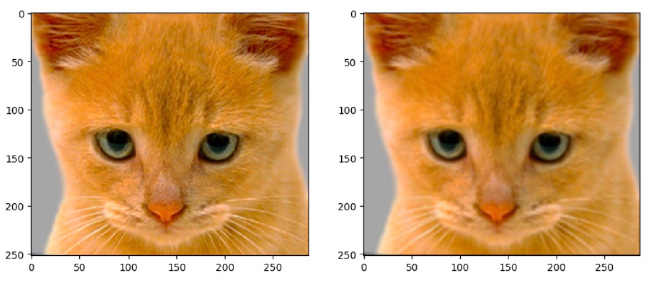
Left-original, right-blurred

Next, we implemented something called a Sobel Filter, which uses the Sobel operator to calculate the gradient of image intensity at each pixel. In terms of image altering, here is what happened to our cat picture after applying the Sobel Filter:
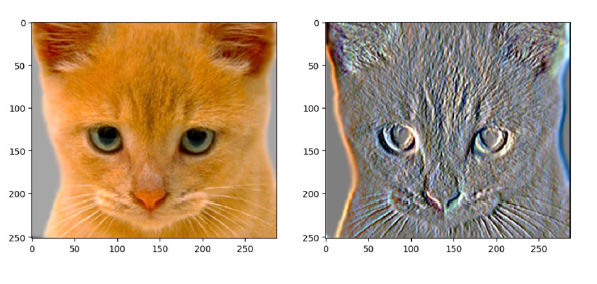
Sobel Filter on cat image

The real fun begins…

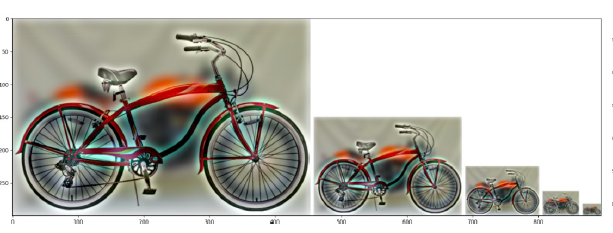
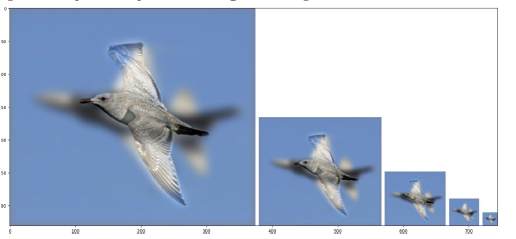
My favorite part of this entire assignment was the hybrid image portion. A hybrid image is the combination of a low-pass filtered version of one image and a high-pass filtered version of another image. Low and high pass filtering refers to cutting out either the low or high frequencies in an image and only leaving one or the other. You might have heard about frequency in sounds, but what is frequency in an image? The frequency of an image is basically the rate of change of intensity values- if an image has high frequency, the pixels move from one pixel to the next quickly. In low frequency, the pixel’s color values share similar hues since the pixels move slowly to the next pixel. Hybrid images remind me of optical illusions because the eye sees one image from looking near the screen and sees the other image when looking from a far distance. The way that the image filtering sort of tricks the eye into seeing two different images in “one” image is one of the things that makes computer vision so cool! Some more hybrid image examples can be seen below:
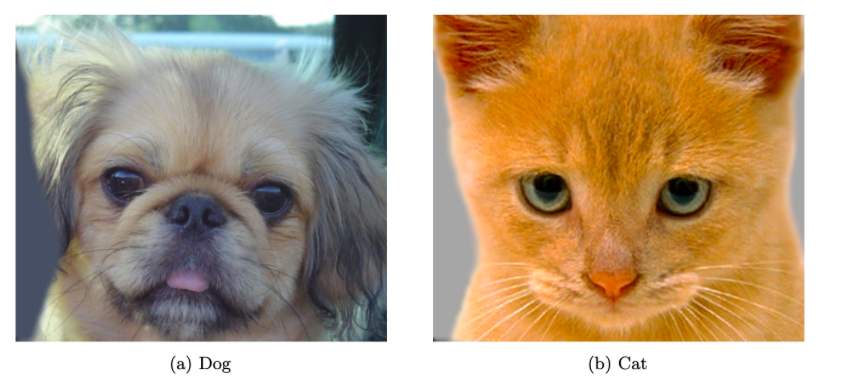
original cat and dog images
Cat + dog, cat from up close and dog from far away
Motorcycle + Bicycle
Bird + plane

Hybrid images are created by first calculating the low frequencies of both images being used. Then we can find the high frequency of one image by subtracting its low frequency value from all the frequencies in the image. This gives us the low frequency of image 1 and the high frequency of image 2- summing these two values gives us the beautiful hybrid images seen above.

Conclusion

Although computer science can be daunting with its vast library of tools and functions, going through the resources bit by bit (no pun intended) and using the help of the class TAs, I was able to complete Project 1! What I learned from this project besides the actual content was that computer vision functions take a long time to run on old computers and that Piazza is one of the best tools ever utilized at Tech. Overall, I had fun making the hybrid images though it took me a while to figure out exactly how. The key to computer science is patience, asking questions, and not giving up when errors keep bombarding your terminal.

Your journey starts here! Let’s talk!

ThemeRex © 2026. All rights reserved.
  Timothy Durham was convicted of rape when a test showed his DNA genotype matched the DNA recovered from the crime scene. Eye witnesses testified that Durham was in a different state at the time of the incident, but he wasn’t exonerated from his 3000 year sentence until follow up DNA analysis showed that the preliminary forensic analysis used in the trial was misinterpreted (Thomas et al.). DNA testing serves an invaluable part in our criminal justice system, but it comes with complications and bias that can lead to wrongful convictions and misinformed juries.  

Background:

Forensic genetics aims to identify the origin of a biological sample. It can be traced back to Karl Landsteiner who discovered human ABO blood groups. With blood groups, suspects could be eliminated based on their blood type. For example, if a suspect had type A blood and there was type B blood left at the scene by the perpetrator, the investigators could rule out the suspect. Unfortunately, the reverse didn’t work. If the suspect and perpetrator both had the same blood type, it can’t be concluded that the suspect was guilty. Blood identifiers evolved into 8 distinct categories which improved the ability to eliminate suspects, but could only conclude that (if the system matched) it might be the perpetrator or this person might be related to the perpetrator (Jobling and Gill). The field evolved in the 1980s with the discovery of Minisatellites, lines of repetitive DNA that don’t encode proteins. Minisatellite patterns in DNA create what we know today as the DNA fingerprint, and it has a much higher accuracy rate than previous methods (Augustyn et al.). Around the same time, a breakthrough for victims of sexual assault was discovered. In the case of assault, bodily fluids of both the victim and the assaulter can get mixed. A process called differential lysis was created which could selectively increase the concentration of sperm in a fluid sample thereby allowing for accurate DNA testing (Jobling and Gill). Forensics evolved to use single-locus probe testing after several years because of its ease of interpretation. It looked at specific minisatellites that had high variability between subjects. This was the first DNA-based method to be used in a criminal investigation. Two murder homicides from several years apart were connected using DNA evidence. The evidence was then used to exonerate an innocent man, and the guilty party was found when he tried to evade mandatory DNA testing for all men in the small town. His guilt was then reinforced when the DNA profiles matched, and he gave a confession (Jobling and Gill). Finding DNA at a crime scene doesn’t guarantee that you’ll find a murderer. There are issues with non-pure samples and limited samples that make DNA work difficult, and accreditation of facilities and new techniques and take time (Jobling and Gill).  

Subjectivity of DNA Interpretation:

In a 2009 publication, the National Academy of Science discusses the possibility for subjective influence in lab based forensics. The interpretation bias happens in complex cases where, for example, there could be a mixture of DNA. A study published in 2011 looked specifically at this issue. A gang rape happened in Georgia, and the mixture in DNA from the case was used to prosecute one suspect after another suspect took a plea bargain to testify against him. With DNA mixtures, there are three possible conclusions: suspect excluded, suspect cannot be excluded, and inconclusive. If the suspect is excluded, it means that there’s little to no possibility that his DNA is part of the sample. If the suspect cannot be excluded, it means that there’s a possibility that his DNA is part of the sample. In the trial, the DNA examiners who knew the context of the case concluded that the suspect being prosecuted could not be excluded. The 2011 study gave the DNA evidence from this case and the DNA profiles of the suspects to 17 forensic examiners. These examiners had no context of the case, and they all worked independently. Of the 17, only 1 came to the same conclusion (suspect cannot be excluded) as the examiners who knew the context of the case. Twelve of the 17 concluded that the suspect who was prosecuted and convicted had no relation to the DNA found in the sample. Not only does this show that subjectivity occurs due to the context of the case, but the 17 examiners came up with different findings based on their past experiences meaning that not all DNA analysis is objective. Some organizations like the Scientific Working Group on DNA Analysis Methods say that quantitative statistical evidence should be presented with every categorical conclusion, but the US doesn’t require this (Dror and Hampikian).

False Positives:

There are two categories that cause wrongful identification in a DNA report: coincidental matches and false positives. Coincidental matches are DNA matches between two unrelated people. The probability of these matches is about 1 to 500,000 for white individuals and about 1 to 350,000 for black individuals. This small probability of coincidental matches makes people feel confident in DNA evidence. False positives, on the other hand, are matches between DNA and test DNA that result from issues in the forensics lab. There have been multiple cases of forensics labs accidentally switching victim and suspected rapist DNA which lead to convictions that were later overturned when the lab realized the error. There are also cases of misreading or misunderstanding a sample. In a case from 1993, a man was convicted of rape because someone interpreted a mixed sample of victim and perpetrator DNA as an individual sample. The conviction was again overturned. To prevent false convictions, retesting DNA is allowed, but it’s not an efficient solution. Many people are pushing for statistical information on the probability of false positives, so that the jurors can make accurate judgements based on DNA evidence (Thomas et al.).  

Conclusion:

DNA analysis is a useful tool for the criminal justice system, but subjectivity can be an issue in forensic testing. To combat wrongful convictions, there are organizations like The Innocence Project who use DNA testing to free the innocent, but reformed forensic testing standards should be put in place to prevent subjectivity and to ensure juries are correctly informed during trials. https://www.innocenceproject.org/    

Citation:

Augustyn , Adam, et al. “DNA Finerprinting.” Encyclopedia Britannica , 26 Apr. 2018, www.britannica.com/science/DNA-fingerprinting#ref153186. Dror, Itiel E., and Greg Hampikian. “Subjectivity and Bias in Forensic DNA Mixture Interpretation.” Science & Justice, vol. 51, no. 4, 2011, pp. 204–208., doi:10.1016/j.scijus.2011.08.004. Jobling, Mark A., and Peter Gill. “Encoded Evidence: DNA in Forensic Analysis.” Nature Reviews: Genetics, vol. 5, no. 10, Oct. 2004, pp. 739–751., doi:10.1038/nrg1455. Thompson, William C, et al. “How the Probability of a False Positive Affects the Value of DNA Evidence.” Journal of Forensic Sciences, vol. 48, no. 1, Jan. 2003, pp. 1–8., doi:10.1520/jfs2001171.