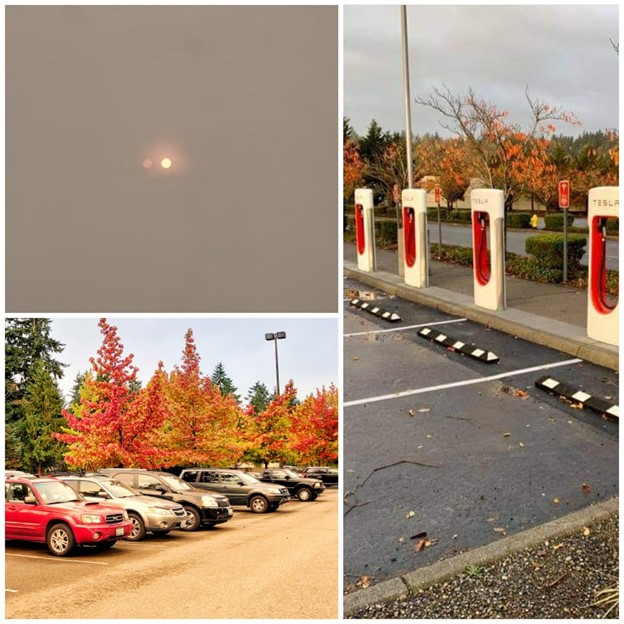
Electric vehicles have gained momentum in the recent years due to a considerable percentage of personal vehicle users as well as freight companies that converted from using internal combustion engine vehicles to some type of electric vehicles. Electric vehicles by definition, have at least some electric powerplant that powers the engine particularly or completely by one or more electric motors. This article forces on the environmental impacts of electric vehicles that entirely depend on batteries for storage and delivering electric power for the motors.
Plug-in hybrid electric vehicles (PHEVs) are being developed for a decade or so for mass production by the automotive industry by some major automakers. However, the rise of Tesla, the most valued automaker at the moment during the time of writing this article, have pushed the limit of how an average car user can adopt completely to an all electric car and thereby save the environment from massive carbon footprint resulting from fossil fuels. PHEVs do not use any type of fuel other than battery packs that store and deliver energy. PHEVs have been touted for their potential to reduce the transportation system’s petroleum dependence and greenhouse gas emissions by using off-peak excess electric generation capacity and increasing the vehicle’s energy efficiency. As such, PHEVs are in a massive boom as several other companies have emerged with large financial backings that have pledged to produce EVs to save the environment and to ensure a zero emission transportation system in the future. The burning question is of course: do EVs actually have a significant impact in the improvement of environment?
The U.S. Department of Energy’s has a Vehicle Technology Program that examines the precompetitive, high-risk research needed to develop the component and infrastructure technologies necessary to enable a full range of affordable cars and light trucks that are expected to reduce the U.S. dependence on imported oil and minimize harmful vehicle emissions, without sacrificing freedom of mobility and freedom of vehicle choice [1]. Although PHEVs are similar to the regular hybrid electric vehicles (HEVs), the battery can be charged using electricity from the grid by being recharged through a wall outlet. In terms of the overall environmental impact, PHEVs not only have direct impact as a result of not burning traditional fuels, but also the battery chemistry, the amount of grid electricity that can be stored in the battery, recycling ability of the raw materials, and the ability to give unused “power back to the grid” could significantly impact the environment.
Below is a schematic showing the life-cycle for a typical EV from production to termination of usage. An EV, by its nature of production type as well as type of usage, typically have less carbon footprint in each lifecycle phase compared to that of a fossil fuel burning vehicle.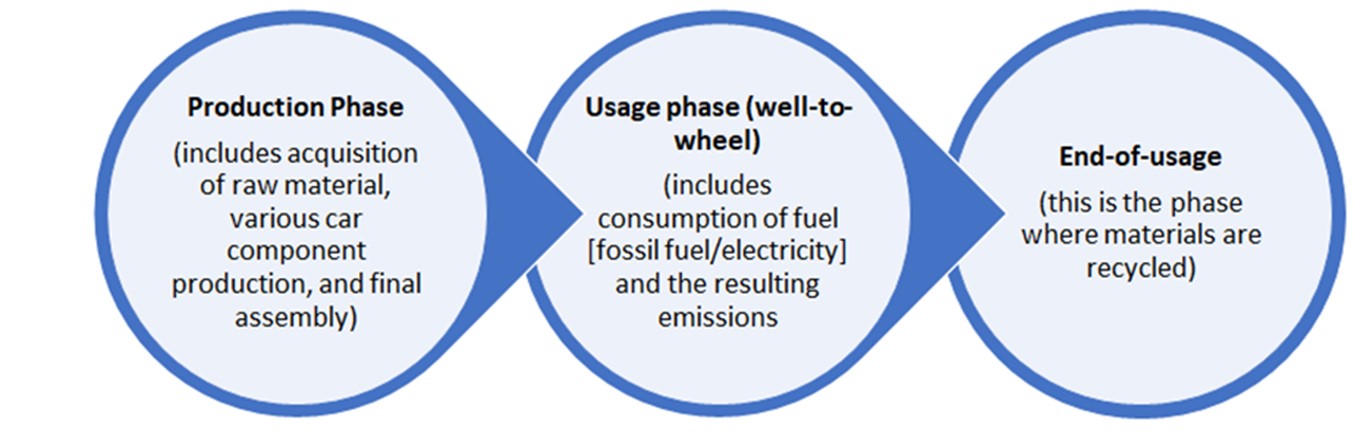
It is important to note that while PHEVs offer the potential for significant reduction in the usage of fossil fuel and resulting emissions of greenhouse gases, the actual benefit calculations need to take into account the upstream energy and emissions penalties that are associated with the electricity generation needed to power the charging systems and the load on the grid. Few studies have indeed taken all of these factors into account for certain vehicles that offer a choice of electric or internal combustion engine options for the same model. A study on the well known Volkswagen Golf model showed that, using the latest EU electricity mix, the current Golf TDI (Diesel) emits 140g CO2/km on average over its entire life cycle, while the e-Golf1 reaches 119g CO2/km. Based on the report, most of the emissions occur during the use phase of the internal combustion engine vehicle. Here the diesel reaches 111g CO2/km while a corresponding vehicle with electric drive emits only 62g CO2/km during the same phase [2].
Key findings about EV and carbon emission
- Several european countries where EVs are prevalent have significantly more carbon-intensive power generation – due to reliance on coal plants – EVs still perform better there on a lifecycle basis, which includes the emissions in manufacturing the battery and vehicle. Based on the Polish average, an EV emits 25% less CO2 over its lifetime. In Sweden, which has one of the cleanest energy mixes in the EU, an EV emits 85% less than a diesel car [3]. The figure below shows a summary of the study [3,4].
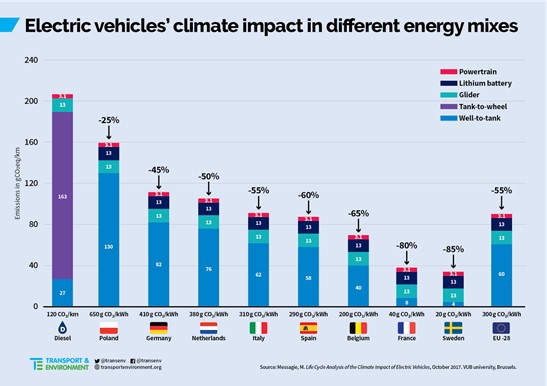
EV Climate impact for different Energy Mixes (reproduced from Transport and Environment) - Replacing a traditional ride-hailing car with an electric vehicle would deliver three times the environmental benefits and emission reductions, according to a new study. The finding comes as a new cost analysis shows that e-vehicles are cheaper to run for Uber drivers in many European cities, and Uber in Portugal says it will only take on new drivers if they have an EV.
- Both Uber and Lyft have made recent statements expressing their intention to move towards a totally electric fleet. But now, for the first time, a study has looked at what the environmental impact might be. The study by University of California’s transportation institute, looked at 400,000 journeys made in a battery EV by 1,000 ride-hailing drivers, and compared the impact with 118,668 journeys made in a petrol or diesel car, as well as over 15,000 in a plug-in hybrid EV [5].
- The biggest finding is that the potential environmental and emission reduction benefits of replacing a ride-hailing traditional car with an EV are ‘approximately three times higher compared with those of regular vehicle usage in California’, and on emissions alone this was ‘the most pessimistic scenario’. This is because vehicles owned by Uber, Lyft and other ride-hailing drivers are driven more than if they were only used for private use (about 305km on average per day compared to 48km) [5].
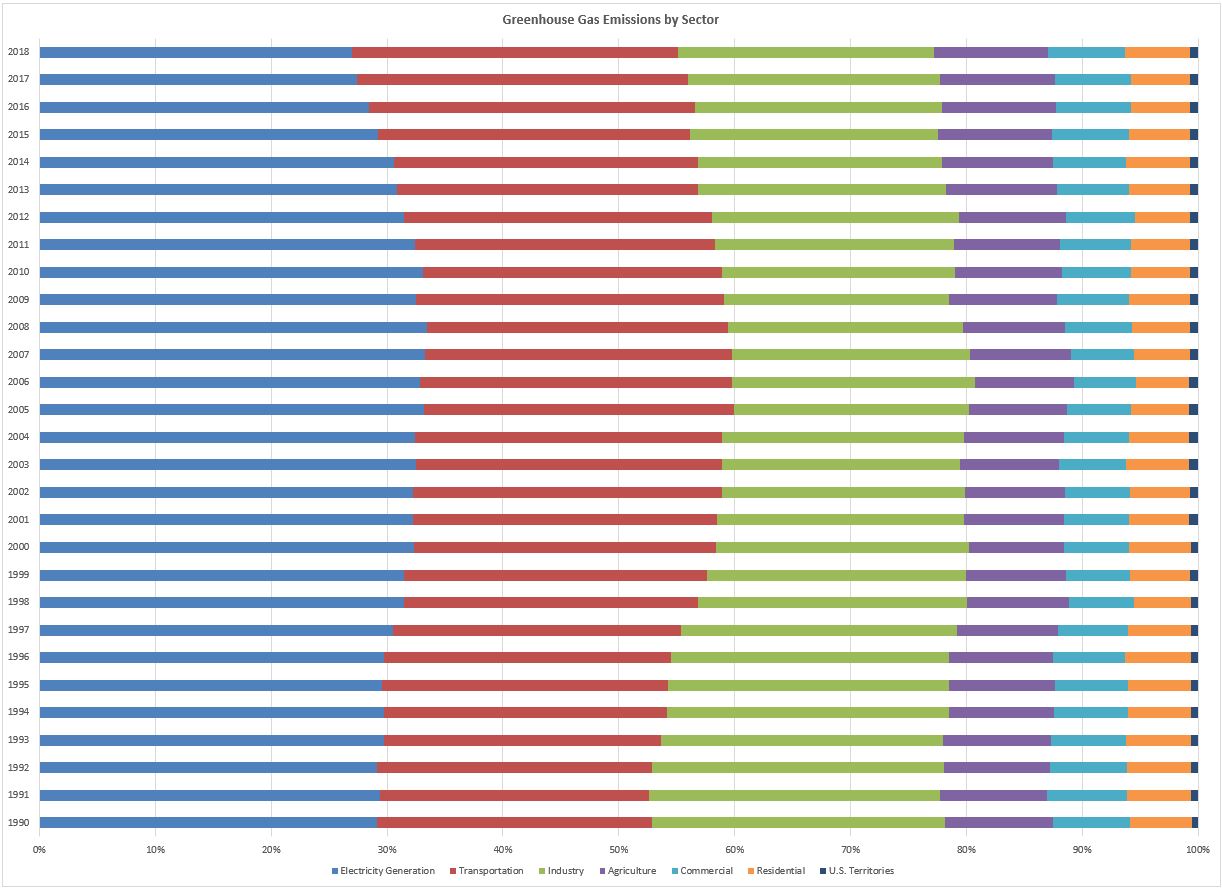
- Below is a chart based on data from EPA in the US for greenhouse gas emissions by different sectors [9] . Based on the data, it can be seen that transportation sector contributes to a large amount of green house emission. It will be interesting to see the insights about how EVs and PHEVs come into play.
How to calculate carbon footprint:
Carbon offsetting funds solutions to reducing carbon emissions now. Frequently carbon offsetting reduces emissions much faster than you can as an individual/single company. Carbon offsetting projects help to combat global climate change as well as caring for local communities. In many instances providing much needed employment, health improvement, biodiversity, reforestation and broad social benefits to impoverished communities.
Calculator:
This free to use online carbon calculator tool is independently audited on an annual basis as part of the Quality Assurance Standard (QAS) for Carbon Offsetting.
https://www.carbonfootprint.com/calculator.aspx
Reference:
-
- Elgowainy, A., Burnham, A., Wang, M., Molburg, J., & Rousseau, A. (2009). Well-to-wheels energy use and greenhouse gas emissions of plug-in hybrid electric vehicles. SAE International Journal of Fuels and Lubricants, 2(1), 627-644.
- https://www.lowcvp.org.uk/news,vw-study-shows-co2-benefits-of-evs-over-whole-lifecycle_3946.htm (accessed October 2020)
- https://www.transportenvironment.org/press/electric-cars-emit-less-co2-over-their-lifetime-diesels-even-when-powered-dirtiest-electricity (Accessed September 2020)
- Messagie, M. (2014). Life cycle analysis of the climate impact of electric vehicles. Journal of Life Cycle Assessment, 2014, 14.
- Jenn, A. (2020). Emissions benefits of electric vehicles in Uber and Lyft ride-hailing services. Nature Energy, 5(7), 520-525.
- Noori, M., Gardner, S., & Tatari, O. (2015). Electric vehicle cost, emissions, and water footprint in the United States: development of a regional optimization model. Energy, 89, 610-625.
- Data from US Dept of energy: https://afdc.energy.gov/data/10347 (annual energy usage impact) (Accessed September 2020)
- https://afdc.energy.gov/data/10301 (US HEV sales by model) (Accessed September 2020)
- https://afdc.energy.gov/data/10802 (Green house gas emission by economic sector) (Accessed September 2020)