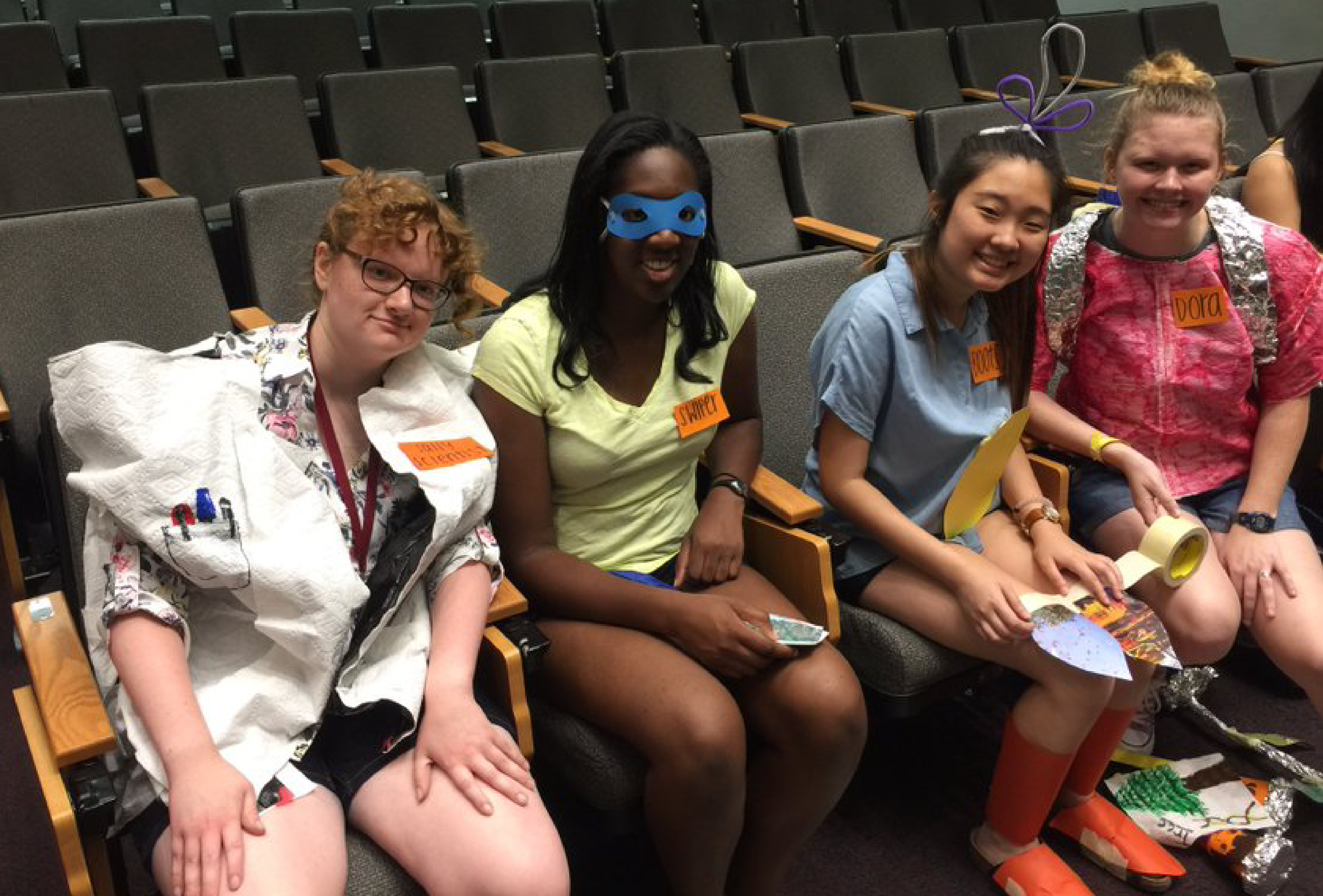
What’s the first thing you notice about this photo? Maybe it’s the girl in the paper towel shirt with a tin foil backpack posing as Dora? Or maybe the girl with the construction paper boots or the girl with the Swiper paper mask? Or maybe you see me in the paper towel lab coat pretending to be a scientist character in the Dora cinematic universe.
Why are we dressed as 5-minute craft Dora characters, you might ask? Well, in the name of science, of course! Specifically, as part of our team’s Presentation of Action on our solution to a Biosecurity problem scenario set 20 years in the future. Ok woah, a lot of exposition. So let’s throw it back and break down one of the most useful organizations for youth interested in STEM, Future Problem Solving!
Alright, what’s Future Problem Solving?
Sounds like a bunch of buzzwords slapped together, but there is a reason for this I promise!
Future Problem Solving (FPS) is an international program for K-12 that teaches students critical and creative problem-solving by training them in a six-step problem-solving model. A quick run-down of the steps:
- Identify Challenges – Given a complex, real-world scenario, what are some problems you can identify? Usually students will use a category list to try to identify problems of a diverse nature.
- Select an Underlying Problem – Out of all the problems identified, which problem is the most impactful on the scenario? Think – if we solved this, other problems might also be solved and the users would be the most benefited. What action verb would possible solutions need to accomplish to solve this main problem?
- Produce Solution Ideas – The fun part! Brainstorm creative yet realistic solutions to the underlying problem.
- Generate and Select Criteria – Create criteria that help you decide which solution is the best at solving the underlying problem and addressing the needs of the original scenario.
- Apply Criteria – Run each solution through the criteria you created and rank which one best meets all criteria overall.
- Develop an Action Plan – Whichever solution ranked first in step 5 will be your final solution to the problem. You need to elaborate on the who, how, what, where, why of the solution to explain how it could be implemented in the scenario and why it solves your underlying problem. (At the state and international level, teams will create a skit that describes their action plan. The limit is that for skit props, teams can only build them out of household items – hence, our makeshift Dora fits above! We created a cute Dora the Explora skit for our Presentation of Action Plan where I was a scientist explaining the research behind our action plan.)
What makes this model unique though, is what problems are being solved (and here’s where the ‘Future’ of FPS comes in).
Each problem scenario is centered around a STEM-related topic, and the sky’s the limit with what areas of STEM these topics can derive from. Some of my favorites during my time included: Enhancing Human Potential, Biosecurity, Energy of the Future, Cloud Storage, Endangered Animals, and 3D Printing. Doing pre-competition research on the topic is highly encouraged, as students are given bonus points if they can describe current technology or solutions from corresponding STEM fields.
The program throws you for another loop though by setting all these topics in a scenario that takes place 10-20 years in the future, making students not only think about the current state of the topic, but how it and its corresponding technology might possibly evolve.
While the program expects you to be creative with solution ideas in this field, it also expects you to understand the feasibility of current tech and how it might realistically look in the future. There are no ‘magic pill’ solutions that solve the problem with the flick of a switch allowed. You can be creative, but it’s got to be something that has a basis in our modern day to get ya points.
So you got the basics of FPS down now. Just like with the Action Plan, let me hit ya with the WHY Future Problem Solving is an integral skill-builder for any primary school kids interested in a STEM career.
Why You Should Force Yourself (or Force Your Child) To Join FPS
I did FPS for 9 years before joining Georgia Tech as a Biomedical Engineering and then Computational Media major, so I speak from experience here that this six-step method of problem-solving is very similar to how both Engineers and Computer Scientists solve real-world problems in their respective fields.
Let’s pretend we’re Biomedical/Software Engineers for a moment, and we’ve been given a specific user base that we want to design a device for that solves an issue they’ve been struggling with:
- To design a medical device or a computer program that’s meant to help a user base, first you need to identify what problem your users have.
- Oftentimes, you’ll do user interviews and find users have MANY problems. One device can solve a few, but often due to restricted budgets and timelines, it’s not feasible to solve all the user’s problems, so you need to identify which ones are the highest priority (your underlying problem).
- From then, research & design happens. You collaborate with your team on seeing what technology/systems currently exist and what are new methods/designs you can try to create that modify the current tech or are completely new from them (and you make simple prototypes of them).
- Then you need to narrow down which design you want to move forward in with prototyping because there’s not enough time and money in the real-world to try to make every idea all the way from scratch to completion.
- This is where you need to set up criteria to assist in deciding which device prototype you’ll choose as your action plan.
- Finally, once you’ve built and tested your device, you need to explain to your stakeholders and users how the device works and solves the identified problems from before. Otherwise, what was this all for besides wasting money?
Did you see all the FPS steps in this engineering/computer science scenario? Granted, while this is a very simplified explanation, at the core, this scenario is what you do while working on projects in these fields. Even though I had no engineering or computer science experience before coming to Tech, it never felt unnatural to me when I was working on design projects because the process had already been ingrained into my being from FPS. I already knew how to critically think, so I could instead really dive into the technology I was working on and focus on coming up with solutions. Imagine starting with a leg-up at GT, and you never knew it!
FPS, My Old Friend
Beyond preparing me just for critical problem-solving in STEM, FPS also fostered my love for collaborating in teams. I loved the moments I shared with my teammates: Our countless recitations of topic-related vocabulary cards on the bus to the state competition in Athens, our nervous hands hovered above the face-down scenarios in a sea of international teams, the late nights of coloring absurd amounts of paper towels red, our screams when we won First Place at Internationals for our Dora skit. I wouldn’t change those moments for the world. Who thought something as educational as solving STEM problems for 2 hours could shape the best parts of my mind and life?
To make it part of your life, check out the FPSPI website to see if you can find an active division near you. And if there are no current divisions, Future Problem Solving always welcomes the start of new ones! Get out there and solve some problems my fellow STEM kids!