Don’t call me bird-brained!

The island of New Caledonia

What’s wrong with you humans, using us as insults? Just the other day, I heard one of you call your boss a vulture! Now, I’m not here to deny that man’s covetous proclivities, but I happen to have a friend who’s met a vulture, and I hear they’re quite lovely chaps. At any rate, they’re probably going to go extinct because of you idiots; some respect on the way out would be nice. Perhaps I’m being uncharitable. I know a lot of you are rather well-meaning, and that you study other animals to understand us better. But you have to realize, my dear apes, it’s not always the case that we can’t figure out some of these tasks you present us with, but that we don’t feel like doing them in the first place!

Anyway, let’s move on to the main subject of my little essay–a paper I found in one of your journals. Here, von Bayern and his buddies studied compound tool construction in my species–New Caledonian crows. Compound tools are made from two or more separate objects, each of which might function individually as a tool. Until recently, compound tool construction has only been observed in your family—the hominids. The most famous example of compound tool construction outside of humans occurred over a century ago when a man named Wolfgang Köhler was studying apes on an island much like mine and discovered that one of his chimpanzees, Sultan, was able to combine two bamboo sticks to reach a banana. With the increasing evidence that members of my family, the corvids, seem to possess rather impressive cognitive abilities (if I do say so myself), von Bayern and his crew decided to conduct a study in which they presented a few of my friends with a variety of tools, some of which could be combined with others to create more complex tools. They were first provided with a food reward that could be extracted with a single tool, after which the researchers introduced pieces of food that were much too far to reach without creating a compound tool. Half of the crows in the experiment (yes, yes, go ahead and laugh–I’m sure all of your friends are geniuses, aren’t they?) were able to combine the tools with no prompting from humans. Even your study concedes that my friends seemed to have created the tools for a very specific purpose and that they seemed to understand when to use the tools because the further the reward was, the more likely they were to combine the provided tools before their first attempt at reaching their treat.
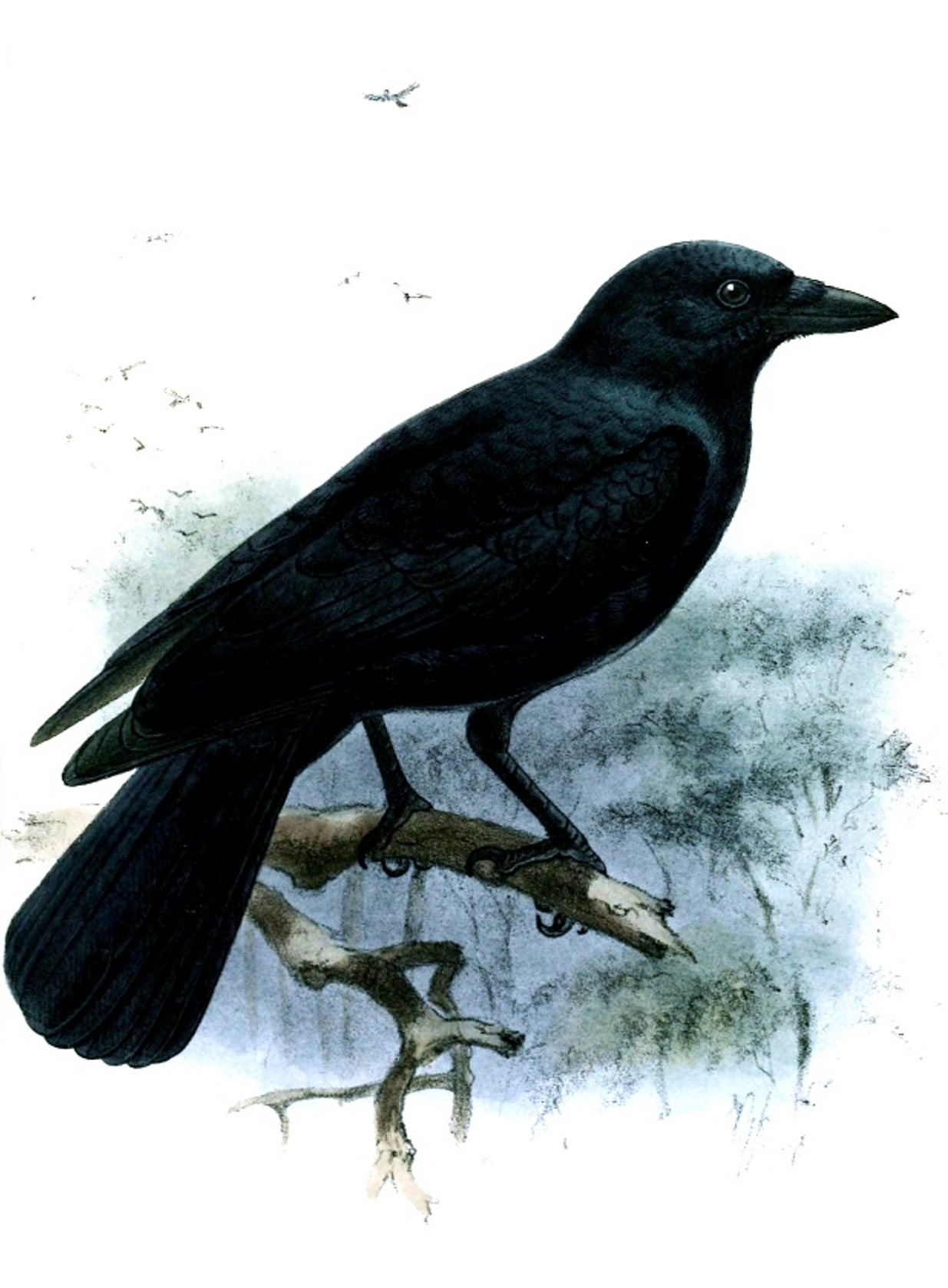
My great-great-great-great…I don’t really know, honestly. My ancestor. Damn handsome fellow. In your year 1877, if you must know. You creatures have such a strange obsession with tracking the sun.

I was more or less happy with the paper so far, but it was the next part that made me squawk with delight! One of my buddies, Wak-wak (I think he was called Mango in the paper–what is it with you people naming us after food? Would you like it if I called you Burger?), happened to break several tools in an effort to fit them into each other. Nevertheless, once he was able to overcome these difficulties, he repeatedly constructed 3- and 4-component tools. You see, as my forefathers took to the heavens, it made it more difficult for their progeny to engage in tool use. To put it more simply, we don’t have hands, damn it! Not one thumb! How the hell am I supposed to build a civilization when all I’ve got is this damn beak?

I will now let you in on a secret. Remember that chimp I told you about earlier? Köhler helped him make the tool. In fact, Sultan was unable to use the bamboo sticks until Köhler showed him how he could hit his finger into one, and even still, it took him over an hour to figure out the task. Moreover, he had some difficulty replicating the task the following day. Compare that to my comrades, who were able to figure the task out in at most six minutes and continued to construct new tools in successive trials. Look, I know that it’s difficult for my species to communicate with yours; hell, I’ve been scrawling this letter out for the past three months on a piece of driftwood. Ultimately, we’re quite different, and you really can’t know for sure why we do the things that we do. All that I ask is a little compassion. A little understanding. A little respect. Sure, we can’t do long division, but why would we want to? Just remember that we all share this planet, and that you can never really know what’s going on in our heads.

Citations:
Ogada et al. (2015). Another Continental Vulture Crisis: Africa’s Vultures Collapsing toward
Extinction. Conservation Letters, 9. https://doi.org/10.1111/conl.12182
von Bayern et al. (2018). Compound tool construction by New Caledonian crows. Scientific
Reports, 8. https://doi.org/10.1038/s41598-018-33458-z

Image Credit:
Araucaria columnaris New Caledonia via Creative Commons license.
New Caledonian Crow via Wikimedia Commons.

Note: The anthropomorphism is merely a vehicle to draw light to a couple of issues. Also, please continue naming animals after food.

Your journey starts here! Let’s talk!

ThemeRex © 2026. All rights reserved.
  Timothy Durham was convicted of rape when a test showed his DNA genotype matched the DNA recovered from the crime scene. Eye witnesses testified that Durham was in a different state at the time of the incident, but he wasn’t exonerated from his 3000 year sentence until follow up DNA analysis showed that the preliminary forensic analysis used in the trial was misinterpreted (Thomas et al.). DNA testing serves an invaluable part in our criminal justice system, but it comes with complications and bias that can lead to wrongful convictions and misinformed juries.  

Background:

Forensic genetics aims to identify the origin of a biological sample. It can be traced back to Karl Landsteiner who discovered human ABO blood groups. With blood groups, suspects could be eliminated based on their blood type. For example, if a suspect had type A blood and there was type B blood left at the scene by the perpetrator, the investigators could rule out the suspect. Unfortunately, the reverse didn’t work. If the suspect and perpetrator both had the same blood type, it can’t be concluded that the suspect was guilty. Blood identifiers evolved into 8 distinct categories which improved the ability to eliminate suspects, but could only conclude that (if the system matched) it might be the perpetrator or this person might be related to the perpetrator (Jobling and Gill). The field evolved in the 1980s with the discovery of Minisatellites, lines of repetitive DNA that don’t encode proteins. Minisatellite patterns in DNA create what we know today as the DNA fingerprint, and it has a much higher accuracy rate than previous methods (Augustyn et al.). Around the same time, a breakthrough for victims of sexual assault was discovered. In the case of assault, bodily fluids of both the victim and the assaulter can get mixed. A process called differential lysis was created which could selectively increase the concentration of sperm in a fluid sample thereby allowing for accurate DNA testing (Jobling and Gill). Forensics evolved to use single-locus probe testing after several years because of its ease of interpretation. It looked at specific minisatellites that had high variability between subjects. This was the first DNA-based method to be used in a criminal investigation. Two murder homicides from several years apart were connected using DNA evidence. The evidence was then used to exonerate an innocent man, and the guilty party was found when he tried to evade mandatory DNA testing for all men in the small town. His guilt was then reinforced when the DNA profiles matched, and he gave a confession (Jobling and Gill). Finding DNA at a crime scene doesn’t guarantee that you’ll find a murderer. There are issues with non-pure samples and limited samples that make DNA work difficult, and accreditation of facilities and new techniques and take time (Jobling and Gill).  

Subjectivity of DNA Interpretation:

In a 2009 publication, the National Academy of Science discusses the possibility for subjective influence in lab based forensics. The interpretation bias happens in complex cases where, for example, there could be a mixture of DNA. A study published in 2011 looked specifically at this issue. A gang rape happened in Georgia, and the mixture in DNA from the case was used to prosecute one suspect after another suspect took a plea bargain to testify against him. With DNA mixtures, there are three possible conclusions: suspect excluded, suspect cannot be excluded, and inconclusive. If the suspect is excluded, it means that there’s little to no possibility that his DNA is part of the sample. If the suspect cannot be excluded, it means that there’s a possibility that his DNA is part of the sample. In the trial, the DNA examiners who knew the context of the case concluded that the suspect being prosecuted could not be excluded. The 2011 study gave the DNA evidence from this case and the DNA profiles of the suspects to 17 forensic examiners. These examiners had no context of the case, and they all worked independently. Of the 17, only 1 came to the same conclusion (suspect cannot be excluded) as the examiners who knew the context of the case. Twelve of the 17 concluded that the suspect who was prosecuted and convicted had no relation to the DNA found in the sample. Not only does this show that subjectivity occurs due to the context of the case, but the 17 examiners came up with different findings based on their past experiences meaning that not all DNA analysis is objective. Some organizations like the Scientific Working Group on DNA Analysis Methods say that quantitative statistical evidence should be presented with every categorical conclusion, but the US doesn’t require this (Dror and Hampikian).

False Positives:

There are two categories that cause wrongful identification in a DNA report: coincidental matches and false positives. Coincidental matches are DNA matches between two unrelated people. The probability of these matches is about 1 to 500,000 for white individuals and about 1 to 350,000 for black individuals. This small probability of coincidental matches makes people feel confident in DNA evidence. False positives, on the other hand, are matches between DNA and test DNA that result from issues in the forensics lab. There have been multiple cases of forensics labs accidentally switching victim and suspected rapist DNA which lead to convictions that were later overturned when the lab realized the error. There are also cases of misreading or misunderstanding a sample. In a case from 1993, a man was convicted of rape because someone interpreted a mixed sample of victim and perpetrator DNA as an individual sample. The conviction was again overturned. To prevent false convictions, retesting DNA is allowed, but it’s not an efficient solution. Many people are pushing for statistical information on the probability of false positives, so that the jurors can make accurate judgements based on DNA evidence (Thomas et al.).  

Conclusion:

DNA analysis is a useful tool for the criminal justice system, but subjectivity can be an issue in forensic testing. To combat wrongful convictions, there are organizations like The Innocence Project who use DNA testing to free the innocent, but reformed forensic testing standards should be put in place to prevent subjectivity and to ensure juries are correctly informed during trials. https://www.innocenceproject.org/    

Citation:

Augustyn , Adam, et al. “DNA Finerprinting.” Encyclopedia Britannica , 26 Apr. 2018, www.britannica.com/science/DNA-fingerprinting#ref153186. Dror, Itiel E., and Greg Hampikian. “Subjectivity and Bias in Forensic DNA Mixture Interpretation.” Science & Justice, vol. 51, no. 4, 2011, pp. 204–208., doi:10.1016/j.scijus.2011.08.004. Jobling, Mark A., and Peter Gill. “Encoded Evidence: DNA in Forensic Analysis.” Nature Reviews: Genetics, vol. 5, no. 10, Oct. 2004, pp. 739–751., doi:10.1038/nrg1455. Thompson, William C, et al. “How the Probability of a False Positive Affects the Value of DNA Evidence.” Journal of Forensic Sciences, vol. 48, no. 1, Jan. 2003, pp. 1–8., doi:10.1520/jfs2001171.