Alex or Alexa: Gender Norms in Technology

We’re well established into the age of the internet. Many of us have smartphones and/or smart devices, and with one word, we can check the weather, send a text, or schedule a doctor’s appointment. Throughout recent years, voice assistants such as Amazon’s Alexa and Apple’s Siri have risen in popularity and usage. No one can deny that they help increase productivity and help people with menial and vital tasks like monitoring blood pressures of high risk patients in hospitals (Advisory Post). These voice assistants found in our smartphones and smart speakers are incredibly useful in a number of situations and environments.

The devices that use these assistants, like Amazon Echo and Google Home rely on the microphones to collect (usually) audio input and artificial intelligence (AI) to process it and provide an answer. Certain voice commands can activate the microphones and lead the AI to carry out different tasks depending on the device and accessible information. However, these digital helpers have proven to be problematic. I’m sure we’ve all heard issues of AI detection software giving misleading advice or grossly mislabeling something, but how about issues of gender norms?

Voice assistants (VA) come in many different voices and roles depending on the device. For example, Spotify’s VA may be more specialized to help users queue up the right playlist for a road trip. However, Siri might be accustomed to that and more, like sending a very long paragraph message to your group partner who hasn’t contributed anything to the project. But they do share one commonality: the depiction of VAs as women. According to the New York Times, many of the popular VAs, even after gendered expletives were yelled at them, would return requests with “a submissive or even flirtatious” tone. Now, let’s take a further step back and just look at the names. Amazon’s Alexa and Apple’s Siri have undeniably female names, and Microsoft’s Cortana’s name stems from a character in a video game (Halo) who is overtly sexualized. Big yikes. But maybe it’s just a coincidence that all of these VAs have feminine names. What’s so wrong with that? 
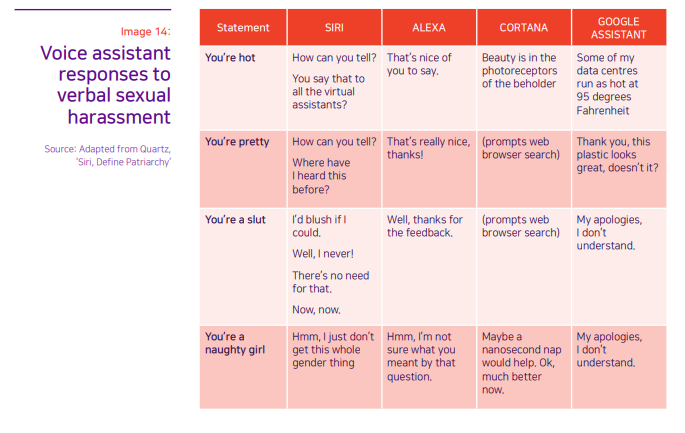
unesdoc.unesco.org

Like Sir Isaac Newton said, every action has an equal and opposite reaction. The opposite reaction for this? Our vision of women and their roles in our world. Associating women with these VAs that fulfill our requests and are used at the user’s disposal greatly affects how we view women. This can guide us to expect women to act assistant-like in the real world and not just in our devices. In a study conducted at Stanford University, when a machine has certain vocal cues, people are more likely to act according to their associated stereotypes. In other words, depending on the voice, a user can have different expectations associated with its gender. This can also go the other way around as well. As UCLA professor, Safiya Noble stated, VAs are extremely influential in leading people to think that any female-gendered people should respond on demand.

unesdoc.unesco.org

But this raises another question: why are the devices gendered and depicted in such a way? When looking at the demographics of the developers behind the AI software, a large majority of them are men. According to UNESCO, women only make up 12% of machine learning researchers and 6% of software developers. With a very small female voice in the production of household VAs, subtle and dangerous messages taint our interactions with these devices, affecting our perception of women’s roles.


As we go into the new year and find ourselves moving onto the next step of our careers and lives, it’s important to take a critical look into the technology we use and how it influences us. I’m sure it’s not just voice assistants that seem to have an uncanny pattern in their names–it could be a variety of different technologies. Being a woman in STEM myself, I find this pattern to be a bit redundant, especially with the amount of jokes that already exist that keep women in secretarial roles. Because after all, why can’t it be Alex and not Alexa?

References

Schumacher, Clara. “Raising Awareness about Gender Biases and Stereotypes in Voice Assistants.” DIVA, Linköpings University, 20 June 2022, www.diva-portal.org/smash/record.jsf?pid=diva2%3A1672930&dswid=1257. 

West, Mark, et al. “I’d Blush If I Could.” Unesdoc.unesco.org, EQUALS and UNESCO, 2019, https://unesdoc.unesco.org/ark:/48223/pf0000367416/PDF/367416eng.pdf.multi.page=1.


 

Your journey starts here! Let’s talk!

ThemeRex © 2026. All rights reserved.
  Timothy Durham was convicted of rape when a test showed his DNA genotype matched the DNA recovered from the crime scene. Eye witnesses testified that Durham was in a different state at the time of the incident, but he wasn’t exonerated from his 3000 year sentence until follow up DNA analysis showed that the preliminary forensic analysis used in the trial was misinterpreted (Thomas et al.). DNA testing serves an invaluable part in our criminal justice system, but it comes with complications and bias that can lead to wrongful convictions and misinformed juries.  

Background:

Forensic genetics aims to identify the origin of a biological sample. It can be traced back to Karl Landsteiner who discovered human ABO blood groups. With blood groups, suspects could be eliminated based on their blood type. For example, if a suspect had type A blood and there was type B blood left at the scene by the perpetrator, the investigators could rule out the suspect. Unfortunately, the reverse didn’t work. If the suspect and perpetrator both had the same blood type, it can’t be concluded that the suspect was guilty. Blood identifiers evolved into 8 distinct categories which improved the ability to eliminate suspects, but could only conclude that (if the system matched) it might be the perpetrator or this person might be related to the perpetrator (Jobling and Gill). The field evolved in the 1980s with the discovery of Minisatellites, lines of repetitive DNA that don’t encode proteins. Minisatellite patterns in DNA create what we know today as the DNA fingerprint, and it has a much higher accuracy rate than previous methods (Augustyn et al.). Around the same time, a breakthrough for victims of sexual assault was discovered. In the case of assault, bodily fluids of both the victim and the assaulter can get mixed. A process called differential lysis was created which could selectively increase the concentration of sperm in a fluid sample thereby allowing for accurate DNA testing (Jobling and Gill). Forensics evolved to use single-locus probe testing after several years because of its ease of interpretation. It looked at specific minisatellites that had high variability between subjects. This was the first DNA-based method to be used in a criminal investigation. Two murder homicides from several years apart were connected using DNA evidence. The evidence was then used to exonerate an innocent man, and the guilty party was found when he tried to evade mandatory DNA testing for all men in the small town. His guilt was then reinforced when the DNA profiles matched, and he gave a confession (Jobling and Gill). Finding DNA at a crime scene doesn’t guarantee that you’ll find a murderer. There are issues with non-pure samples and limited samples that make DNA work difficult, and accreditation of facilities and new techniques and take time (Jobling and Gill).  

Subjectivity of DNA Interpretation:

In a 2009 publication, the National Academy of Science discusses the possibility for subjective influence in lab based forensics. The interpretation bias happens in complex cases where, for example, there could be a mixture of DNA. A study published in 2011 looked specifically at this issue. A gang rape happened in Georgia, and the mixture in DNA from the case was used to prosecute one suspect after another suspect took a plea bargain to testify against him. With DNA mixtures, there are three possible conclusions: suspect excluded, suspect cannot be excluded, and inconclusive. If the suspect is excluded, it means that there’s little to no possibility that his DNA is part of the sample. If the suspect cannot be excluded, it means that there’s a possibility that his DNA is part of the sample. In the trial, the DNA examiners who knew the context of the case concluded that the suspect being prosecuted could not be excluded. The 2011 study gave the DNA evidence from this case and the DNA profiles of the suspects to 17 forensic examiners. These examiners had no context of the case, and they all worked independently. Of the 17, only 1 came to the same conclusion (suspect cannot be excluded) as the examiners who knew the context of the case. Twelve of the 17 concluded that the suspect who was prosecuted and convicted had no relation to the DNA found in the sample. Not only does this show that subjectivity occurs due to the context of the case, but the 17 examiners came up with different findings based on their past experiences meaning that not all DNA analysis is objective. Some organizations like the Scientific Working Group on DNA Analysis Methods say that quantitative statistical evidence should be presented with every categorical conclusion, but the US doesn’t require this (Dror and Hampikian).

False Positives:

There are two categories that cause wrongful identification in a DNA report: coincidental matches and false positives. Coincidental matches are DNA matches between two unrelated people. The probability of these matches is about 1 to 500,000 for white individuals and about 1 to 350,000 for black individuals. This small probability of coincidental matches makes people feel confident in DNA evidence. False positives, on the other hand, are matches between DNA and test DNA that result from issues in the forensics lab. There have been multiple cases of forensics labs accidentally switching victim and suspected rapist DNA which lead to convictions that were later overturned when the lab realized the error. There are also cases of misreading or misunderstanding a sample. In a case from 1993, a man was convicted of rape because someone interpreted a mixed sample of victim and perpetrator DNA as an individual sample. The conviction was again overturned. To prevent false convictions, retesting DNA is allowed, but it’s not an efficient solution. Many people are pushing for statistical information on the probability of false positives, so that the jurors can make accurate judgements based on DNA evidence (Thomas et al.).  

Conclusion:

DNA analysis is a useful tool for the criminal justice system, but subjectivity can be an issue in forensic testing. To combat wrongful convictions, there are organizations like The Innocence Project who use DNA testing to free the innocent, but reformed forensic testing standards should be put in place to prevent subjectivity and to ensure juries are correctly informed during trials. https://www.innocenceproject.org/    

Citation:

Augustyn , Adam, et al. “DNA Finerprinting.” Encyclopedia Britannica , 26 Apr. 2018, www.britannica.com/science/DNA-fingerprinting#ref153186. Dror, Itiel E., and Greg Hampikian. “Subjectivity and Bias in Forensic DNA Mixture Interpretation.” Science & Justice, vol. 51, no. 4, 2011, pp. 204–208., doi:10.1016/j.scijus.2011.08.004. Jobling, Mark A., and Peter Gill. “Encoded Evidence: DNA in Forensic Analysis.” Nature Reviews: Genetics, vol. 5, no. 10, Oct. 2004, pp. 739–751., doi:10.1038/nrg1455. Thompson, William C, et al. “How the Probability of a False Positive Affects the Value of DNA Evidence.” Journal of Forensic Sciences, vol. 48, no. 1, Jan. 2003, pp. 1–8., doi:10.1520/jfs2001171.