The Omnivore’s Dilemma: What Will You Put on Your Plate?

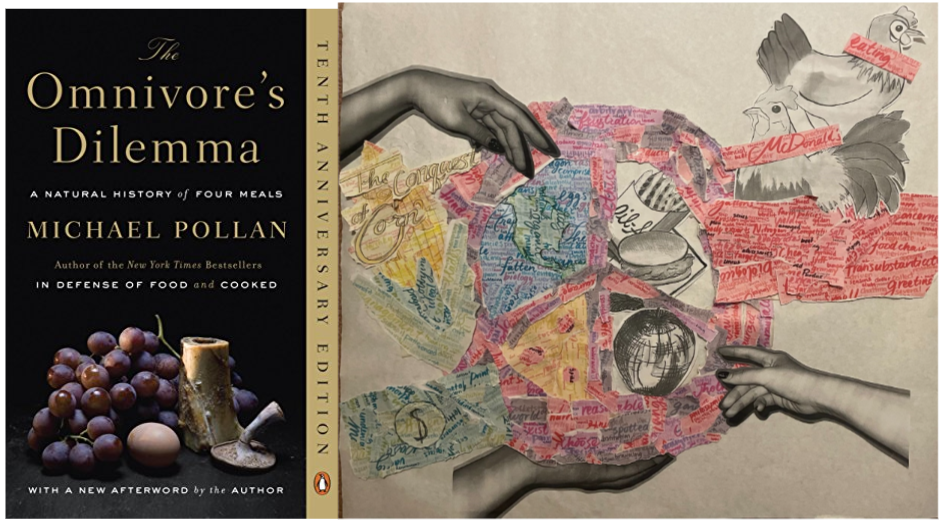
The Omnivore’s Dilemma: A Natural History of Four Meals written by Michael Pollan is an intriguing book about the current food situation of America and by marking major developments in food and his journey to find “the best” way to eat. To choose to eat every day is to choose to survive but we rarely think about the science behind our choices or behind why those are the only seemingly available choices. While researching this topic and throughout reading this book, I made word clouds around central themes using words said throughout the book in order to point out things to consider while we make our food choices. Every time you look closer at any of the word collages, you notice something different to consider when thinking about food. I then made a collage incorporating these various topics because I believe that art would be the best way to communicate about food, another lesser thought about art form. Both food and art are forms of therapeutic activities that we oftentimes fall back on.  

Michael Pollan coins an interesting term: the People of Corn which he uses to contrast the difference between the usage of corn by Americans and Native Americans (Pollan). America can very easily be considered a nation run on corn, on corn syrup, on corn-starch, and on corn-based fuel.  

Unlike the Native Americans, current Americans heavily process corn to the point that it is no longer recognizable. This is not only an amazing feat of innovation, but its impact is also astounding as well. Corn was originally an incredibly thin and weed-like grass with some seeds at the top, but its current form is the result of generations of domestication and modification (Smithsonian 2020). The modern corn is very large, sweet, and fleshy making it an ideal source of energy in both food, livestock feed, and fuel. America grows over a third of the entire world’s corn and dominates the industry in the use of corn-based products in food and in bioethanol (Swain 2019). Corn is an incredible fuel source with it being one of the biggest components in the bioethanol industry, but it has many drawbacks considering that producing more fuel will limit how much food can be produced (Swain 2019). There are also many more unintentional effects of the abundance, and many uses for corn. Corn is a large factor as to why so many processed foods exist today. 

Credit Thomas Hopper. 

Processed foods are by no means entirely terrible, but it is important to consider that many processed foods exist solely because they are profitable even though they are at the expense of many of us. But interestingly, there is a high correlation between the higher income countries having higher rates of processed foods and obesity while middle income countries are following suit (Monteiro 2013). A neat way to sum it up is that “When consumed in small amounts and with other healthy sources of calories, ultra-processed products are harmless; however, intense palatability (achieved by high content of fat, sugar, salt, and cosmetic and other additives), omnipresence, and sophisticated and aggressive marketing strategies (such as reduced price for super-size servings), all make modest consumption of ultra-processed products unlikely and displacement of fresh or minimally processed foods very likely (Monteiro 2013). 

Michael Pollan takes drastic steps of attempting to forage, strictly buying locally and freshly farmed and raised foods (Pollan). While that is certainly not possible for everyone, something that anyone can take from Michael Pollan’s approach is that we should be more mindful about what we eat but also remember to savor our food a little more. For example, there has been a lot of discourse surrounding a TikTok creator named Nara Smith who goes by the handle @naraazizasmith. She started making foods from scratch because of her eczema and skin conditions that caused her to reconsider many of the foods she was consuming, and she now primarily creates videos of her creating many foods from scratch such as yogurt, ice cream, breads, etc. Many others commented on her videos especially about her portion control because she seemed to be very satisfied with the small amounts of treats, such as ice cream, that she gives herself. It was apparent to see that she savored every single bite of the ice cream that she made from scratch and that she was truly satisfied with everything that she ate. 

An interesting thing that Michael Pollan notes is that food and cooking is not as valued today. More often than not it is seen as a chore which is easy to do when life is constantly busy and throwing curve balls at you from left and right. But isn’t it more satisfying eating something that you took the time to make yourself? Of course, it can be very taxing and difficult but without cooking, most of us don’t take the time to reflect upon what we are eating. Do we take the time to enjoy our food? Rather than needing to cook everything ourselves, I believe that it is up to us to set aside time to enjoy food thoroughly by eating with friends and family or by reflecting upon ourselves and the joys within our lives. The dilemma isn’t whether or not we consume meat but rather what we have as food for thought!

Sources: 

Mohanty, Sujit K., et al. “Bioethanol Production from Corn and Wheat: Food, Fuel, and Future.” Bioethanol Production from Food Crops, Academic Press, 24 Aug. 2018, www.sciencedirect.com/science/article/pii/B9780128137666000035?via=ihub#s0070. 

Monteiro, C. A., et al. Ultra‐processed Products Are Becoming Dominant in the Global Food System – Monteiro – 2013 – Obesity Reviews – Wiley Online Library, onlinelibrary.wiley.com/doi/full/10.1111/obr.12107. Accessed 19 Apr. 2024. 

Pollan, Michael. The Omnivore’s Dilemma: A Natural History of Four Meals. Penguin Group, 2006. 

Smithsonian Institution. “Ancient DNA Continues to Rewrite Corn’s 9,000-Year Society-Shaping History.” Smithsonian Institution, 1 Jan. 1970, www.si.edu/newsdesk/releases/ancient-dna-continues-rewrite-corns-9000-year-society-shaping-history#:~:text=Some%209%2C000%20years%20ago%2C%20corn,a%20handful%20of%20stony%20kernels. 

Your journey starts here! Let’s talk!

ThemeRex © 2026. All rights reserved.
  Timothy Durham was convicted of rape when a test showed his DNA genotype matched the DNA recovered from the crime scene. Eye witnesses testified that Durham was in a different state at the time of the incident, but he wasn’t exonerated from his 3000 year sentence until follow up DNA analysis showed that the preliminary forensic analysis used in the trial was misinterpreted (Thomas et al.). DNA testing serves an invaluable part in our criminal justice system, but it comes with complications and bias that can lead to wrongful convictions and misinformed juries.  

Background:

Forensic genetics aims to identify the origin of a biological sample. It can be traced back to Karl Landsteiner who discovered human ABO blood groups. With blood groups, suspects could be eliminated based on their blood type. For example, if a suspect had type A blood and there was type B blood left at the scene by the perpetrator, the investigators could rule out the suspect. Unfortunately, the reverse didn’t work. If the suspect and perpetrator both had the same blood type, it can’t be concluded that the suspect was guilty. Blood identifiers evolved into 8 distinct categories which improved the ability to eliminate suspects, but could only conclude that (if the system matched) it might be the perpetrator or this person might be related to the perpetrator (Jobling and Gill). The field evolved in the 1980s with the discovery of Minisatellites, lines of repetitive DNA that don’t encode proteins. Minisatellite patterns in DNA create what we know today as the DNA fingerprint, and it has a much higher accuracy rate than previous methods (Augustyn et al.). Around the same time, a breakthrough for victims of sexual assault was discovered. In the case of assault, bodily fluids of both the victim and the assaulter can get mixed. A process called differential lysis was created which could selectively increase the concentration of sperm in a fluid sample thereby allowing for accurate DNA testing (Jobling and Gill). Forensics evolved to use single-locus probe testing after several years because of its ease of interpretation. It looked at specific minisatellites that had high variability between subjects. This was the first DNA-based method to be used in a criminal investigation. Two murder homicides from several years apart were connected using DNA evidence. The evidence was then used to exonerate an innocent man, and the guilty party was found when he tried to evade mandatory DNA testing for all men in the small town. His guilt was then reinforced when the DNA profiles matched, and he gave a confession (Jobling and Gill). Finding DNA at a crime scene doesn’t guarantee that you’ll find a murderer. There are issues with non-pure samples and limited samples that make DNA work difficult, and accreditation of facilities and new techniques and take time (Jobling and Gill).  

Subjectivity of DNA Interpretation:

In a 2009 publication, the National Academy of Science discusses the possibility for subjective influence in lab based forensics. The interpretation bias happens in complex cases where, for example, there could be a mixture of DNA. A study published in 2011 looked specifically at this issue. A gang rape happened in Georgia, and the mixture in DNA from the case was used to prosecute one suspect after another suspect took a plea bargain to testify against him. With DNA mixtures, there are three possible conclusions: suspect excluded, suspect cannot be excluded, and inconclusive. If the suspect is excluded, it means that there’s little to no possibility that his DNA is part of the sample. If the suspect cannot be excluded, it means that there’s a possibility that his DNA is part of the sample. In the trial, the DNA examiners who knew the context of the case concluded that the suspect being prosecuted could not be excluded. The 2011 study gave the DNA evidence from this case and the DNA profiles of the suspects to 17 forensic examiners. These examiners had no context of the case, and they all worked independently. Of the 17, only 1 came to the same conclusion (suspect cannot be excluded) as the examiners who knew the context of the case. Twelve of the 17 concluded that the suspect who was prosecuted and convicted had no relation to the DNA found in the sample. Not only does this show that subjectivity occurs due to the context of the case, but the 17 examiners came up with different findings based on their past experiences meaning that not all DNA analysis is objective. Some organizations like the Scientific Working Group on DNA Analysis Methods say that quantitative statistical evidence should be presented with every categorical conclusion, but the US doesn’t require this (Dror and Hampikian).

False Positives:

There are two categories that cause wrongful identification in a DNA report: coincidental matches and false positives. Coincidental matches are DNA matches between two unrelated people. The probability of these matches is about 1 to 500,000 for white individuals and about 1 to 350,000 for black individuals. This small probability of coincidental matches makes people feel confident in DNA evidence. False positives, on the other hand, are matches between DNA and test DNA that result from issues in the forensics lab. There have been multiple cases of forensics labs accidentally switching victim and suspected rapist DNA which lead to convictions that were later overturned when the lab realized the error. There are also cases of misreading or misunderstanding a sample. In a case from 1993, a man was convicted of rape because someone interpreted a mixed sample of victim and perpetrator DNA as an individual sample. The conviction was again overturned. To prevent false convictions, retesting DNA is allowed, but it’s not an efficient solution. Many people are pushing for statistical information on the probability of false positives, so that the jurors can make accurate judgements based on DNA evidence (Thomas et al.).  

Conclusion:

DNA analysis is a useful tool for the criminal justice system, but subjectivity can be an issue in forensic testing. To combat wrongful convictions, there are organizations like The Innocence Project who use DNA testing to free the innocent, but reformed forensic testing standards should be put in place to prevent subjectivity and to ensure juries are correctly informed during trials. https://www.innocenceproject.org/    

Citation:

Augustyn , Adam, et al. “DNA Finerprinting.” Encyclopedia Britannica , 26 Apr. 2018, www.britannica.com/science/DNA-fingerprinting#ref153186. Dror, Itiel E., and Greg Hampikian. “Subjectivity and Bias in Forensic DNA Mixture Interpretation.” Science & Justice, vol. 51, no. 4, 2011, pp. 204–208., doi:10.1016/j.scijus.2011.08.004. Jobling, Mark A., and Peter Gill. “Encoded Evidence: DNA in Forensic Analysis.” Nature Reviews: Genetics, vol. 5, no. 10, Oct. 2004, pp. 739–751., doi:10.1038/nrg1455. Thompson, William C, et al. “How the Probability of a False Positive Affects the Value of DNA Evidence.” Journal of Forensic Sciences, vol. 48, no. 1, Jan. 2003, pp. 1–8., doi:10.1520/jfs2001171.