

Okay, guys. It’s the end of the semester and my brain is kind of fried. That being said, it would be fun and informational to rank the human brain regions. I used Tiermaker, and this is how I define the different categories. Feel free to make a tierlist yourself before you read the rest of the article to see how our rankings match up.
S tier: coolest brain regions. iconic amazing perfect
A tier: pretty interesting but just missing that star quality, y’know?
B tier: it’s fine. a little boring maybe
C tier: boooooooring
F tier: I have personal beef against this mound of fatty squishy brain tissue
Let’s go!
Amygdala
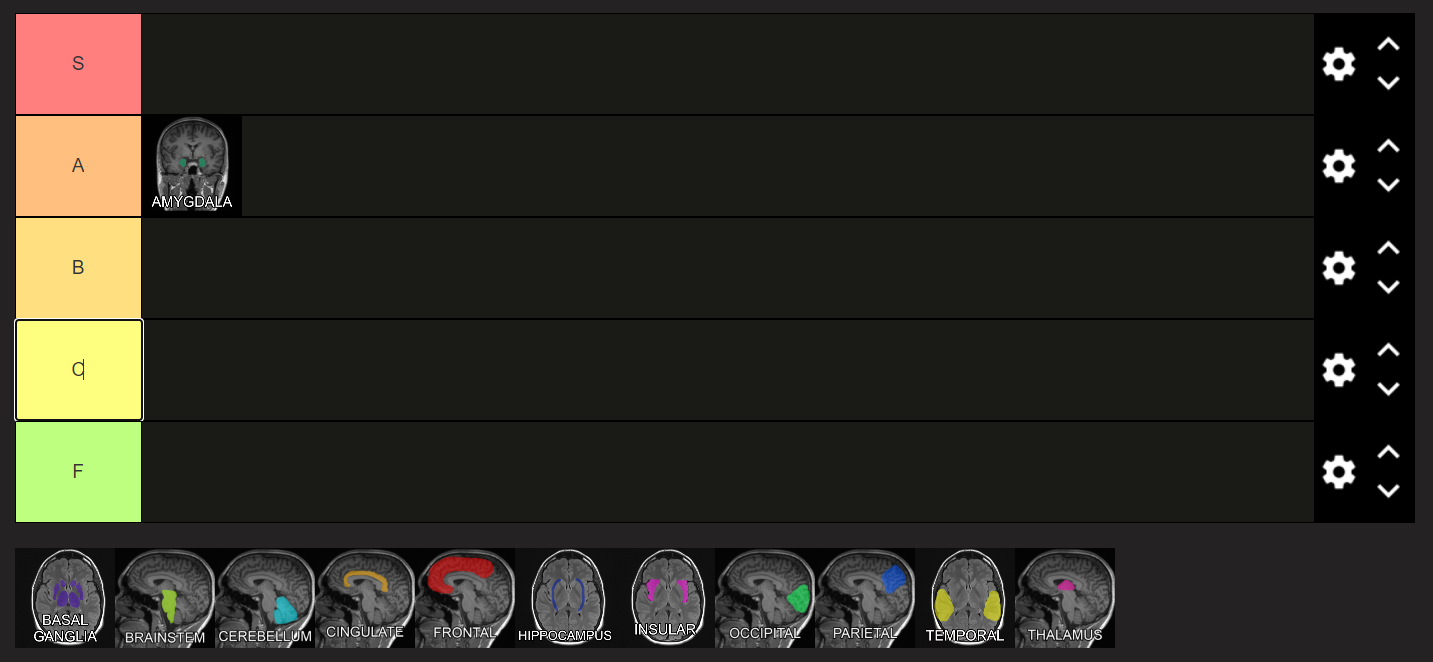
A tier. Really interesting in that it’s involved in so many circuits (fear, memory, even smell!). If you didn’t have it, you wouldn’t be able to avoid harmful situations–famous patient S.M. had her amygdalae removed and she wasn’t able to get scared at movies or notice when people were robbing her! She’s kinda been pop cultured to death, though…everyone kinda already knows her deal. She needs to bring something new to the table.
Basal Ganglia
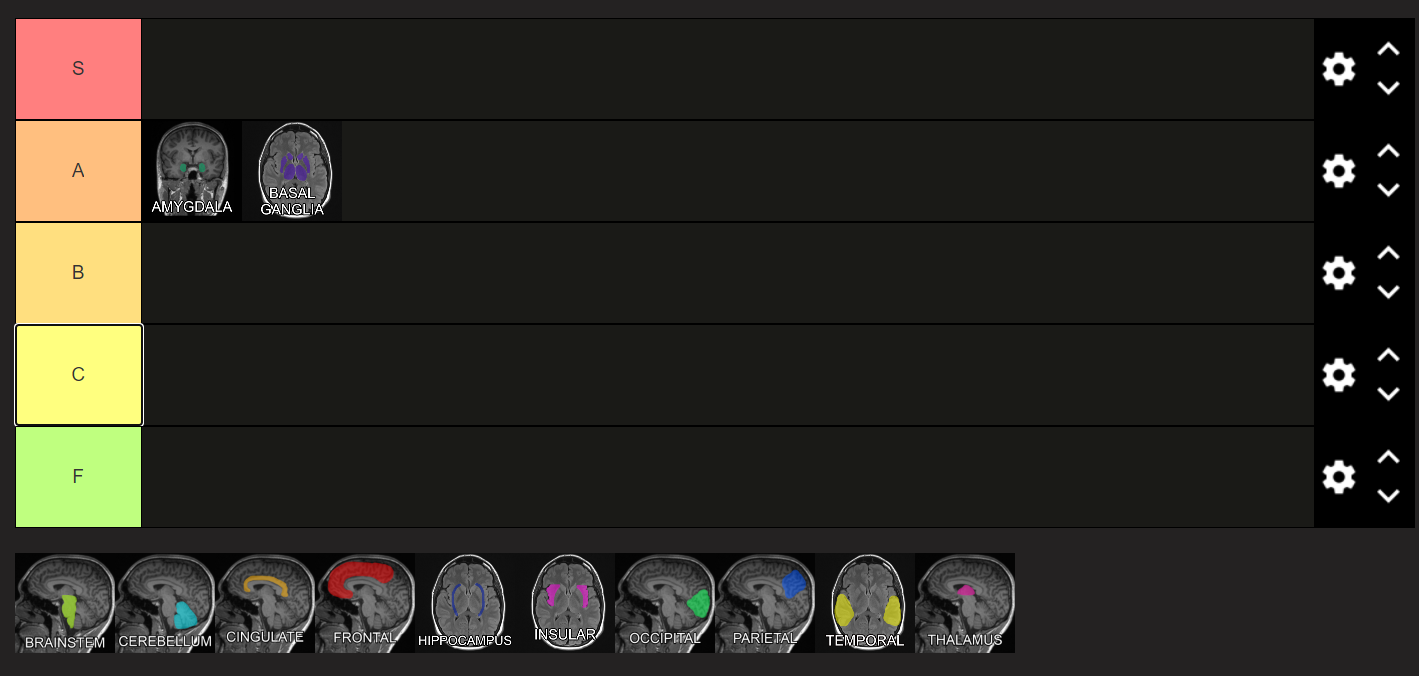 A tier! Okay, I’m gonna say it, I’m biased! This is the area of the brain I research in lab. The basal ganglia isn’t well known outside of neuro circles, but ganglia just means a collection of nodes. This little string of pearls is near the center of our brain and controls voluntary movements while stopping unwanted movements. When things go awry, you can get tics, difficulty moving, or tremors. Think Parkinson’s disease or Huntington’s disease. The basal ganglia is a beautifully complex brain region, but she’s a little hard for beginners to understand. God knows I’ve had many headaches trying to wrap my head around what goes on in here.
Brainstem and Cerebellum
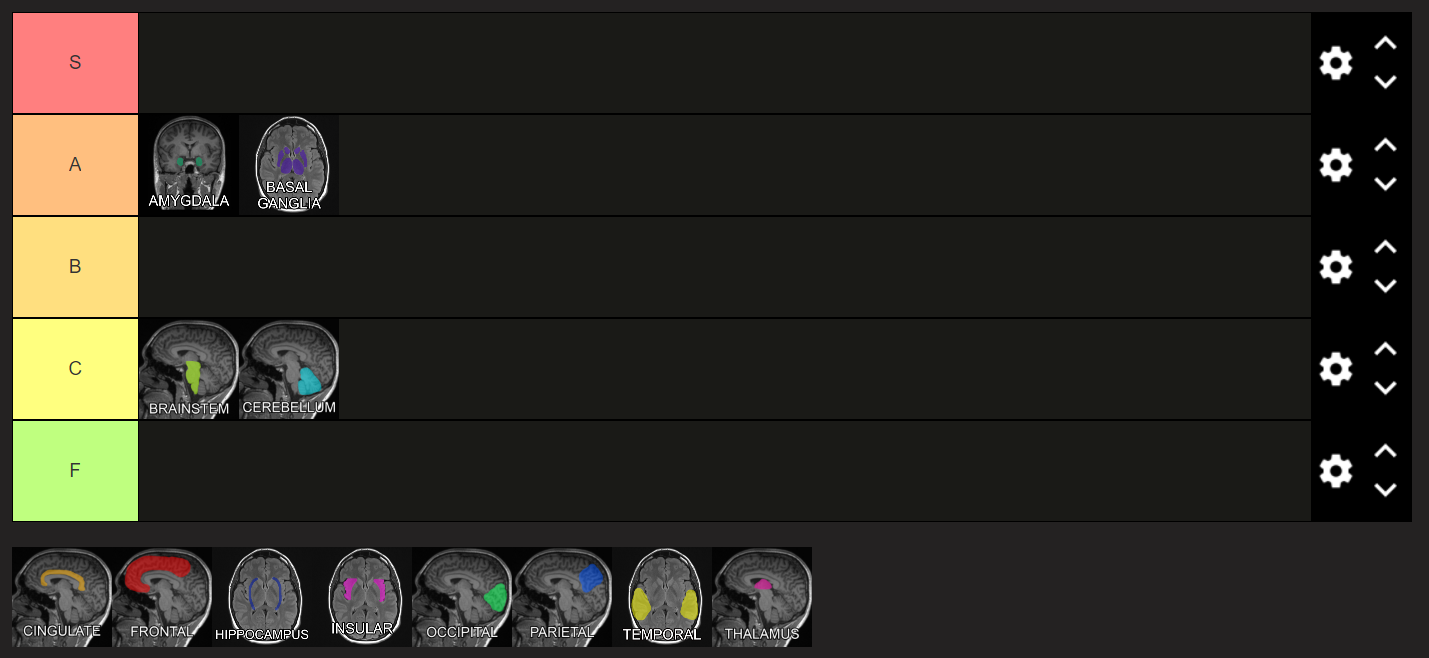 Grouping these 2 together in C tier feels right. Sure, these two play crucial roles doing (brainstem) and coordinating (cerebellum) movements, but these are pretty basic hardware found in pretty much any animal with a centralized brain. These were the first brain areas of the brain to evolve, after all, and they’re the first parts of the brain to form in a human embryo. I’m just saying that you praise basketball players for dunking, not for knowing how to dribble. Too simple.
Cingulate (cortex)
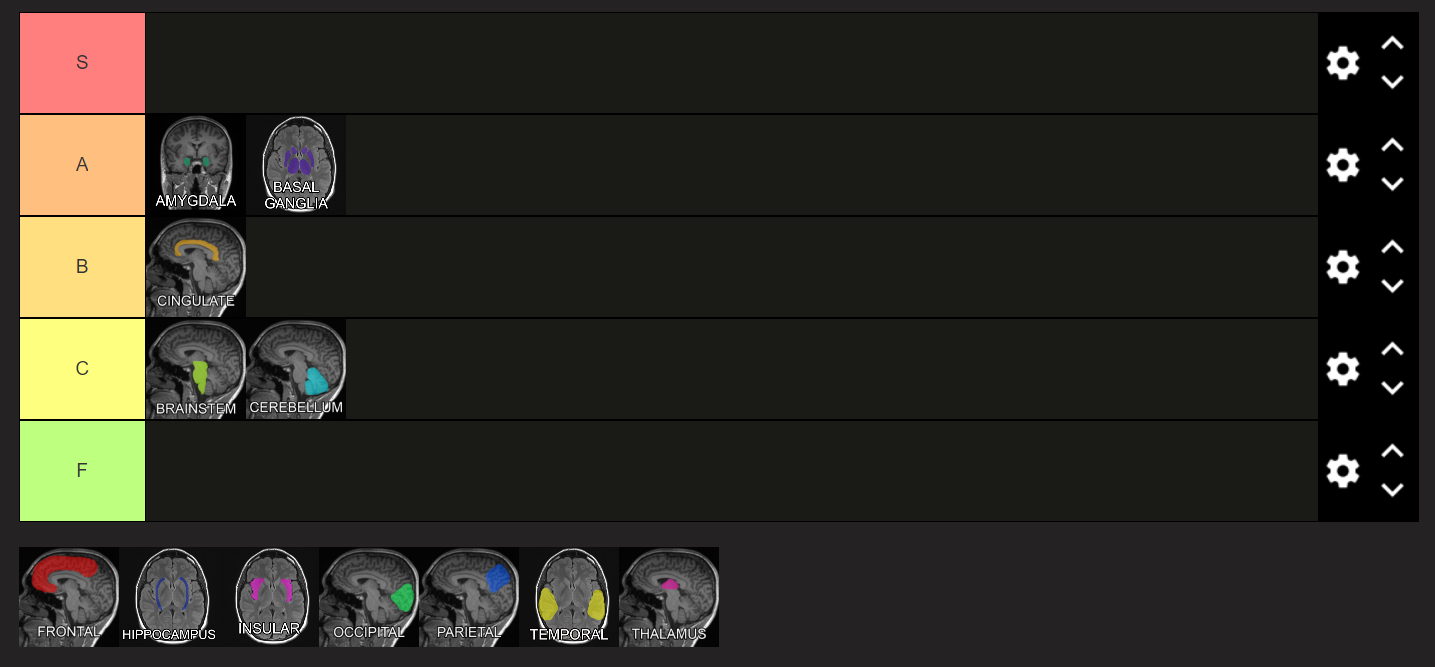
B tier because while I’m really intrigued by it, I always forget all the bajillion things it’s involved in. This gyrus stretches from where the frontal cortex is to the somatosensory cortex (senses), motor cortex (movements), and corpus callosum (connects the two halves of your rain). So, it’s involved in a ton of circuits relating to the way you behave and feel. It’s a part of this cool club called the limbic system, which makes you feel emotions and effects your motivation, learning, and memory. This system also includes the amygdala and its origins are also pretty far up the evolutionary tree, so it’s got retro vibes. Groovy.
Frontal Lobe 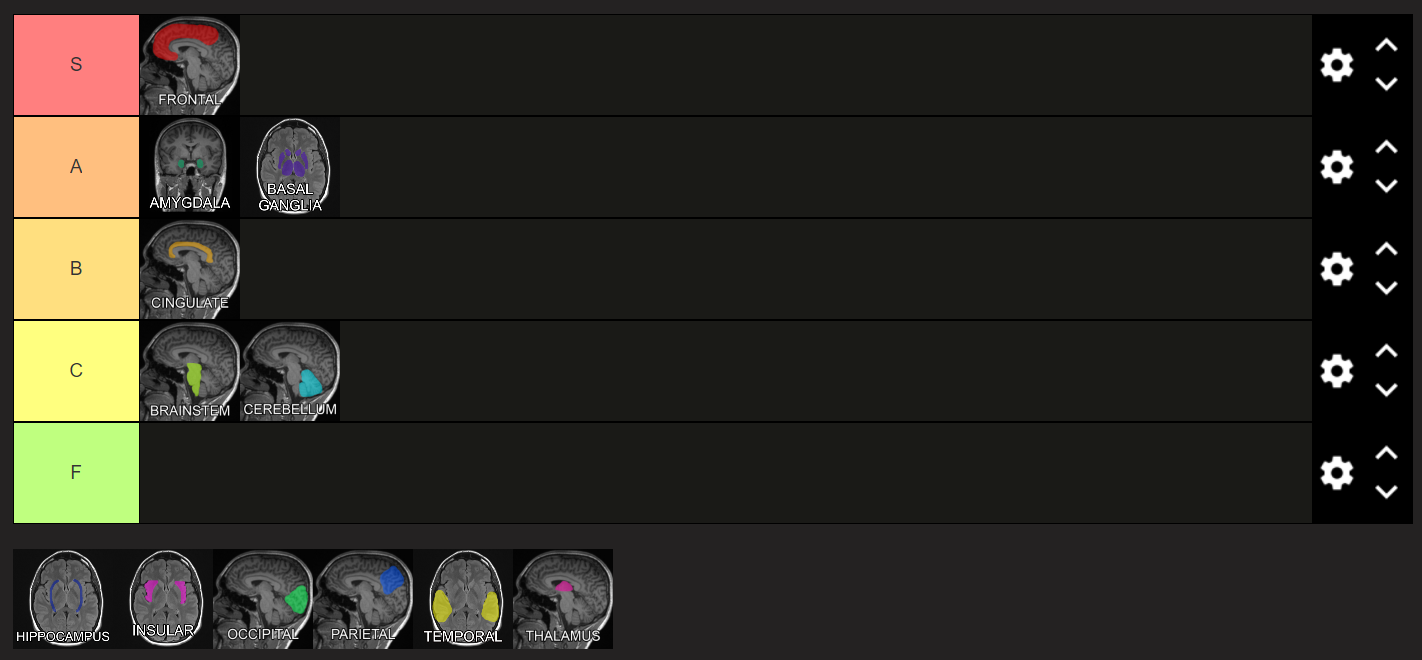 S tier! What is there to say about the frontal lobe? She’s pretty much the it girl in pop psychology at the moment, and it’s hard not to see why. Young Gen Z on the internet love to use the fact that their frontal lobes aren’t mature yet as an excuse for everything–and can you blame them? This area of your brain controls decision-making, goal-setting, and is also involved in self awareness, cognition, and memory too. She can do it all! Your frontal lobe helps determine your personality and controls pretty much any voluntary movements you do (that’s pretty much everything that isn’t hearts beating or intestines squelching). And she is definitely not making me rank her at the top. Absolutely not. I have control. But if my sense of self is determined by my frontal lobe then can I truly be separ–
Hippocampus
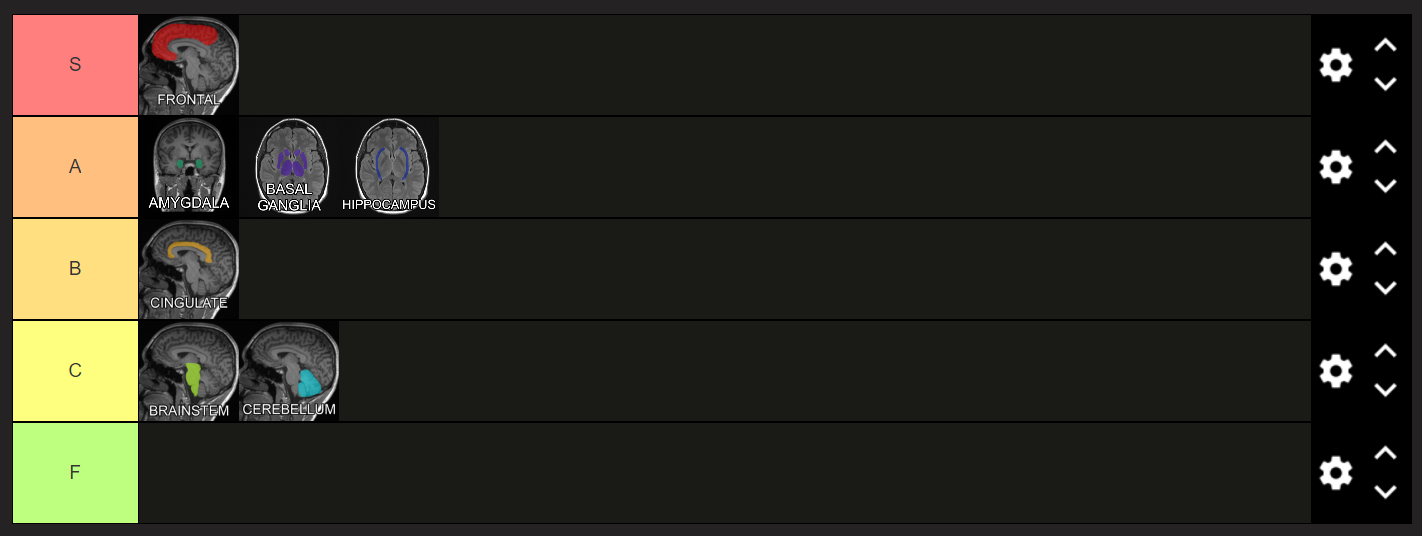 A classic girlie! One of the first to be really understood, so an A tier feels right. Don’t underestimate the svelte size of this structure in this picture–this area may have been named after the Greek word for “seahorse”, but he has a mighty function. Our memories are formed in the hippocampus, which also acts as a hub for us to remember stuff later. He specialized in one thing, and he does it well! Would be S tier, but I seem to misplace mine around finals.
Insula
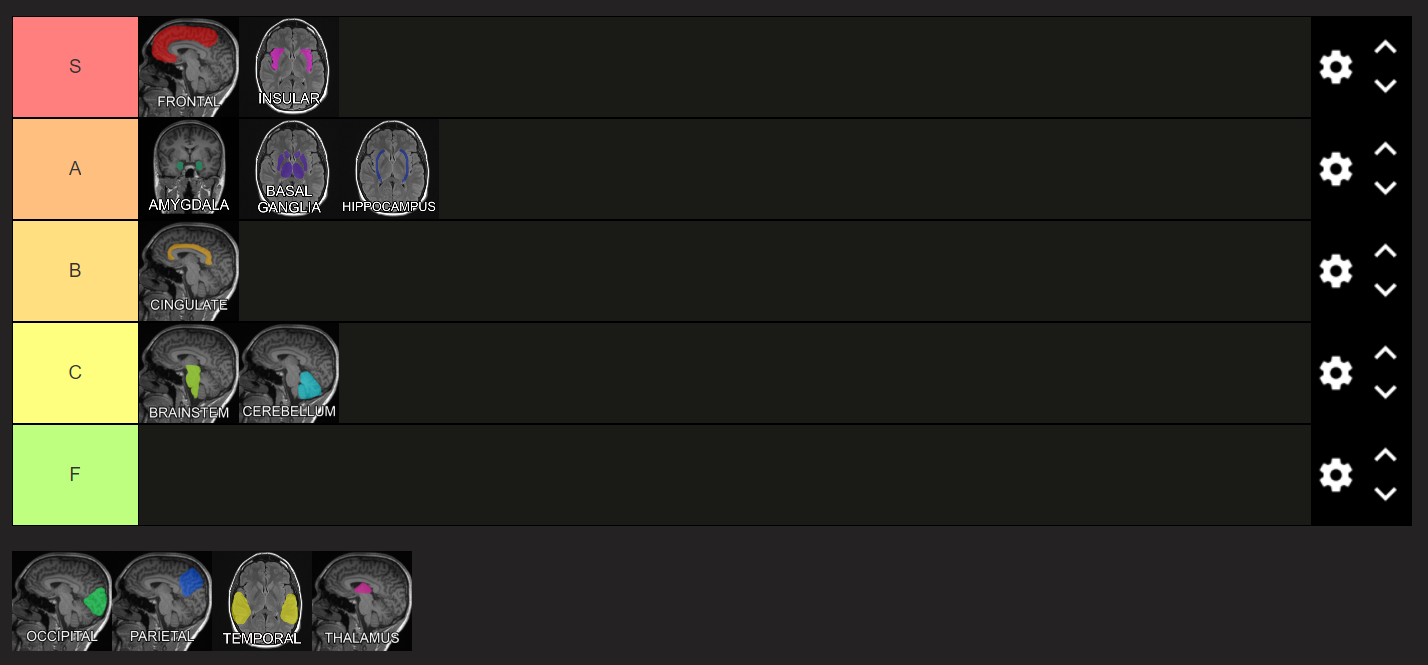
This one’s an underrated classic! The insula is a region inside the brain under the cortices that’s involved in smell and taste. It is also the area of our brain that helps us feel our organs and know what’s going on under our skin, a “sixth sense” called interoception. This area is still poorly understood, which means it has an air of mystery about it. But what we do know is really cool and spooky. S-tier.
Occipital Lobe
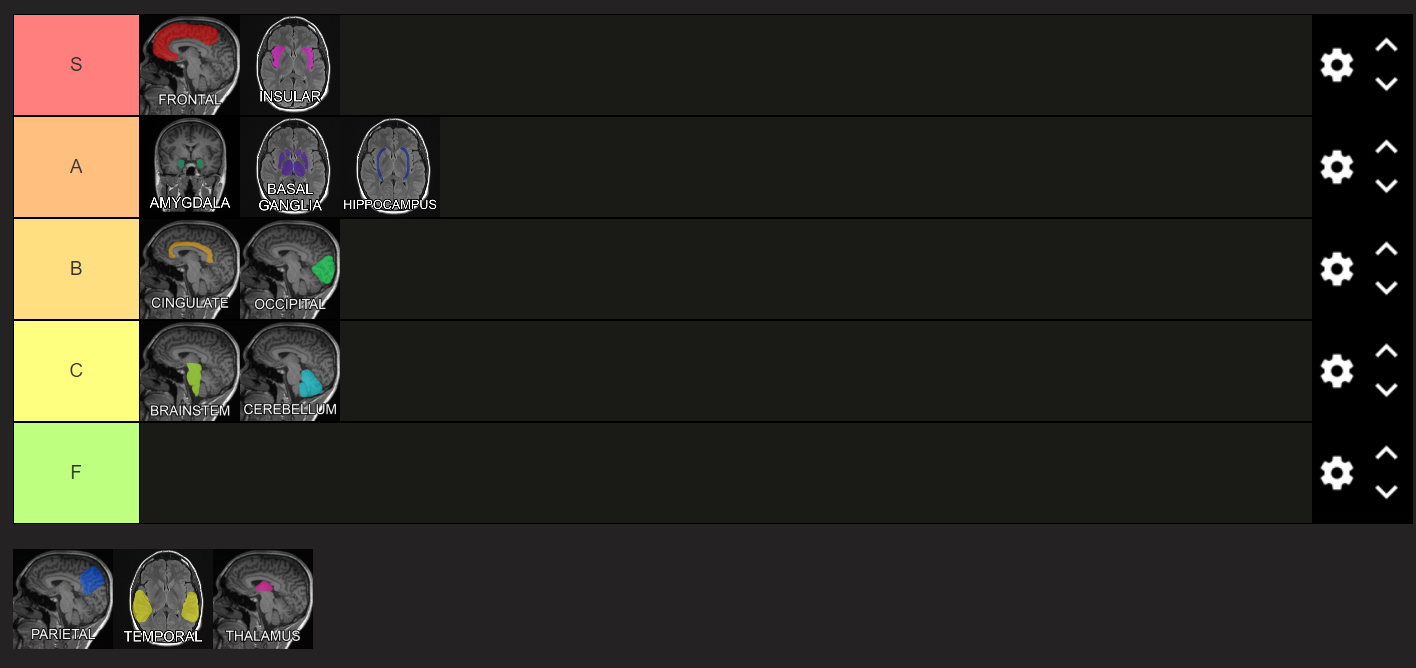 B tier. Not much to say about this one. It helps you see!
Parietal Lobe
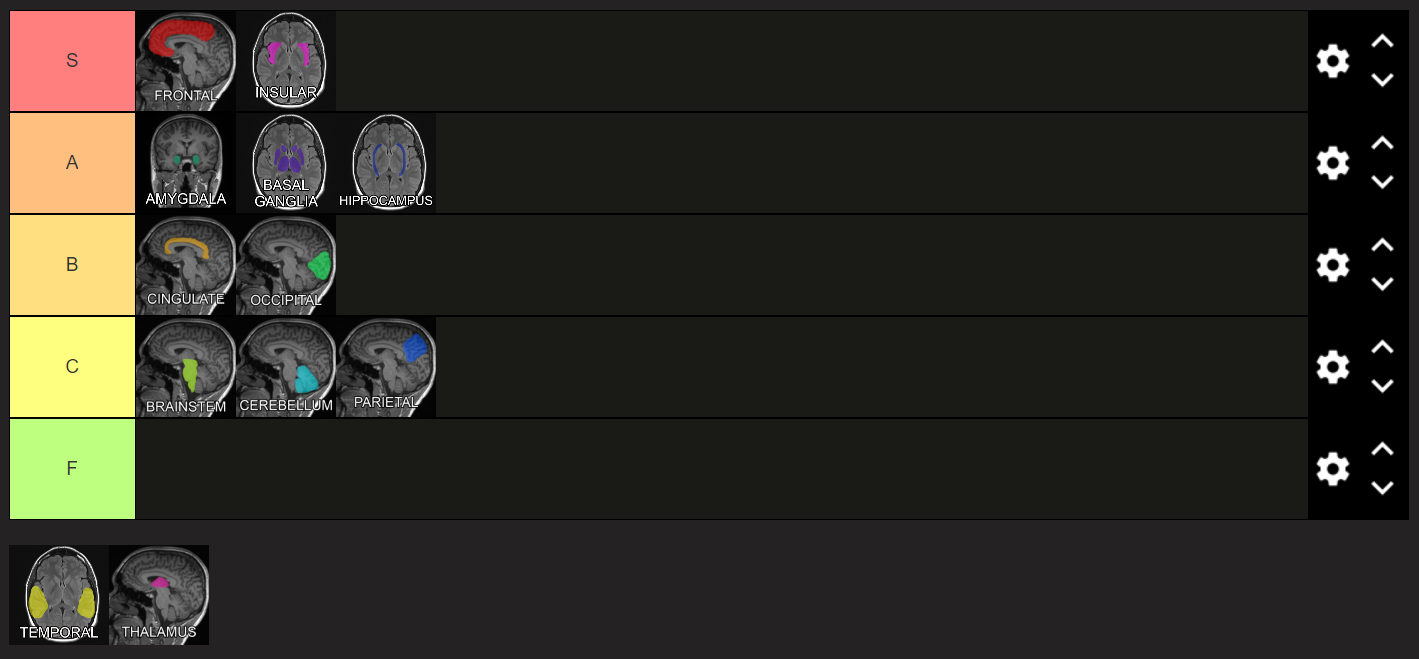 Out of the “big four” lobes of the brain (frontal, occipital, temporal being the others), the parietal lobe is the most forgotten one. Every time I think of what it does, I think sensory, maybe? And that is what the parietal lobe does. A lot of sensory information is processed here–in particular, touch, temperature, and pain. All three together are called somatosensation. But honestly, “processing” sensory information is not the most interesting to me. C tier.
Temporal Lobe
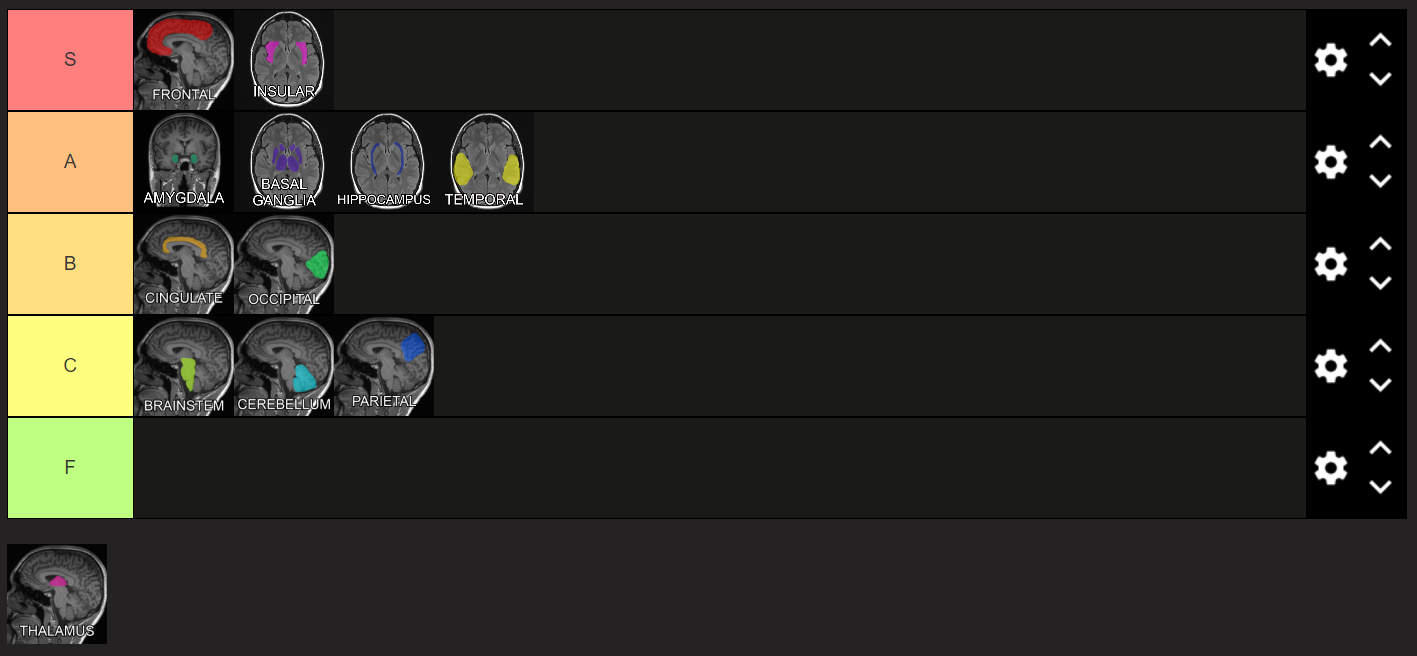 This lobe is best known for housing the language centers of the brain (Broca’s area and Wernicke’s area), but it’s involved in so much more! The amygdala and hippocampus are inside this lobe, so fittingly, this one also goes into A tier. This lobe is not just language, but also memory, social functions, emotions, and even some vision! This is because this lobe is just so large and connects with so many regions. The back end of the temporal lobe is right next to the occipital! If you’ve ever heard of synesthesia, people who have it often have more connections between their temporal and occipital lobes. Accordingly, the most common subtype of synesthesia, where sounds are associated with colors, is colored hearing. This lobe is just really cool–and as much as we know about it, we’re still finding new things out all the time!
Thalamus
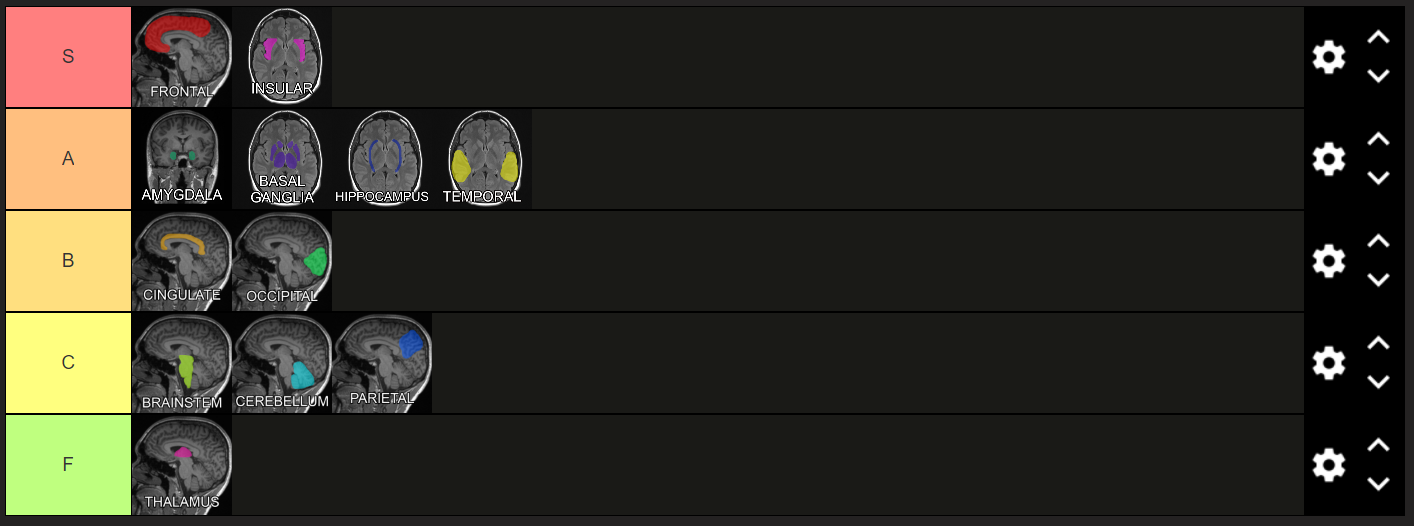 F-tier. F-tier! Look–I love the brain. That’s why I decided to spend 4 years studying it. That’s why I want to research it when I graduate. But this tiny tiny area is the whole reason I wanted to add an F tier. This area of the brain is like a relay hub where pretty much every area of the brain connects to. That sounds great, until you realize there are hundreds of nuclei (neuron groups) that scientists have identified that do all sorts of different things with about six or seven different separate pathways. There are so many that we’ve had to group them into the anterior nuclear group, the medial nuclear group, midline nuclear group, intralaminar nuclear group, the lateral nuclear group (not to be confused with the ventral lateral group), and so on. Confused yet? This is the most annoying thing about neuroscience to me, and the thing that I feel like puts people off studying the subject. Because who wants to memorize all that? Anyway, if you disagree, you drill all that into your brain for a Neuroanatomy class and get back to me. Take it up with my 97 card “Thalamic Nuclei Groups” Anki set.
Well, here’s my final ranking! How did it match up to yours? Did you learn something new? At least, I hope it made you think of the jelly stuff in your skull a little differently.


