The Yellow-Bellied Sapsucker: A Well Traveled Woodpecker

The Yellow-Bellied Sapsucker: A Well Traveled Woodpecker
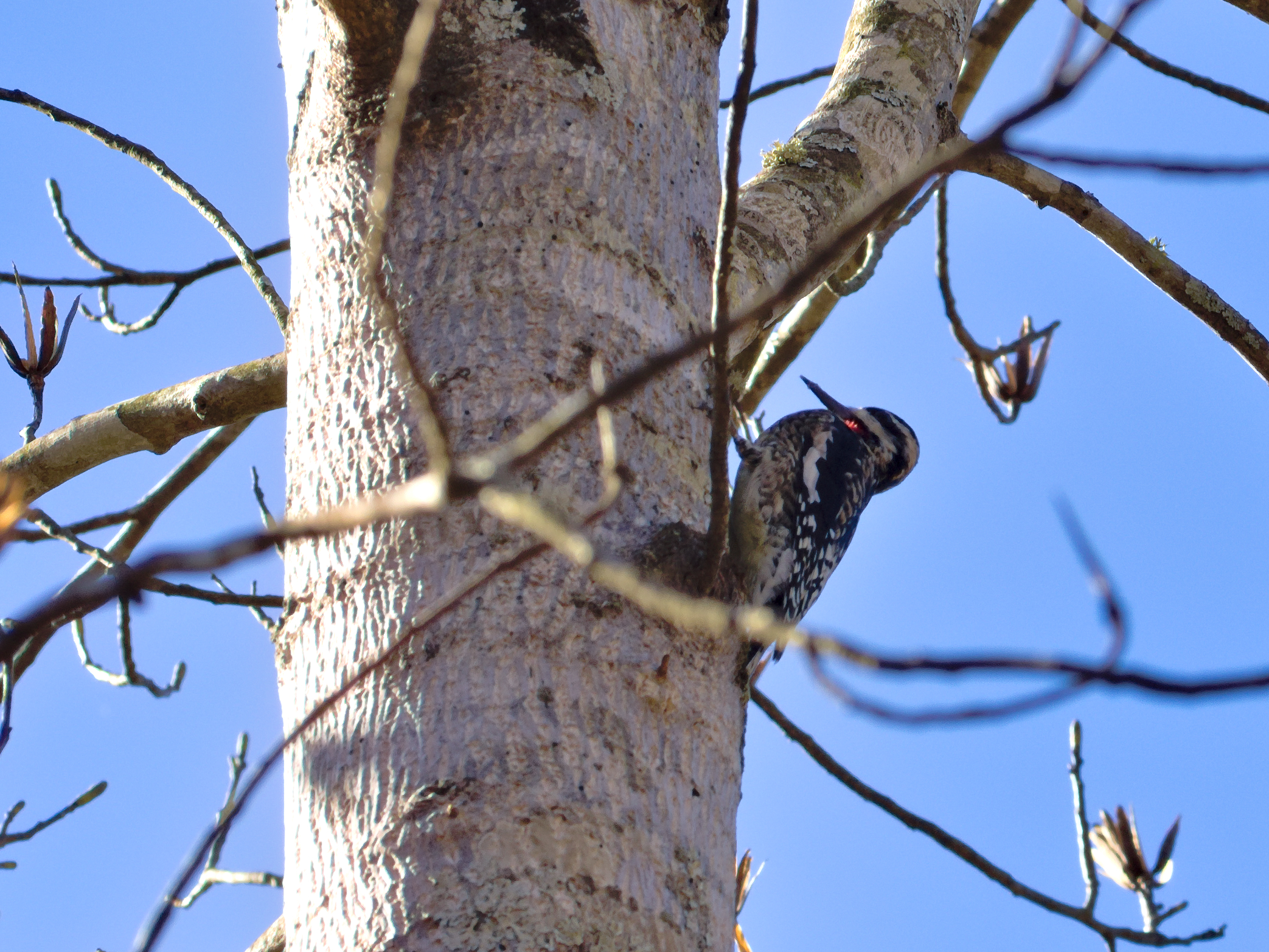
A yellow-bellied sapsucker.

The yellow-bellied sapsucker (Sphyrapicus varius) is a woodpecker that has a wide range across North America. In summer, the sapsucker can be found as far north as Alaska, Minnesota, and Nova Scotia and in winter, the birds can be found as far south as much of Central America and the Caribbean. The yellow-bellied sapsucker is migratory — the birds spend the winters in the south, and their summers in the north. This is unusual for woodpeckers. Out of the twenty two woodpecker species found north of Mexico, fifteen of them don’t migrate at all, with many of these species only flying for short distances during their regular activities. This leaves us with seven woodpecker species that do migrate — and of those, the yellow-bellied sapsucker takes the crown for the largest migration range. Interestingly, the sapsuckers do their migratory flying at night.

Yellow-Bellied Sapsucker Habitat and Diet

The yellow-bellied sapsucker is found in forests. Maple forests, aspen forests, and mixed forests are all popular habitats for sapsuckers. Research has shown that maple forests have better outcomes overall for breeding sapsuckers than aspen forests. However, both maple and aspen forests allow sapsuckers to sustain their populations over time. Both of these forests have trees that are good for sap drilling — the yellow-birch in maple forests, and the paper birch in aspen forests. Sap is one of the primary food sources of the yellow-bellied sapsucker (which, given the name, isn’t very surprising). Sapsuckers have a variety of preferences for trees to tap for sap depending on their range. In urban areas of Southern Florida, for example, black olive and tropical almond trees are a preferred source of sap. Yellow-bellied sapsuckers also feed on arthropods (think of spiders, centipedes, insects, and the like), especially while nesting.
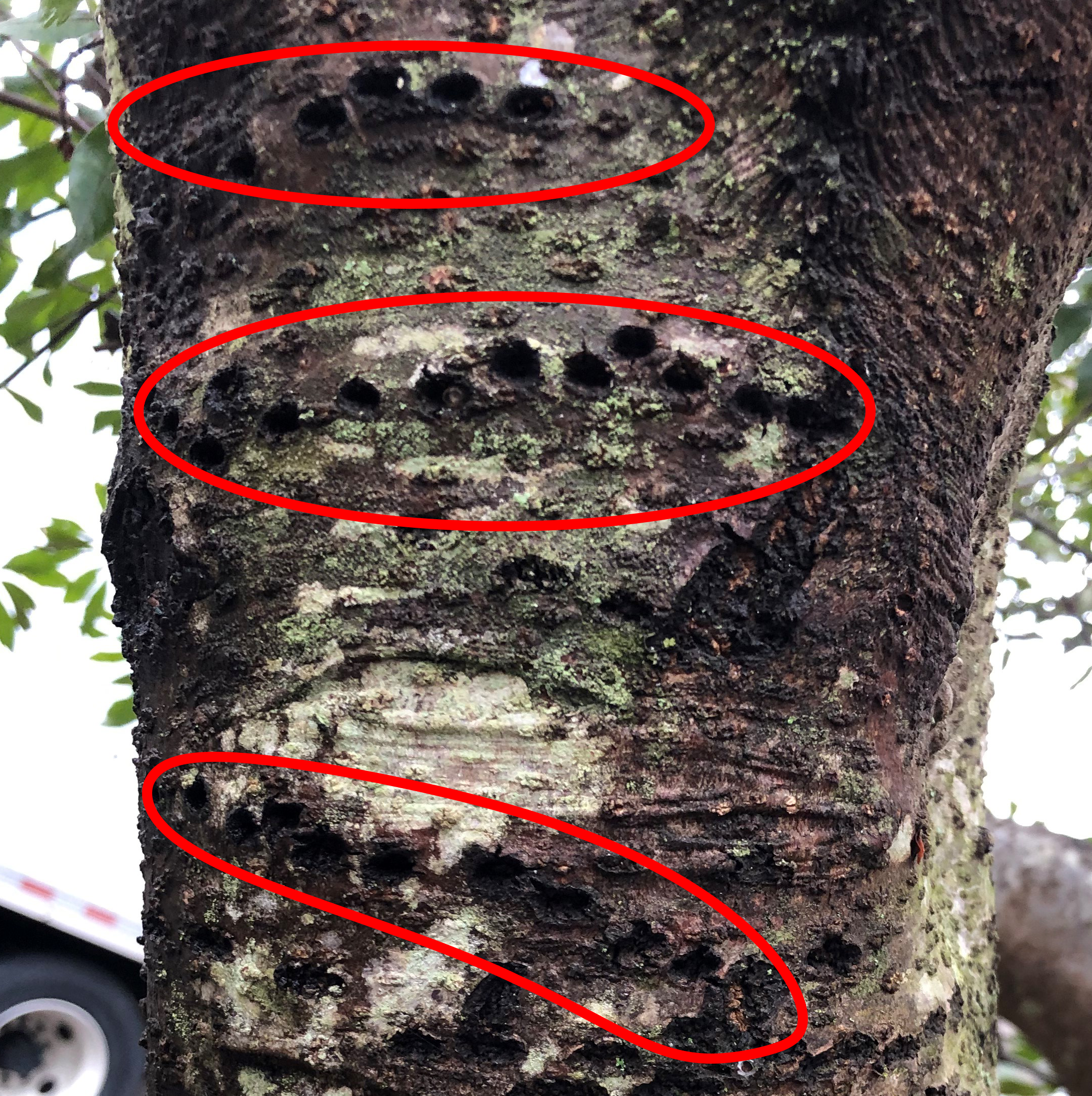
A tree with lines of sapsucker holes.
Pictured: Sapsucker holes in a tree. Drilling holes in straight lines is typical for them.
Why are woodpeckers so concussion proof?

One of the most interesting behaviors woodpeckers exhibit as a group is the tree drilling that they’re named for. A very common question related to this drilling is how do woodpeckers avoid rampant brain injuries due to ramming their heads against trees repeatedly, at high speeds, for ages. Woodpeckers routinely bash their heads into trees at far more than double the acceleration that would concuss humans. While humans are concussed at 300 g of acceleration, woodpeckers have been known to regularly drill into trees at accelerations on the order of 600–1500 g.

A variety of mechanisms have been proposed to explain the woodpeckers’ resilience to brain injury. There are three primary reasons woodpeckers aren’t all concussed all of the time. The first being their small size. The acorn woodpecker’s brain, for example, has a mass of 2.5 grams. A human brain has a mass of 1400 grams. The woodpecker brain is so much smaller than a human brain that they generate much less force when they smack into the skull. The second limiting factor that protects woodpeckers is the short duration of impact. One of the documented factors that increases the likelihood someone will be concussed is how long their brain is exposed to high acceleration. A woodpecker only drills against a tree for a millisecond or less each time, so their time of impact is very short.

The last quirk of woodpecker anatomy guarding them from brain injury is how their brain sits in their skull. Both human brains and woodpecker brains are hemispherical (if you cut a globe in half, you will have two hemispheres). If you cut the globe in half at the equator, your top hemisphere is oriented like a human brain is. If it were to go flying forward, only the small portion at the front will hit the skull. This concentrates the impact right around the forehead area. On the other hand, a woodpecker brain is much more like if you had cut your globe from the Arctic to Antarctica, and chose to look at the left section. The large flat side of a woodpecker’s brain rests against the front of their skull. When their brain goes smacking against their skull while they drill, the force is distributed among the largest possible region of their brain. This lessens the impact overall.
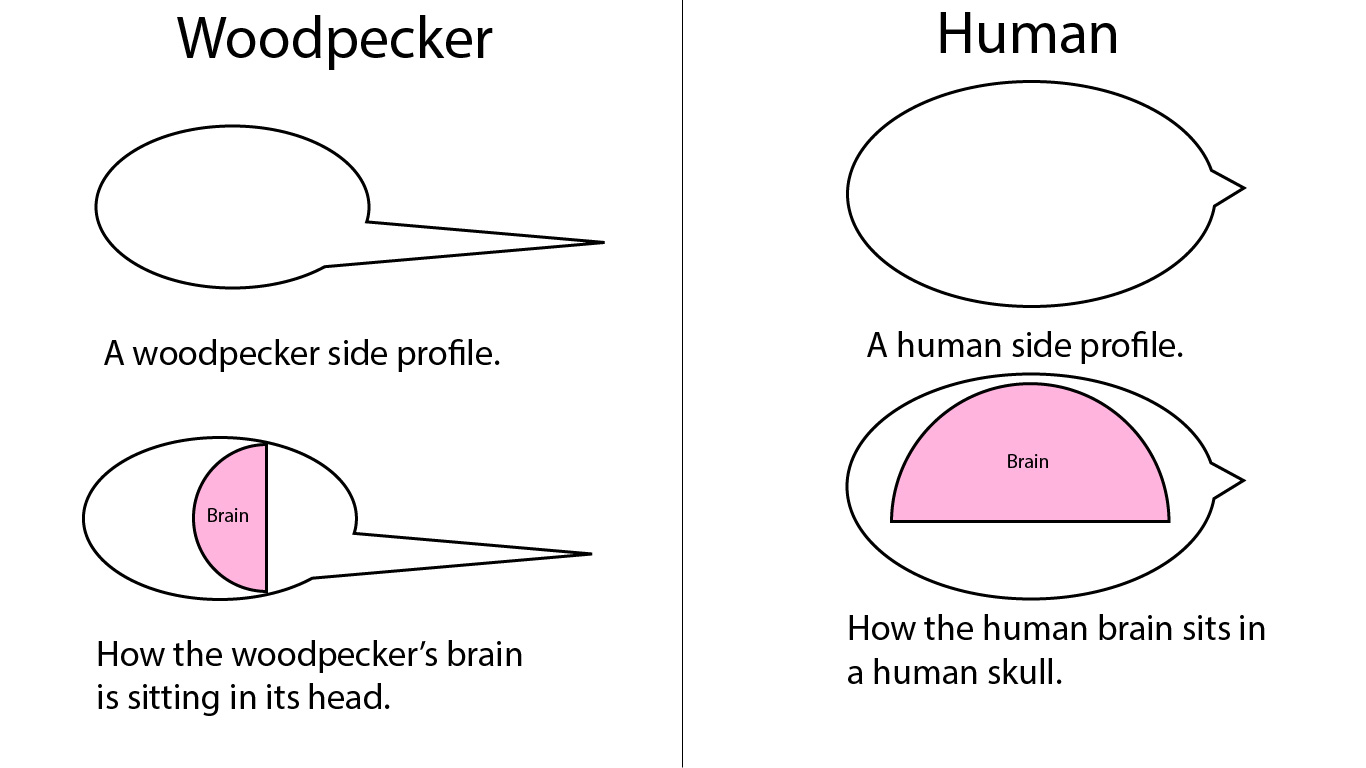
An image illustrating the difference in orientation of a human brain versus a woodpecker brain, as described in the paragraph above.
Notice the difference in alignment when comparing a human brain to a woodpecker brain.
A visualization of how the force is more distributed over the woodpecker's brain compared to a human brain.
Look at how much more relative space the force has to distribute itself on the woodpecker’s brain versus the human brain.
Ecological Status of the Yellow-Bellied Sapsucker

Ecologically speaking, the yellow-bellied sapsucker is in a good place to stick around. The International Union for Conservation of Nature (IUCN) has marked the yellow-bellied sapsucker as a species in the “least concern” of going extinct. Despite this, there are still some concerns for the sapsucker, especially as they’re being seen more and more often in urban and suburban areas. Being in areas with humans presents several new challenges for sapsuckers. Flying into windows is one of these concerns. Some research has been done into this phenomenon, known as “window strikes”. One study suggests that migrating birds are at a higher risk of striking windows than year-round resident birds, which poses a threat for migratory birds like the yellow-bellied sapsucker. Another threat to sapsuckers in areas with high human density are pets, domestic cats in particular. Outdoor cats have long been a threat to bird populations, and sapsuckers living in areas with them are no exception. Like many other species, the yellow-bellied sapsucker’s future will be strongly impacted by human activity.

References

Diamond, Joshua M, & Ross, Michael S. (2018). Tree selection and foraging height of wintering Yellow-bellied Sapsuckers (Sphyrapicus varius) in an urban environment. The Wilson Journal of Ornithology, 130(4), 932-939.

Gibson, L. J. (2006). Woodpecker pecking: How woodpeckers avoid brain injury. Journal of Zoology (1987), 270(3), 462-465.

Kerlinger, P. (2008, April). Sap hunter: why the Yellow-bellied Sapsucker does what most woodpeckers don’t: migrate. Birder’s World, 22(2), 52. https://link.gale.com/apps/doc/A175629258/ITOF?u=gainstoftech&sid=ITOF&xid=177e1123

Natola, Libby, & Burg, Theresa M. (2018). Population Genetics and Speciation of Yellow-Bellied, Red-Naped, and Red-Breasted Sapsuckers (Sphyrapicus varius, S. nuchalis, and S. ruber). The Journal of Heredity, 109(6), 663-674.

Sabo, Ann M, Hagemeyer, Natasha D G, Lahey, Ally S, & Walters, Eric L. (2016). Local avian density influences risk of mortality from window strikes. PeerJ (San Francisco, CA), 4, E2170.

Tozer, Douglas C, Nol, Erica, & Burke, Dawn M. (2011). Quality of mature aspen and maple forests for breeding Yellow-bellied Sapsuckers (Sphyrapicus varius). Canadian Journal of Zoology, 89(2), 148-160.


Your journey starts here! Let’s talk!

ThemeRex © 2026. All rights reserved.
  Timothy Durham was convicted of rape when a test showed his DNA genotype matched the DNA recovered from the crime scene. Eye witnesses testified that Durham was in a different state at the time of the incident, but he wasn’t exonerated from his 3000 year sentence until follow up DNA analysis showed that the preliminary forensic analysis used in the trial was misinterpreted (Thomas et al.). DNA testing serves an invaluable part in our criminal justice system, but it comes with complications and bias that can lead to wrongful convictions and misinformed juries.  

Background:

Forensic genetics aims to identify the origin of a biological sample. It can be traced back to Karl Landsteiner who discovered human ABO blood groups. With blood groups, suspects could be eliminated based on their blood type. For example, if a suspect had type A blood and there was type B blood left at the scene by the perpetrator, the investigators could rule out the suspect. Unfortunately, the reverse didn’t work. If the suspect and perpetrator both had the same blood type, it can’t be concluded that the suspect was guilty. Blood identifiers evolved into 8 distinct categories which improved the ability to eliminate suspects, but could only conclude that (if the system matched) it might be the perpetrator or this person might be related to the perpetrator (Jobling and Gill). The field evolved in the 1980s with the discovery of Minisatellites, lines of repetitive DNA that don’t encode proteins. Minisatellite patterns in DNA create what we know today as the DNA fingerprint, and it has a much higher accuracy rate than previous methods (Augustyn et al.). Around the same time, a breakthrough for victims of sexual assault was discovered. In the case of assault, bodily fluids of both the victim and the assaulter can get mixed. A process called differential lysis was created which could selectively increase the concentration of sperm in a fluid sample thereby allowing for accurate DNA testing (Jobling and Gill). Forensics evolved to use single-locus probe testing after several years because of its ease of interpretation. It looked at specific minisatellites that had high variability between subjects. This was the first DNA-based method to be used in a criminal investigation. Two murder homicides from several years apart were connected using DNA evidence. The evidence was then used to exonerate an innocent man, and the guilty party was found when he tried to evade mandatory DNA testing for all men in the small town. His guilt was then reinforced when the DNA profiles matched, and he gave a confession (Jobling and Gill). Finding DNA at a crime scene doesn’t guarantee that you’ll find a murderer. There are issues with non-pure samples and limited samples that make DNA work difficult, and accreditation of facilities and new techniques and take time (Jobling and Gill).  

Subjectivity of DNA Interpretation:

In a 2009 publication, the National Academy of Science discusses the possibility for subjective influence in lab based forensics. The interpretation bias happens in complex cases where, for example, there could be a mixture of DNA. A study published in 2011 looked specifically at this issue. A gang rape happened in Georgia, and the mixture in DNA from the case was used to prosecute one suspect after another suspect took a plea bargain to testify against him. With DNA mixtures, there are three possible conclusions: suspect excluded, suspect cannot be excluded, and inconclusive. If the suspect is excluded, it means that there’s little to no possibility that his DNA is part of the sample. If the suspect cannot be excluded, it means that there’s a possibility that his DNA is part of the sample. In the trial, the DNA examiners who knew the context of the case concluded that the suspect being prosecuted could not be excluded. The 2011 study gave the DNA evidence from this case and the DNA profiles of the suspects to 17 forensic examiners. These examiners had no context of the case, and they all worked independently. Of the 17, only 1 came to the same conclusion (suspect cannot be excluded) as the examiners who knew the context of the case. Twelve of the 17 concluded that the suspect who was prosecuted and convicted had no relation to the DNA found in the sample. Not only does this show that subjectivity occurs due to the context of the case, but the 17 examiners came up with different findings based on their past experiences meaning that not all DNA analysis is objective. Some organizations like the Scientific Working Group on DNA Analysis Methods say that quantitative statistical evidence should be presented with every categorical conclusion, but the US doesn’t require this (Dror and Hampikian).

False Positives:

There are two categories that cause wrongful identification in a DNA report: coincidental matches and false positives. Coincidental matches are DNA matches between two unrelated people. The probability of these matches is about 1 to 500,000 for white individuals and about 1 to 350,000 for black individuals. This small probability of coincidental matches makes people feel confident in DNA evidence. False positives, on the other hand, are matches between DNA and test DNA that result from issues in the forensics lab. There have been multiple cases of forensics labs accidentally switching victim and suspected rapist DNA which lead to convictions that were later overturned when the lab realized the error. There are also cases of misreading or misunderstanding a sample. In a case from 1993, a man was convicted of rape because someone interpreted a mixed sample of victim and perpetrator DNA as an individual sample. The conviction was again overturned. To prevent false convictions, retesting DNA is allowed, but it’s not an efficient solution. Many people are pushing for statistical information on the probability of false positives, so that the jurors can make accurate judgements based on DNA evidence (Thomas et al.).  

Conclusion:

DNA analysis is a useful tool for the criminal justice system, but subjectivity can be an issue in forensic testing. To combat wrongful convictions, there are organizations like The Innocence Project who use DNA testing to free the innocent, but reformed forensic testing standards should be put in place to prevent subjectivity and to ensure juries are correctly informed during trials. https://www.innocenceproject.org/    

Citation:

Augustyn , Adam, et al. “DNA Finerprinting.” Encyclopedia Britannica , 26 Apr. 2018, www.britannica.com/science/DNA-fingerprinting#ref153186. Dror, Itiel E., and Greg Hampikian. “Subjectivity and Bias in Forensic DNA Mixture Interpretation.” Science & Justice, vol. 51, no. 4, 2011, pp. 204–208., doi:10.1016/j.scijus.2011.08.004. Jobling, Mark A., and Peter Gill. “Encoded Evidence: DNA in Forensic Analysis.” Nature Reviews: Genetics, vol. 5, no. 10, Oct. 2004, pp. 739–751., doi:10.1038/nrg1455. Thompson, William C, et al. “How the Probability of a False Positive Affects the Value of DNA Evidence.” Journal of Forensic Sciences, vol. 48, no. 1, Jan. 2003, pp. 1–8., doi:10.1520/jfs2001171.