To Zoo or Not to Zoo: a Story of Harambe

harambe2

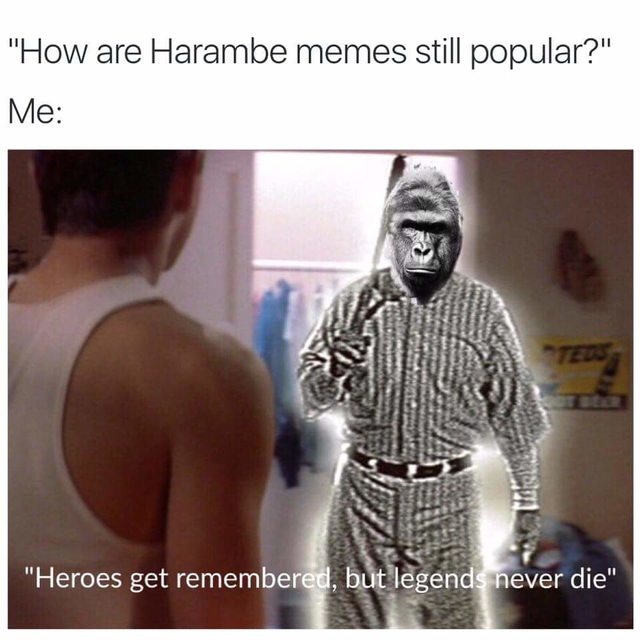
If you have been online at all the past couple of months, you have probably ran into Harambe–the latest meme hot off of the internet presses (wherever that is). Like, really, he is everywhere. It is kind of scary.

With many of these memes you will find a lot to the effect of #RIPHarambe or #neverForget. And yeah, it is kind of hilarious and kind of ridiculous and kind of sad at the same time. The majority of stuff you find online is probably not authentic, but as a great scholar once said, “At the heart of every meme there is a grain of truth.” Or something like that, I don’t know.
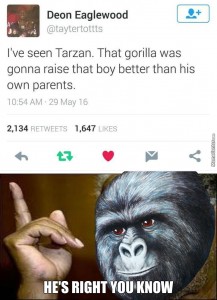
harambe3For the uninformed, Harambe was a gorilla at the Cincinnati Zoo and Botanical Garden. On May 28th, 2016, a young child climbed (or fell) into the enclosure. Harambe claimed the child as his own and raised him as part of the troop. Frightened, the child begins to cry as the adult male gorilla approaches. I mean shit, I would probably cry too. This stresses out Harambe, and he begins to drag the child around the enclosure. It is honestly terrifying, and shows just how effortlessly this gorilla could kill a small child. If you haven’t seen the recording of the encounter, you really need to check it out.

After about ten minutes of this, the zookeepers decided to shoot and kill Harambe. In my opinion, this is both a simple and complicated issue. Simple in that a kid’s life was in danger. I mean, damn, look at that video. I am sure that many of people placed in that situation would make the same choice, but what about the alternatives? Why not tranquilize Harambe, then remove the child when the endangered Western lowland gorilla is out cold? According to zookeepers and primatologists responding to the incident, that would of just pissed the ape off before any effects took place. So that means Harambe had to be shot. This is where the problem becomes a bit more complex. Who do we blame for this?

Surely there is some pitchfork that can be grabbed–someone needs to take responsibility. Do we blame the child for wandering into the pit? Do we blame the gorilla for acting like a gorilla? Do we blame the mother for negligence? Maybe. I think Donald Trump actually (and shockingly, I know) summed this up quite eloquently.

Or, we could think about the zoo itself. Many people disagree with zoos. Whether it is for treating the animals poorly, being unnatural, or commercializing nature itself, zoos often take the hotseat when discussing eco-conservation. For transparency, I am not one of those people.

I love zoos, but I understand and empathize with many of those points. I believe, that in a perfect world, there would be no zoos in the concrete jungle, and that profit would always take a back seat to conservation. I agree that zoos must be kept under constant supervision in regard to the treatment of their animals. And I think the most important item on the docket is restoring natural habitats–Yes. All of that is important. But I also believe that how zoos support communities, and how zoos support conservation are also important.

One of my favorite memories from my childhood is visiting the Atlanta Zoo. I had the pleasure of seeing its famous silverback gorilla, Willie B., just before he passed away. My mom bought me a silver necklace of Willie B., and I thought it was the coolest thing in the world. My name is William Bradley Martin. My mom would call me Willie B., and now I got to see this awesome animal that had the same name! How cool is that? I still have the necklace to this day.

That memory is so important to me, because it was the first time in my life I found myself interested in science. I wanted to know more about it, no matter what shape it took. I read Zoo Books, watched Animal Planet, I would draw chimpanzees in a sketchbook I had. My young mind was on overload. Though this interest in science has grown and changed a bit over the years, I can trace it back to that specific moment. All because of a zoo. It makes me wonder, how many other people that now work in wildlife conservation were at one point inspired by some zoo or garden, aquarium, or museum? Zoos have been around for hundreds of years, surely some other sparks must of been lit besides mine.

So when I think of the Cincinnati Zoo and of Harambe and of the tragedy that happened, I am saddened. Yes, he had to be shot. But I believe that the blame is put on society instead of any one individual. Zoos can be a wonderful and enlightening experience – an opportunity to learn about a world that naturally we would most likely never come in contact with. But the moment the zoo is simply an amusement park, with horseplay (no pun intended) and spilt popcorn and kids running around like animals, someone – or something – is bound to get hurt.

Sources:

Downes, Azzedine. “Jane Goodall, Azzedine Downes Together Offer Thoughts on Tragic Harambe Killing.” IFAW. N.p., 19 June 2016. Web. 09 Sept. 2016. <http://www.ifaw.org/united-states/news/jane-goodall-azzedine-downes-together-offer-thoughts-tragic-harambe-killing>.

Ohlheiser, Abby. “The Internet Won’t Let Harambe Rest in Peace.”Washington Post. The Washington Post, 27 July 2016. Web. 09 Sept. 2016. <https://www.washingtonpost.com/news/the-intersect/wp/2016/07/27/the-internet-wont-let-harambe-rest-in-peace/>.

Also, I highly recommend reading Life of Pi, by Yann Martel, for a beautiful and passionate defense of zoos.


Your journey starts here! Let’s talk!

ThemeRex © 2026. All rights reserved.
  Timothy Durham was convicted of rape when a test showed his DNA genotype matched the DNA recovered from the crime scene. Eye witnesses testified that Durham was in a different state at the time of the incident, but he wasn’t exonerated from his 3000 year sentence until follow up DNA analysis showed that the preliminary forensic analysis used in the trial was misinterpreted (Thomas et al.). DNA testing serves an invaluable part in our criminal justice system, but it comes with complications and bias that can lead to wrongful convictions and misinformed juries.  

Background:

Forensic genetics aims to identify the origin of a biological sample. It can be traced back to Karl Landsteiner who discovered human ABO blood groups. With blood groups, suspects could be eliminated based on their blood type. For example, if a suspect had type A blood and there was type B blood left at the scene by the perpetrator, the investigators could rule out the suspect. Unfortunately, the reverse didn’t work. If the suspect and perpetrator both had the same blood type, it can’t be concluded that the suspect was guilty. Blood identifiers evolved into 8 distinct categories which improved the ability to eliminate suspects, but could only conclude that (if the system matched) it might be the perpetrator or this person might be related to the perpetrator (Jobling and Gill). The field evolved in the 1980s with the discovery of Minisatellites, lines of repetitive DNA that don’t encode proteins. Minisatellite patterns in DNA create what we know today as the DNA fingerprint, and it has a much higher accuracy rate than previous methods (Augustyn et al.). Around the same time, a breakthrough for victims of sexual assault was discovered. In the case of assault, bodily fluids of both the victim and the assaulter can get mixed. A process called differential lysis was created which could selectively increase the concentration of sperm in a fluid sample thereby allowing for accurate DNA testing (Jobling and Gill). Forensics evolved to use single-locus probe testing after several years because of its ease of interpretation. It looked at specific minisatellites that had high variability between subjects. This was the first DNA-based method to be used in a criminal investigation. Two murder homicides from several years apart were connected using DNA evidence. The evidence was then used to exonerate an innocent man, and the guilty party was found when he tried to evade mandatory DNA testing for all men in the small town. His guilt was then reinforced when the DNA profiles matched, and he gave a confession (Jobling and Gill). Finding DNA at a crime scene doesn’t guarantee that you’ll find a murderer. There are issues with non-pure samples and limited samples that make DNA work difficult, and accreditation of facilities and new techniques and take time (Jobling and Gill).  

Subjectivity of DNA Interpretation:

In a 2009 publication, the National Academy of Science discusses the possibility for subjective influence in lab based forensics. The interpretation bias happens in complex cases where, for example, there could be a mixture of DNA. A study published in 2011 looked specifically at this issue. A gang rape happened in Georgia, and the mixture in DNA from the case was used to prosecute one suspect after another suspect took a plea bargain to testify against him. With DNA mixtures, there are three possible conclusions: suspect excluded, suspect cannot be excluded, and inconclusive. If the suspect is excluded, it means that there’s little to no possibility that his DNA is part of the sample. If the suspect cannot be excluded, it means that there’s a possibility that his DNA is part of the sample. In the trial, the DNA examiners who knew the context of the case concluded that the suspect being prosecuted could not be excluded. The 2011 study gave the DNA evidence from this case and the DNA profiles of the suspects to 17 forensic examiners. These examiners had no context of the case, and they all worked independently. Of the 17, only 1 came to the same conclusion (suspect cannot be excluded) as the examiners who knew the context of the case. Twelve of the 17 concluded that the suspect who was prosecuted and convicted had no relation to the DNA found in the sample. Not only does this show that subjectivity occurs due to the context of the case, but the 17 examiners came up with different findings based on their past experiences meaning that not all DNA analysis is objective. Some organizations like the Scientific Working Group on DNA Analysis Methods say that quantitative statistical evidence should be presented with every categorical conclusion, but the US doesn’t require this (Dror and Hampikian).

False Positives:

There are two categories that cause wrongful identification in a DNA report: coincidental matches and false positives. Coincidental matches are DNA matches between two unrelated people. The probability of these matches is about 1 to 500,000 for white individuals and about 1 to 350,000 for black individuals. This small probability of coincidental matches makes people feel confident in DNA evidence. False positives, on the other hand, are matches between DNA and test DNA that result from issues in the forensics lab. There have been multiple cases of forensics labs accidentally switching victim and suspected rapist DNA which lead to convictions that were later overturned when the lab realized the error. There are also cases of misreading or misunderstanding a sample. In a case from 1993, a man was convicted of rape because someone interpreted a mixed sample of victim and perpetrator DNA as an individual sample. The conviction was again overturned. To prevent false convictions, retesting DNA is allowed, but it’s not an efficient solution. Many people are pushing for statistical information on the probability of false positives, so that the jurors can make accurate judgements based on DNA evidence (Thomas et al.).  

Conclusion:

DNA analysis is a useful tool for the criminal justice system, but subjectivity can be an issue in forensic testing. To combat wrongful convictions, there are organizations like The Innocence Project who use DNA testing to free the innocent, but reformed forensic testing standards should be put in place to prevent subjectivity and to ensure juries are correctly informed during trials. https://www.innocenceproject.org/    

Citation:

Augustyn , Adam, et al. “DNA Finerprinting.” Encyclopedia Britannica , 26 Apr. 2018, www.britannica.com/science/DNA-fingerprinting#ref153186. Dror, Itiel E., and Greg Hampikian. “Subjectivity and Bias in Forensic DNA Mixture Interpretation.” Science & Justice, vol. 51, no. 4, 2011, pp. 204–208., doi:10.1016/j.scijus.2011.08.004. Jobling, Mark A., and Peter Gill. “Encoded Evidence: DNA in Forensic Analysis.” Nature Reviews: Genetics, vol. 5, no. 10, Oct. 2004, pp. 739–751., doi:10.1038/nrg1455. Thompson, William C, et al. “How the Probability of a False Positive Affects the Value of DNA Evidence.” Journal of Forensic Sciences, vol. 48, no. 1, Jan. 2003, pp. 1–8., doi:10.1520/jfs2001171.